Productboard tells you the number before you sign up. Pendo asks you to book a call first, on every paid plan it sells, and the reason is that its meter is not your team at all. It is everybody who opens your product.
Everything below was read on each vendor's own pages on 15 September 2026.
What does each one charge?
Nineteen dollars a maker a month for one of them, and a demo request for the other.
| Vendor | From | Billed per | Free plan | Trial |
|---|---|---|---|---|
| VoteFirst | $7.50/mo | plan | – | 14 days, card |
| Productboard | $19/maker/mo | maker | 500 notes | – |
| Pendo | Not published | monthly active user | Beta | – |
Read on each vendor's own pricing page on 2026-09-15.
Productboard's own page prices Plus at nineteen dollars a maker a month billed annually, with a floor of one maker, so a single person can be on it. A maker is their word for a product manager or lead, and colleagues who only comment do not count against that rate.
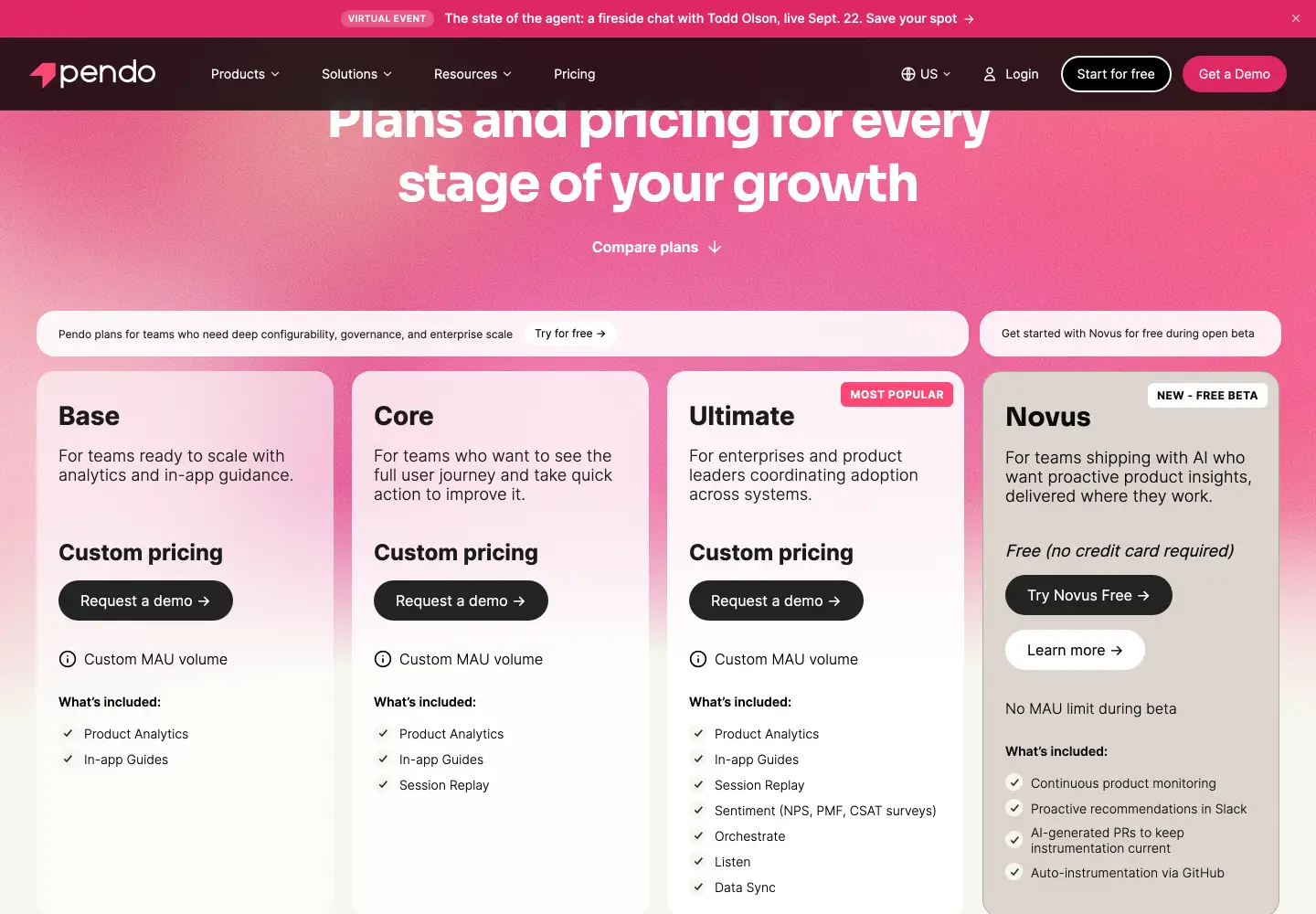
Pendo prints one price, on the Free card, and stops there. The Base, Core and Ultimate cards each ask you to request a demo instead of naming a figure.
What runs the bill is the monthly active user, and their FAQ defines that as a person who opened your app at least once in the past thirty days.
Productboard's own screenshot lives in the same proof folder, reused already on its own pricing page, so it is skipped here rather than shown twice.
How much does Productboard cost compared to Pendo?
Pendo's number never appears in this arithmetic, because there is no published rate to put in it.
| Your situation | Productboard | Pendo |
|---|---|---|
| 2 makers, 8,000 monthly active users | $38/mo, Plus at $19 a maker | Not published, above the 500 free cap |
| 6 makers, 40,000 monthly active users | $114/mo, Plus at $19 a maker | Not published |
| 15 makers, 250,000 monthly active users | $285/mo, Plus at $19 a maker | Not published |
Productboard's bill only moves with the middle column, your own makers. Add customers or monthly visitors and the price does not change. Pendo's bill would move with the third column, and that column is exactly the one its page will not price.
Pendo's own free plan caps at five hundred monthly active users, so any product with real traffic clears that line before the first invoice would even exist.
Our own demo board needs no login if a working example answers more than a pricing table does.
Which one should you choose?
They are built for different jobs, and naming both honestly matters more than picking a side.
Pendo is genuinely the stronger tool for watching what people do inside your product, and that case is not close. Its own materials put product analytics, session replay and in app guidance at the centre of the company, aimed at a team studying behaviour rather than sorting through a request list.
Productboard's maker rate is the fairer bet for a small team, because it never charges for the people who only look. Contributors who submit and comment sit outside the maker count entirely, on every plan.
Pendo folds a feedback module into a much larger analytics platform, so the entry ticket for that module alone is a sales conversation about the whole thing.
Why choose Productboard over Pendo, or Pendo over Productboard?
Choose Productboard when a handful of people plan the roadmap and you want a number you can read today, because the rate is on the page and a single maker can start at nineteen dollars.
Choose Pendo when the actual job is understanding usage across a large product, guiding people through it and reading support tickets in one place, because that is what its four modules are built to do and a feedback board alone will not do it.
The choice turns on whether the thing you are buying is a request list or a lens on your whole product. Read against that question, the price difference stops being the interesting part.
The demo board is open and it asks for no account.
Is there a cheaper alternative to both?
Yes, if what you actually need is a public board and neither maker seats nor an analytics platform is the job.
Pendo has no printed number to undercut, only a sales call. Productboard does, and a flat price beats its per maker rate as soon as a fourth maker joins, which the calculator will work out for a team size of your own.
Every tool in this category, and the unit it actually bills on, is listed on one page. This one sits on that page at nine dollars flat.
What does each do with a vote from a big customer?
Neither one multiplies the vote a customer actually cast. Both attach revenue to a request some other way.
Productboard's own prioritization language talks about customer value and business outcomes, with no revenue or MRR wording on the pages we read. Nothing there ties a dollar figure to an individual vote.
Pendo keeps its own arithmetic further back, inside internal planning screens. A roadmap there can carry total votes next to a dollar figure for an initiative, and a separate scoring page weighs an idea against accounts, ARR, effort and impact all at once, none of it on a page a customer would ever open.
We counted the whole matrix ourselves. Eleven of the thirty two vendors we track put any answer at all, yes or no, against whether a vote carries revenue. Productboard and Pendo sit in the larger group of twenty two that leave the row blank.
Can I move from one to the other?
Only one side of this is written down anywhere we read.
Productboard names its export plainly: the list of feature requesters, included on every plan. That is a roster of who asked, not the board, the votes on it or the comments underneath.
Pendo's pricing page and its own alternative page say nothing about exporting feedback or vote data at all, so we are not putting a claim there that neither page supports.
A move rarely carries across the small things anyway. Who actually cast a vote, rather than just the running count, the back and forth in a comment thread, and a link somebody already shared with a customer tend to be the first casualties.
Where we fit, and where we do not
Watching what people do inside your product is not something this board does, and neither is listening to a support inbox or a sales call on your behalf. Both vendors above do at least one of those two things.
Both ship an AI feature and we have none. Productboard's own pricing page describes AI tooling metered in credits per maker per month. Pendo's materials describe an AI reading of tickets, calls and surveys that surfaces trends and flags duplicate ideas on its own.
Both let you see what a customer did inside your product, not only what they asked for. Pendo is built around that view, with session replay and in app guides on top of it. Productboard connects to Amplitude and Mixpanel on its paid plans. We connect to neither, and we hold no usage data at all.
Instead, a tier on this product carries a multiplier, and that number gets written onto a vote as it lands, on the nine dollar plan and the thirty nine dollar one alike. The plain count still sits next to it on the card.
What is Productboard, and what is Pendo?
Productboard is a product management suite billed per maker, where a customer portal, roadmaps, prioritization and an insights layer sit around a feedback repository built for a product organisation.
Pendo is a product analytics platform billed by the monthly active user, where product usage, session replay and in app guides are the core of the company and a feedback module rides along inside it.
Does either one have a free plan?
Both do, and the caps measure entirely different things. Productboard's pricing page read on 15 September 2026 gives five hundred feedback notes, one teamspace and one portal, a cap on content rather than on people.
Pendo's Novus beta, checked the same day, stops at five hundred monthly active users and needs no card to start. Underneath that cap it still bundles product analytics, in app guidance and a set of roadmaps and surveys carrying Pendo's own branding.
What this costs
Lite
$9 /mo
Pro
$39 /mo
Lifetime
$999 once
Fourteen day trial of Pro, card asked for at signup. Nothing here counts the people who vote, so the bill does not move when the board starts working. The long version, with what happens if you stop paying.
The honest summary
Productboard prices the people who plan your roadmap and lets everyone else look for free. Pendo prices the people who open your app, and will not tell you that number until somebody has called you about it.
Neither multiplies a vote by what the customer behind it pays, and neither is trying to be a public board first. Choose Productboard for a priced maker seat with a portal attached. Choose Pendo only once the job is watching your whole product, not reading a request list.
The Productboard alternative page and the Pendo one carry each side on its own.
14 days, a card at signup, then $9 or $39 a month.