ProdPad's pricing page is a module picker. Whatever number it shows you is computed after you load it, and a crawler, or a comparison page like this one, never sees a figure at all. Productboard's page carries an actual number for anyone who opens it.
Everything below was read on each vendor's own pages on 15 September 2026.
What does each one charge?
Nothing printed for one of them, and nineteen dollars a maker a month for the other.
| Vendor | From | Billed per | Free plan | Trial |
|---|---|---|---|---|
| VoteFirst | $7.50/mo | plan | – | 14 days, card |
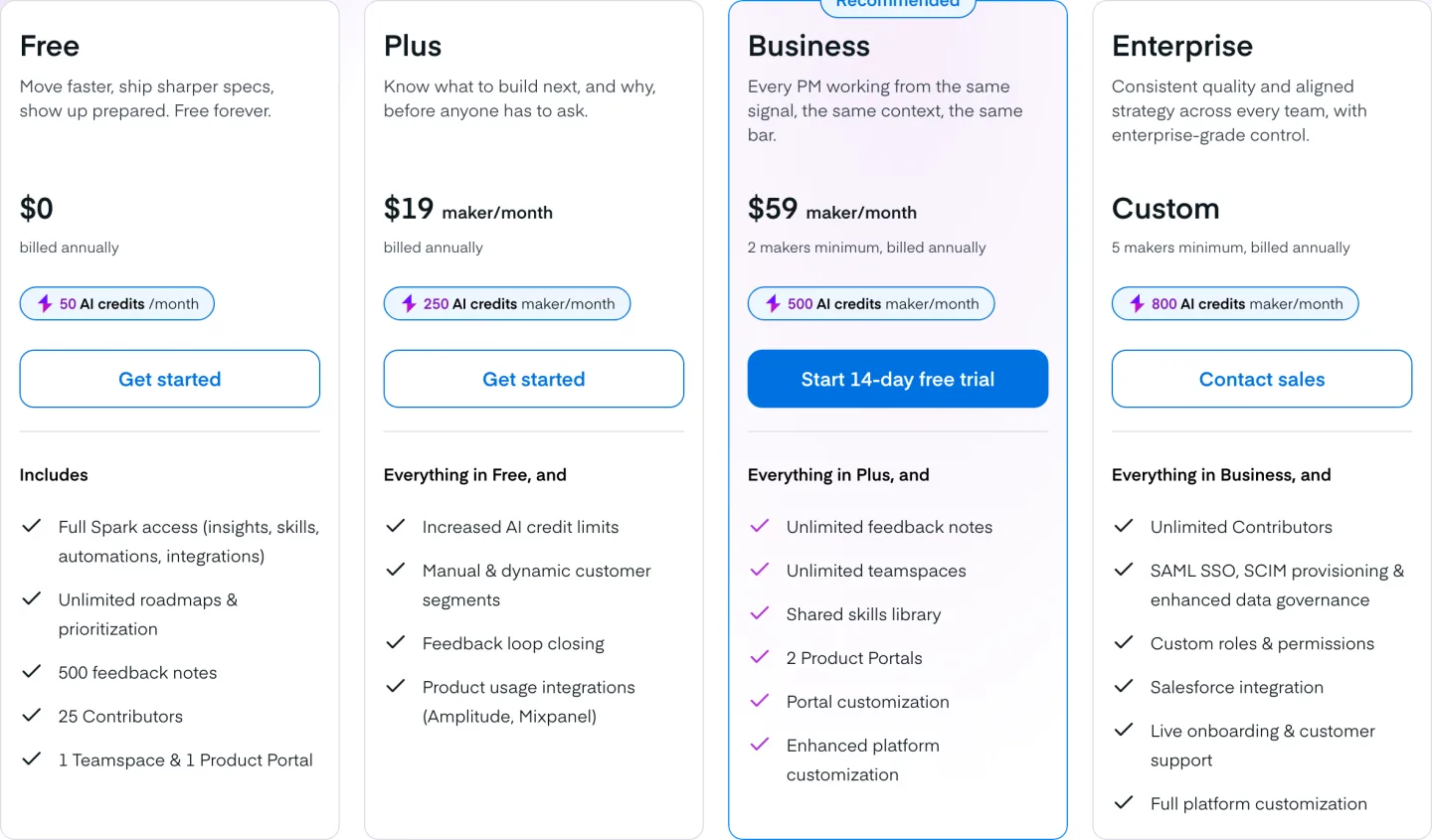
| Productboard | $19/maker/mo | maker | 500 notes | – |
| ProdPad | Not published | module | – | 7 days |
Read on each vendor's own pricing page on 2026-09-15.
ProdPad has no pricing proof image in our archive, because its own pricing page computes a figure inside the browser rather than printing one in the markup a screenshot would capture. There is nothing to point a camera at.
ProdPad's own heading over the builder reads build your package to build your products, and you assemble a price from named modules and a count of editors. Productboard's maker is their word for a product manager, and the rate applies from the first one.
How much does ProdPad cost compared to Productboard?
One column of this table has a real figure in it, and the other names what you would have to select to get one.
| Your situation | ProdPad | Productboard |
|---|---|---|
| 1 editor, the feedback module alone | Not published, priced inside their builder | $19/mo, one maker on Plus |
| 6 editors, three modules picked | Not published | $114/mo, six makers on Plus at $19 |
| 20 editors, every module including the AI assistant | Not published | $1,180/mo, twenty makers on Business at $59 |
Every row on the ProdPad side says the same thing, because the number depends on choices a reader of this page has not made yet. Productboard's side simply multiplies your maker count by its printed rate.
ProdPad's reviewers do not appear in that table at all. Their own answer to who can join for free says any number of reviewers, at no cost, and a reviewer can add and edit their own ideas while viewing and commenting on everyone else's. Productboard's contributors work the same way, submitting and commenting without touching the maker count.
If you would rather look at a working board than build a package, the demo is open without an account.
Which one should you choose?
They are aimed at different buyers, and naming both fairly matters more than picking a winner.
ProdPad's magically extending trial is a genuinely unusual offer. Their own page describes seven days that grow past thirty by completing tasks inside the product, and no card is asked for at any point in it.
Productboard's free plan is a real product, not a stripped demo. Five hundred feedback notes, one teamspace and one portal, read on their pricing page on 15 September 2026, is a workable ceiling for one person trying the category's best known name before paying anything.
Choose ProdPad if you want the price to reflect exactly the modules you use and nothing else. Choose Productboard if you want the number in front of you before you have picked anything at all.
Nine dollars a month for one project, with weighted voting on it.
Why choose ProdPad over Productboard, or Productboard over ProdPad?
Because one prices a package assembled from parts and the other prices a seat.
Choose ProdPad when your team already works from a mix of modules, roadmaps, ideas, feedback, portfolio management, objectives and reporting, and paying only for the ones you actually turn on matters more than knowing the number up front.
Choose Productboard when you would rather read a rate today than spend an afternoon inside a builder discovering what your own combination costs.
The trade is simple to state even though neither vendor states it plainly. A package builder can undercharge a small team and overcharge a large one, and a per maker rate always charges the same amount for the same seat.
Is there a cheaper alternative to both?
Yes, and it is easier to compare against a printed rate than against a builder with no number in it.
Against Productboard's per maker rate, a flat price wins the moment a sixth colleague joins, and the calculator works that arithmetic at a team size you choose. Against ProdPad, there is nothing published to run the same comparison on, so the honest answer is that we cannot say at what size a flat price wins.
The whole field, with the unit each vendor bills on, sits on one page, at nine dollars a month here.
What does each do with a vote from a big customer?
Neither multiplies a vote by what the voter pays. Both attach money to the idea a different way.
Read on each vendor's own pages on the date in the row above. A dash means nobody could read it on the pages opened that day, never that the capability is absent.
ProdPad's own help centre describes an admin typing an annual revenue figure onto a company record, capped at 9,999,999,999 and shown in your account currency. An idea then carries a total, summed from the companies linked to feedback on it, with a company counted once no matter how many times it wrote in.
Productboard's prioritization copy talks about customer value and business outcomes, and neither the word revenue nor MRR turned up anywhere we read.
Can I move from one to the other?
Both let some data out, and neither export is the whole board.
ProdPad's help centre says all users can export ideas to CSV and PDF, which is a snapshot of the ideas rather than of every vote or comment attached to them.
Productboard's own comparison table lists exporting the list of feature requesters as included on every plan, which is a roster of who asked rather than a record of what they asked for.
Who cast a given vote, the back and forth underneath a request, and any portal link somebody has already shared are the kind of thing neither page describes surviving a move.
Where we fit, and where we do not
Neither vendor above sells a single purpose voting board, and that is the honest reason a price comparison alone flatters neither of them.
Both ship an AI feature and we have none. ProdPad's own module list names an AI assistant sitting alongside its other modules. Productboard's pricing page describes AI tooling metered in credits per maker per month. We have no AI feature of any kind and none is planned.
Both are built around objectives, portfolios and a roadmap for a whole product organisation, not a single board. ProdPad's modules run to lean product roadmaps, product portfolio management, objectives and key results and reporting. Productboard bundles a strategy layer, teamspaces and an insights repository around its own feedback store.
What we do instead is smaller. One board, one roadmap with a Denied column, one changelog, and a vote that carries the weight of what the voter pays on every plan we sell, including the nine dollar one.
What is ProdPad, and what is Productboard?
ProdPad is a product management platform assembled from modules you pick, roadmaps, ideas, feedback, portfolio management, objectives and reporting among them, priced by the combination and the number of editors, with reviewers included free.
Productboard is a product management suite billed by the maker, where a customer portal, roadmaps, prioritization and an insights layer sit around a feedback repository built for a product organisation.
Does either one have a free plan?
Neither does. ProdPad's pricing page read on 15 September 2026 offers a seven day trial that can be extended past thirty by completing tasks, and asks for no card, but nothing free once it ends.
Productboard does carry a free plan, capped at five hundred feedback notes, one teamspace and one portal, read on their pricing page the same day, so between this pair Productboard is the one with something to keep for nothing.
What this costs
Lite
$9 /mo
Pro
$39 /mo
Lifetime
$999 once
Fourteen day trial of Pro, card asked for at signup. Nothing here counts the people who vote, so the bill does not move when the board starts working. The long version, with what happens if you stop paying.
The honest summary
One of these vendors will not show you a number until you have built something, and the other prints a rate you can read on the first visit. Neither weights a vote by what the customer behind it pays, and neither is a public board first.
Choose ProdPad if your organisation already thinks in modules and unlimited free reviewers matters to you. Choose Productboard if you want a printed maker rate and a free tier to start on. Ours is a flat number for a board where the vote itself carries the money.
The ProdPad alternative page and the Productboard one carry each side on its own.
14 days, a card at signup, then $9 or $39 a month.