This is a list of open source feedback tools you can host yourself, each one read in its own repository on 2 or 3 October 2026. Six are voting boards with a roadmap, one is a survey platform, one has had no commit on its main branch since March 2024 and still lists feature requests as planned, and one has not been pushed to since January and is marked archived by its own owner. VoteFirst, which publishes this page, is not one of them, and it is named once at the end for anyone who decides a server is not what they want to run.
Not all nine are what their homepage badge suggests, which is the reason to check a repository rather than copy a list.
Is there an open source feature request tool?
Yes, and the one to start with is Fider.
| Project | License | Stars | Last commit | Stack | Hosted price |
|---|---|---|---|---|---|
| Fider | AGPL-3.0 | 4,555 | 2 Oct 2026 | Go, PostgreSQL | Free to 250 items, then $25/mo |
| ClearFlask | Apache-2.0 | 451 | 3 Oct 2026 | Java, MySQL or Elasticsearch | $29/mo hosted; self hosting free, or $9/mo for a support license |
| Formbricks | Not a standard identifier | 13,049 | 2 Oct 2026 | TypeScript, PostgreSQL | Free to 250 responses, then $74/mo |
| Quackback | AGPL-3.0 | 302 | 2 Oct 2026 | TypeScript, PostgreSQL | Free 1 seat, then $29/mo billed yearly |
| LogChimp | Not a standard identifier | 1,133 | 1 Oct 2026 | TypeScript, PostgreSQL | Free tier, then $24/mo |
| ABC User Feedback | Apache-2.0 | 378 | 1 Oct 2026 | TypeScript, Docker | Not sold hosted |
| FeedbackBin | Source available, not OSI approved | 5 | 1 Oct 2026 | Ruby, PostgreSQL | None published, self hosted only |
| Astuto | AGPL-3.0 | 2,347 | 9 Jan 2026, archived | TypeScript, PostgreSQL | None, project ended |
| Feedbase | AGPL-3.0 | 677 | 30 Mar 2024 | TypeScript, Supabase | Free signup, no published price |
Every figure in that table came from the GitHub API on 1, 2 and 3 October 2026, which is why most last commit dates are the day of the read rather than a rounded month.
Fider is the one most people mean. It collects feedback, it votes, it has a public board, and since April 2026 a self hosted instance sets its own Pro flag, so self hosting is not a stripped version of the hosted one. What it actually costs to run it yourself is a page of its own.
ABC User Feedback, at line/abc-user-feedback, is the quiet one. Apache-2.0 rather than AGPL, which matters if you intend to modify it inside a company that will not publish the changes, and it starts from Docker images through its own command line tool with no hosted tier to buy instead.
Formbricks is on this list to say that it belongs to a different category. Surveys and in product experience data, the largest project here by stars, and the wrong shape entirely if what you want is a place for customers to post and vote.
Quackback is the newest board here and the only one whose maintainers also sell a hosted version of the same code at a published price, so the decision it asks you to make is hosting rather than product. It carries a support inbox, the feedback board, a help centre, a changelog and a status page at once.
FeedbackBin is the smallest and the one most roundups miss. Five stars, pushed to on 1 October 2026, a plain Ruby on Rails board with voting, statuses and a roadmap. Its own license file is not AGPL or any other standard identifier. It is a source available license the project calls the O'Saasy License, which lets you run and modify the code but forbids reselling it as a competing hosted service. Read that file yourself before building a business on the code, because the homepage calling it open source and the actual terms are two different documents.
ClearFlask is missing from most lists and is the only project here that lets what a customer pays shape a vote. Its own comparison page describes issuing customers credits based on their value, such as monthly spend, which they then spend on features instead of upvoting. Its pricing page, read 3 October 2026, contradicts itself on the free tier: the plan table caps the open source column at 100 posts, while the answer beneath it says self hosting is free with all functionality and the $9 a month license buys support. Hosted, it is $29 a month with unlimited teammates and posts.
Feedbase looks like a feedback board from its homepage, and its own repository says otherwise. The README calls it a product management tool in very early stages, still lists roadmaps and feature requests as planned, and its main branch has had no commit since 30 March 2024. The hosted site at feedbase.app still loads, with a free signup and no published price.
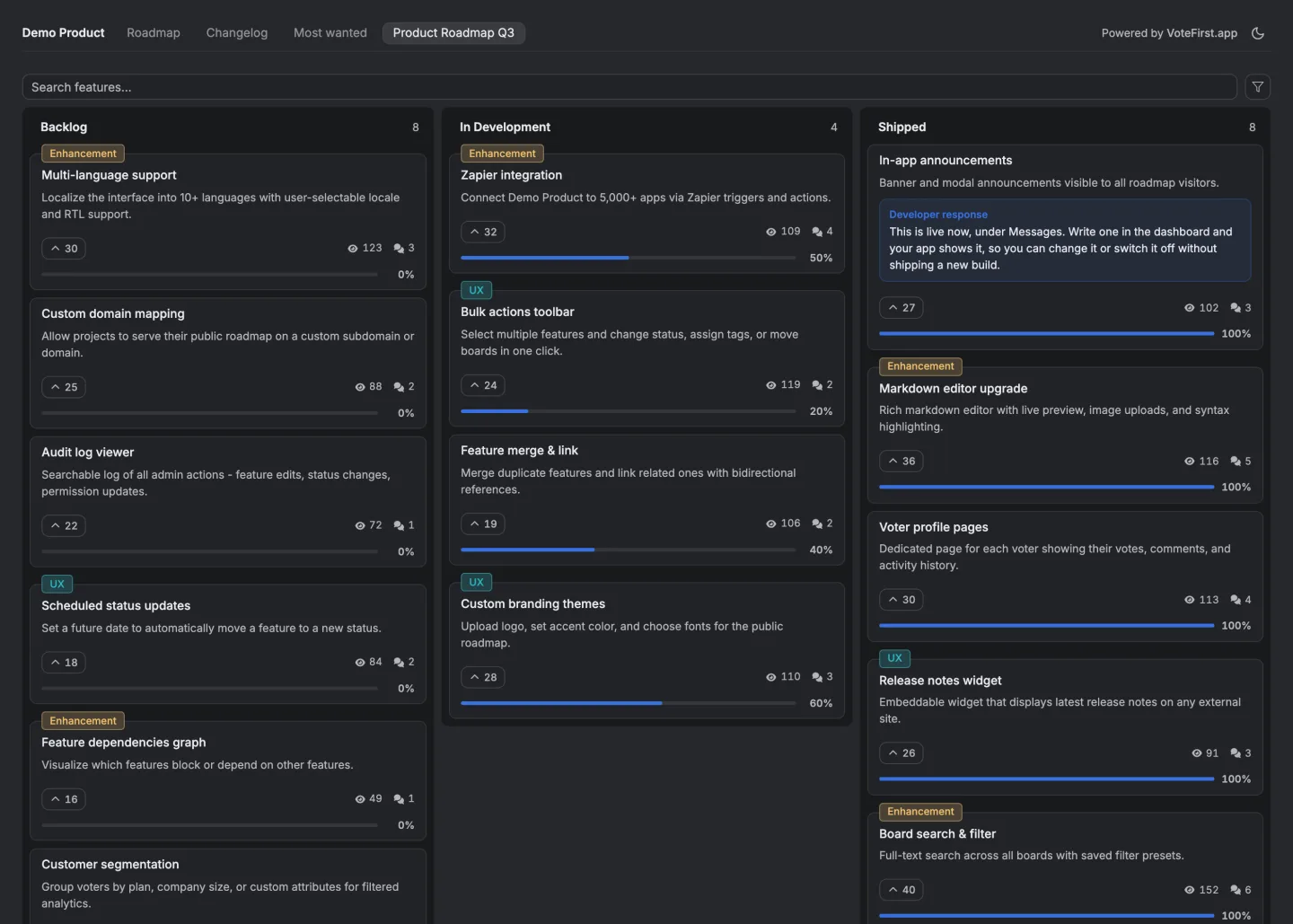
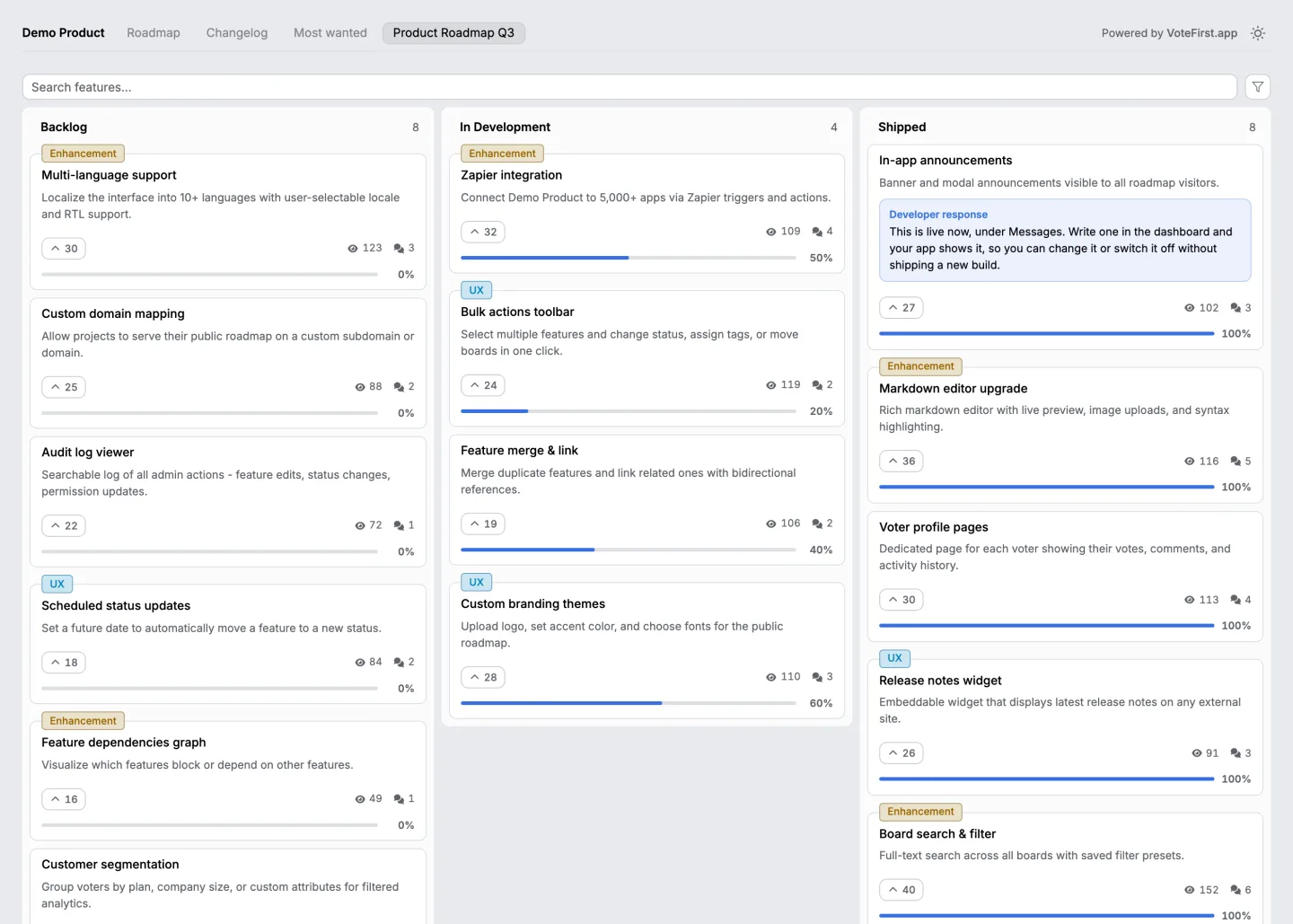
Which of these is free, and which is only open source?
Fider for the first and several hosted products for the second, and the two questions have different answers.
Open source feature request tracking means the code is yours to run. That is Fider, ABC User Feedback, LogChimp or FeedbackBin, each for the cost of a server rather than a license.
A feature voting tool open source in that sense costs nothing in license and something every month in operating it, which the section below works through.
A free feature request tool usually means somebody else runs it and does not charge you. Those are hosted free tiers, they have limits, and the limits are the whole of the deal.
Fider's hosted tier runs to two hundred and fifty feedback items, Quackback's to one seat, and LogChimp's lowest paid step is $24 a month once the free tier is not enough, all read on their own pages on 2 October 2026.
Two hundred and fifty items is more room than it sounds. On 3 October 2026, 534 of 648 hosts running a public Canny or Featurebase board, 82 percent, held 250 public requests or fewer, counted in one open file. The same day, 9 of 19 Fider Cloud boards told search engines to leave them out of results, in a response header rather than in the page, so a board meant to be found is worth checking with a header tool and not only the page source. Every board read is in its own file.
The question worth asking before either is which cost you would rather carry, because one is an afternoon a month and the other is a ceiling you will eventually hit.
Is there a Usersnap open source alternative, and what happened to Astuto and LogChimp?
Not on this page. Five projects that capture a screenshot or a session, with their licenses, are compared on their own page. The two projects with a changed address are the reason to check a repository rather than a list.
Usersnap is visual bug reporting. Somebody drags a box over a broken screen, the tool captures the screenshot and the browser details with it, and the report lands with the evidence attached. None of the projects on this page does that.
They are feedback boards, so a person types what they want and other people vote on it, which is a different job with a different screen. An open source board is not a replacement for a screenshot capture tool, and saying otherwise would send somebody to install the wrong thing.
Astuto is archived. The last push was 9 January 2026 and the repository is marked archived by its own owner, which is the clearest signal a project can send. Its old address, astuto.io, now forwards through two other domains to a site with nothing to do with feedback software, read again on 2 October 2026, so a list that still names it is sending readers somewhere that has changed hands twice over.
LogChimp's bare domain, logchimp.com, is listed for sale at $650 on a domain marketplace, read 2 October 2026. The project itself is not dead. Code was pushed to its repository the day before this read, and its real site at logchimp.app loads, shows the product and a hosted pricing page starting at $24 a month. The lesson is that the name alone is not where to look.
Nothing here counts the people who vote, so a busy board costs the same.
Is there an open source roadmap tool?
Every board on this page publishes a roadmap, and none of them is a roadmap planner.
Fider, Quackback, LogChimp and FeedbackBin each turn statuses into a public page showing what is planned, in progress and shipped. That is the roadmap most people searching for one actually want, because its audience is customers.
What none of them does is the internal planning kind: swimlanes across quarters, dependencies between initiatives, capacity against teams. Those tools exist and the open source ones are general project planners rather than product roadmap software, so you would be adapting something rather than installing something. What the commercial roadmap tools cost is a separate page.
Is there an open source release notes tool?
Three of the boards above carry a changelog, and there is no widely used project that only does release notes.
Quackback's own feature list names a changelog and a status page alongside the board. FeedbackBin and the other projects here answer the same question with a status on each request, which tells a customer that their own request shipped without publishing a release note.
If a changelog is the whole job, the open source route is usually a static site generator with a posts folder, which is free, fast and already on your machine. What it will not do is the widget inside your product or the email to subscribers, and those two are what the commercial changelog products are actually selling. The template for writing the entries is free here.
Is there an open source Canny alternative?
Fider is the closest, and the comparison is narrower than the phrase suggests.
Fider gives you the public board, the voting, the statuses and the roadmap page, which is the core of what Canny does, for nothing but the server it runs on. It does not give you private boards, revenue segmentation, integrations with a helpdesk, or a support queue to shout at when something breaks.
Quackback and LogChimp are the newer answers and both cover more surface, because each board arrives with extra services already attached, a support inbox and a help centre on Quackback, a themeable front end on LogChimp.
So the trade is the usual one. The whole Canny comparison, including what a hosted alternative costs, is a different page, and self hosting exchanges a monthly bill for an afternoon a month and a server you are responsible for.
Is there an open source website feedback tool?
Only if you mean a board. If you mean the widget that captures a screenshot, no.
A website feedback tool usually means one of two different things, and the difference decides which repository you want. A feedback board collects requests and votes, which is every project on this page. A visual feedback widget lets somebody draw on a broken page and sends the screenshot with the browser details attached, which is none of them.
Nothing on this list captures a screenshot. Saying otherwise would send somebody to install the wrong thing, which is the single most common fault in the roundups that list these projects.
Is there open source idea management software?
Yes, and it depends whether the ideas come from your staff or your customers.
For customer requests, the projects in the table above are idea management software under a different name: somebody posts an idea, other people vote, the duplicates merge into one row.
For internal innovation programmes, with challenges, evaluation stages and scoring committees, the open source options are thin and the category is dominated by commercial platforms priced per employee. The commercial ones and their prices are on their own page, and the reason nobody has built a good open source one is probably that the hard part is the process rather than the software.
What does the license column actually tell you?
Less than the badge does, and three of these nine prove it.
Formbricks and LogChimp both report no license through the API, for two different reasons. Formbricks carries an AGPL-3.0 file with a separate section covering enterprise code and the packaged SDKs, so the detector will not name one license for a repository holding more than one. LogChimp's license file opens with a company copyright line rather than a standard preamble, and the detector reports nothing.
FeedbackBin's case is plainer and more important. Its own license file names itself the O'Saasy License, and it says directly that you cannot use the code to compete with FeedbackBin as a hosted SaaS product. That is a real restriction on a real activity, not a detector quirk.
None of the three is a reason to avoid the project. All three are a reason to open the file before building a company on it, because open source on a homepage and the terms in the repository are two different statements and only one of them is enforceable.
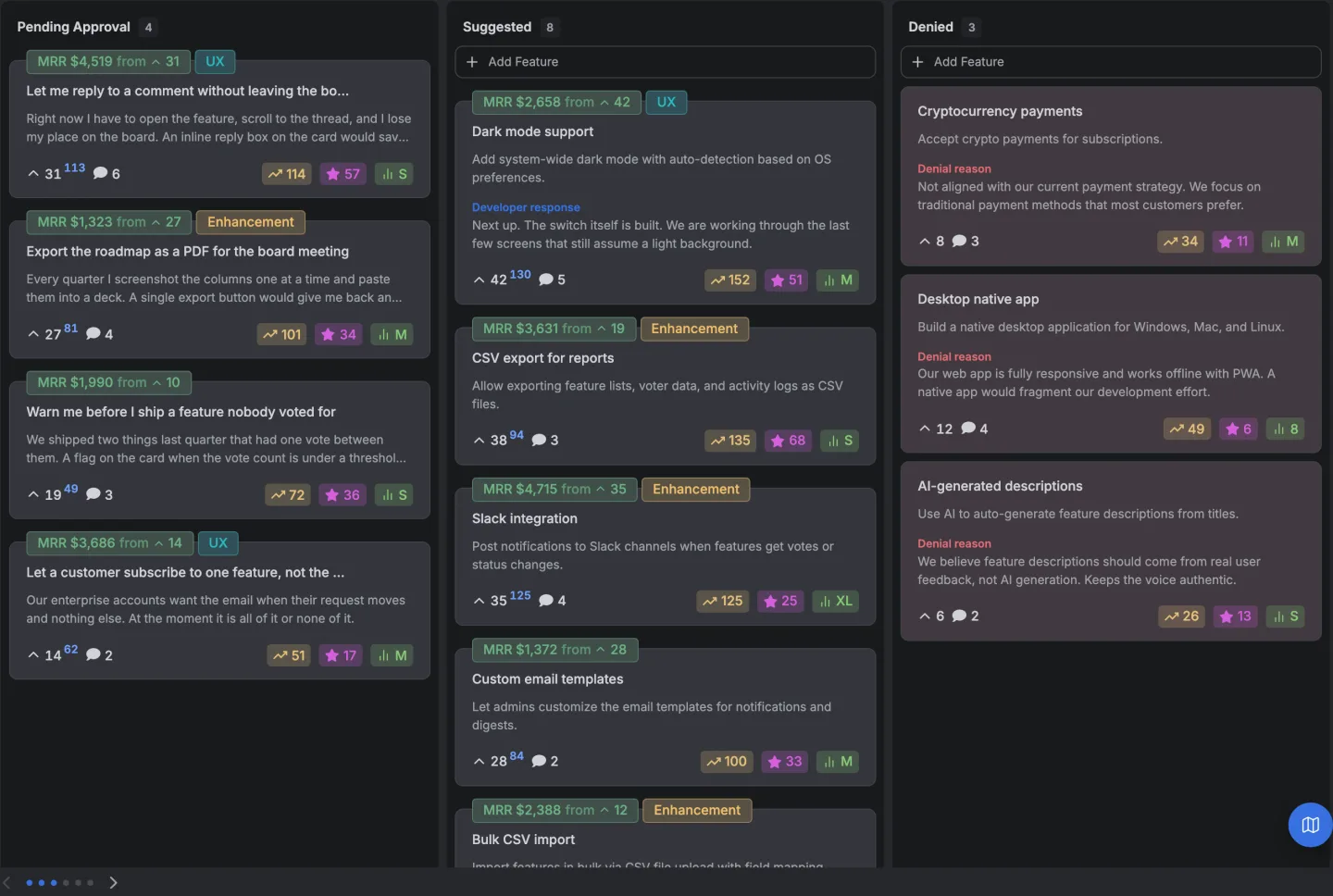
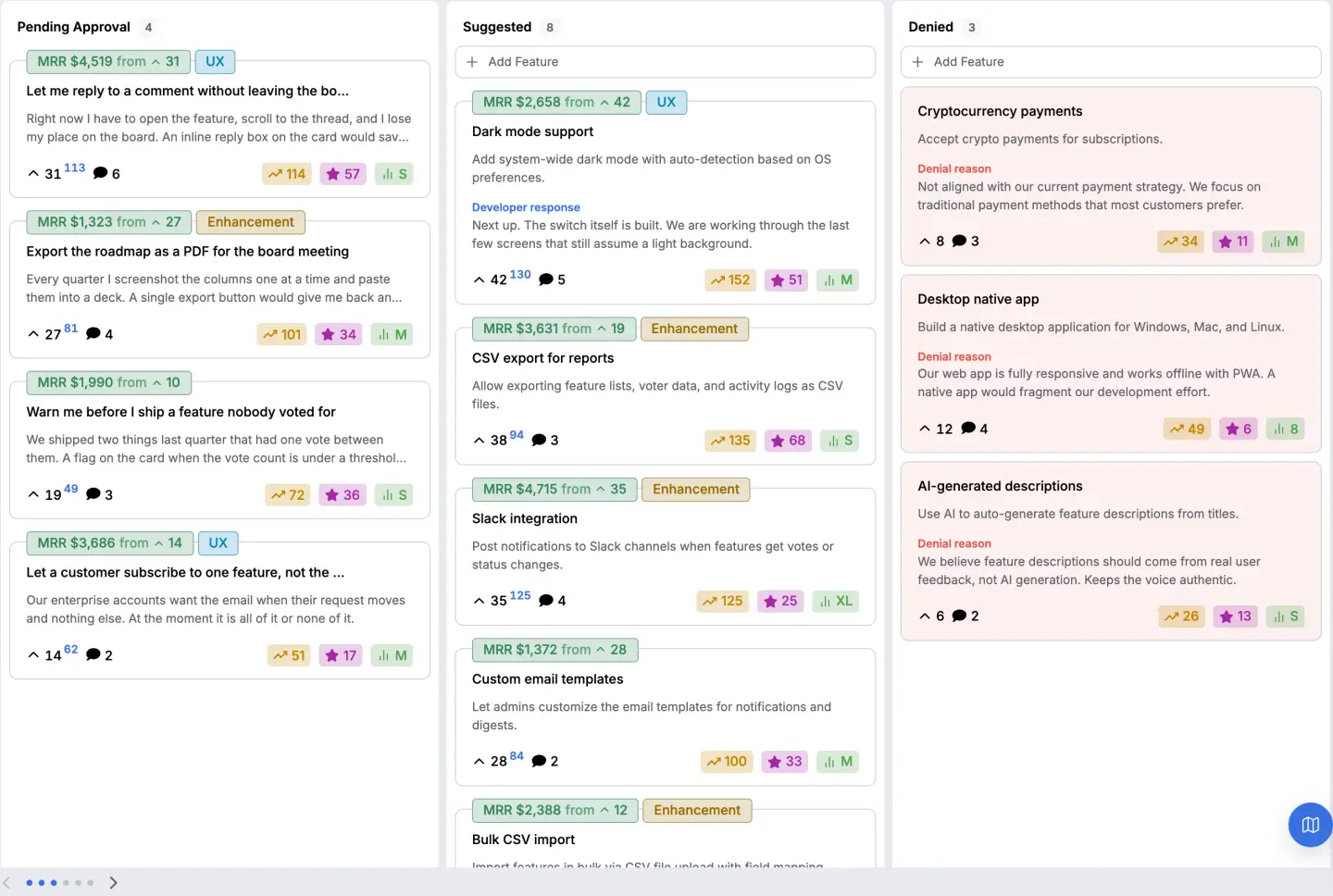
What does it cost to self host a feedback board?
Nothing in license and something every month in everything else.
LogChimp's own compose file defines five services, being a cache, a database, a migrator, an API and a theme, on the postgres:12 image. FeedbackBin is a single Rails app, so one process and one Postgres database rather than five services, which is a real difference in what you are keeping running.
Fider needs PostgreSQL 12 or newer and its sample compose file runs Postgres 17 in a container on a host volume. ABC User Feedback ships Docker images and a command line tool to start them and names no database in its README. ClearFlask's quick start is a Docker Compose file that brings up its own dependencies, and its Helm chart installs MySQL and LocalStack beside a Java server.
None of that is hard for a team already running Docker and Postgres in production.
For a team that is not, the bill is a server, a database somebody operates, a mail path that reaches inboxes rather than spam folders, a backup regime nobody wrote for you, and the hour you lose the day an upgrade goes sideways. Reckon on an evening to get any one of these running the first time and a recurring hour or two a month after that, on top of whatever the server itself costs.
This page does not print a dollar figure for the server. The shape of the bill is worked through on the Fider page.
Is there a free idea management tool?
Yes, and open source and free are not the same question.
Every project above is free to run. Separately from that, several hosted products have a free tier, read on their own pages on 14 September 2026. Fider's hosted tier runs to two hundred and fifty feedback items.
UserJot gives two boards and three admin roles. Supahub gives one board and one admin. Featurebase gives one seat. Sleekplan's Indie tier is a single admin workspace that does not expire.
The whole field's published prices sit in one directory if the free tier is the start of a longer comparison.
Which tool should you choose?
Whichever of the nine is still being pushed to and answers at an address you can open.
| If you | Choose |
|---|---|
| Need the source and want the mature one | Fider |
| Need a permissive license rather than a copyleft one | ABC User Feedback, which is Apache-2.0 |
| Are building surveys rather than a voting board | Formbricks, and not the rest of this list |
| Want the smallest possible footprint, one app and one database | FeedbackBin, read the license first |
| Want somebody else to run the database | a hosted product, VoteFirst or another |
| Want customers to spend a budget sized to what they pay | ClearFlask, through its credit system |
| Found Astuto on an older list | none of it, the repository is archived |
Who should not buy VoteFirst?
Anybody for whom open source is the requirement.
If your company will not run software it cannot read, or you need the data on hardware you own, or the budget for tooling is genuinely zero, take Fider, ClearFlask, ABC User Feedback or FeedbackBin from the table above, not VoteFirst.
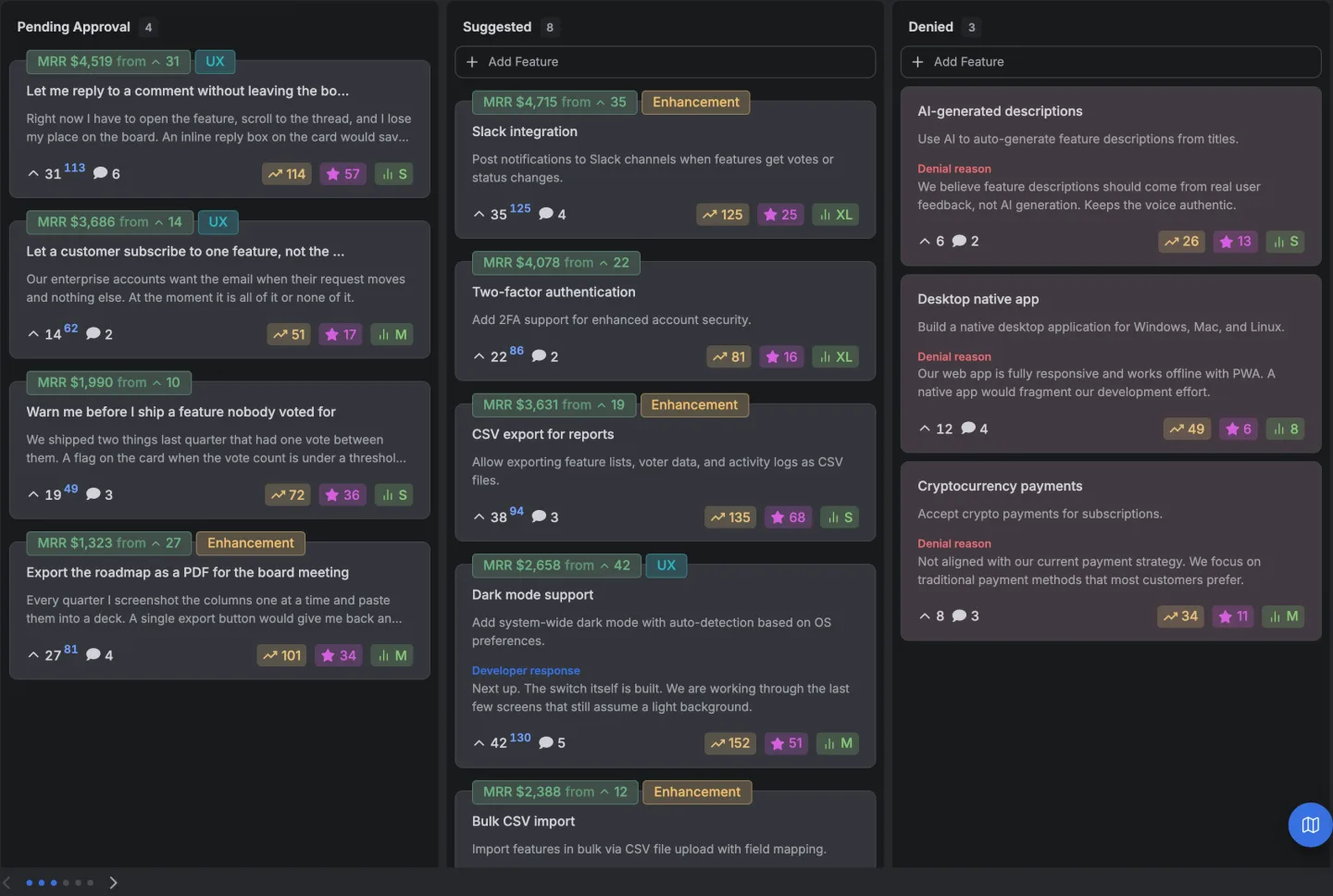
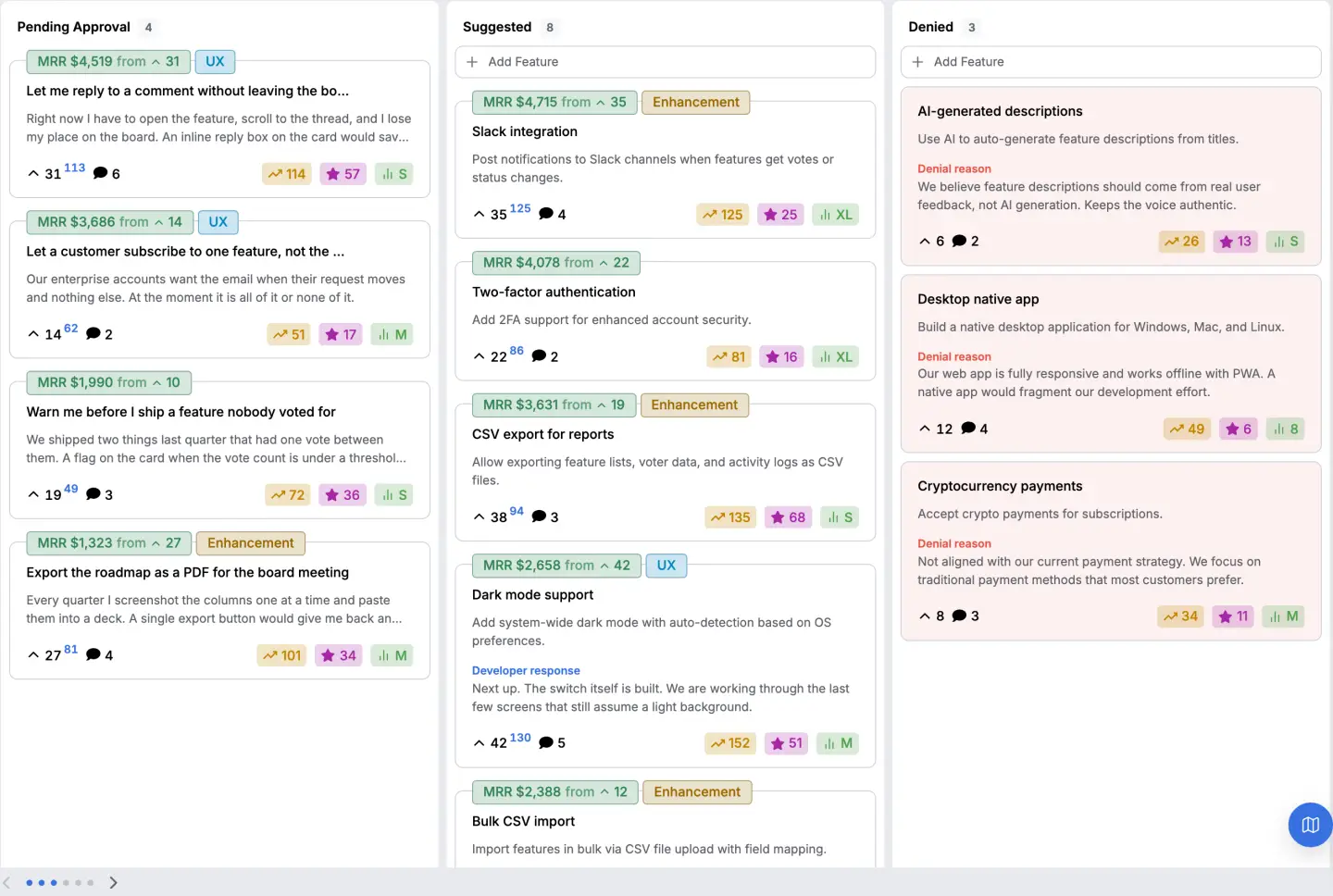
ClearFlask is the one board of the nine where what a customer pays shapes a vote, and it does that through a credit budget you issue rather than by recording the payment on the vote. The other eight count every vote once, which answers a different question, how many people wanted a thing rather than how much money is behind wanting it. Recording what the voter pays on the vote itself is the one thing VoteFirst does differently, and it is also the only reason to pick a hosted, closed source board over a free one.
Take VoteFirst when your voters pay you very different amounts, when you would rather not operate a database, and when nine dollars a month is cheaper than the afternoon you would spend on a mail path. Those are the conditions, stated as conditions.
14 days, a card at signup, then $9 or $39 a month.