Canny and Pendo both put a number on a monthly bill, and the two numbers count entirely different people. Canny's meter is anybody who posted, voted or commented on your board. Pendo's meter is anybody who opened your product at all, whether they ever gave you feedback or not.
Everything below was read on each vendor's own pages on 15 September 2026.
What does each one charge?
Seventy nine dollars a month for one of them, and no figure at all for the other.
| Vendor | From | Billed per | Free plan | Trial |
|---|---|---|---|---|
| VoteFirst | $7.50/mo | plan | – | 14 days, card |
| Canny | $79/mo | tracked user | 25 users | – |
| Pendo | Not published | monthly active user | Beta | – |
Read on each vendor's own pricing page on 2026-09-15.
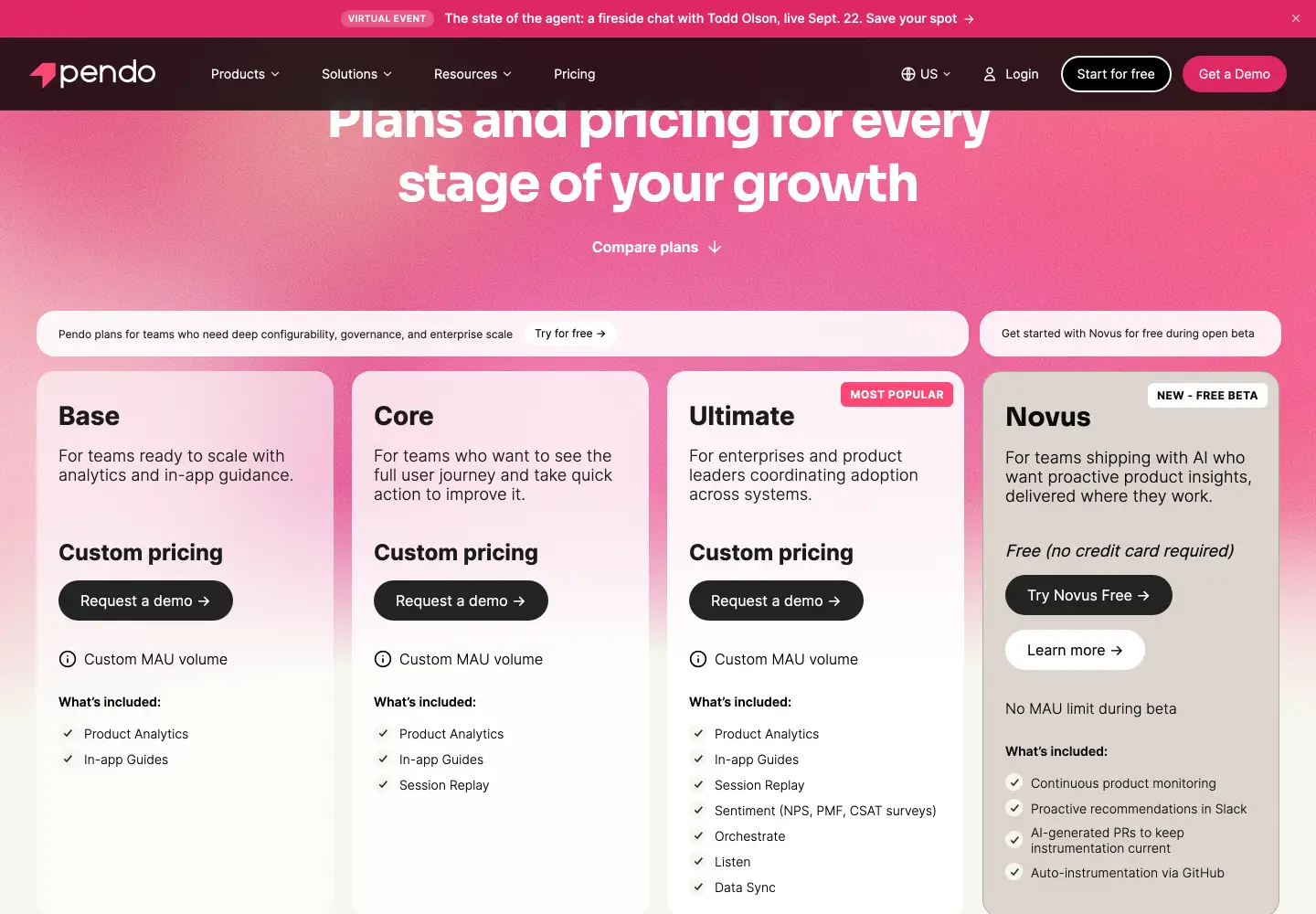
Pendo's own page carries four plans. Free is free. Base, Core and Ultimate each read custom pricing, with a button asking for a demo where a number would sit. Its own philosophy section calls this clear upfront, which is a claim about the quote you are handed rather than about the page itself.
Canny's own page starts the Pro plan at seventy nine dollars a month billed yearly, for a hundred tracked users, under a free tier capped at twenty five. Pendo's meter is monthly active users, its own term for a unique visitor who opened your app in the trailing thirty days.
Canny's meter only counts people tied to a post, a vote or a comment.
How much does Canny cost compared to Pendo?
Pendo's rate never appears in this arithmetic, because nobody outside Pendo has the number to put in it. Canny's does, at three published steps.
| Your product | Canny | Pendo |
|---|---|---|
| 2,000 monthly active users, 40 customers have ever voted | $79/mo, under the 100 tracked user step | Not published, above the 500 active user free cap |
| 50,000 monthly active users, 1,000 customers have voted | $529/mo billed yearly, at the 1,000 tracked user step | Not published |
| 300,000 monthly active users, 5,000 customers have voted | $1,079/mo billed yearly, at the top of the published ladder | Not published |
Canny's number moves with the third column in that table, the people who voted, whatever size the product behind the board happens to be. Pendo's number would move with the first column, the people who opened the app, and that column is exactly what its page will not print.
Neither vendor's own page states a rate above the last step it shows. Canny stops printing a figure past five thousand tracked users. Pendo never starts printing one on any paid plan, at any size.
If you would rather look at a board than read about billing, the demo is open without an account.
Which one should you choose?
They answer different questions, and naming both honestly matters more than picking a side.
Pendo is genuinely the deeper product for understanding what people do inside your app, and it is not a close call. Its own page names product analytics, session replay and in app guides as the core of the company, built for a team that needs to watch behaviour rather than read a request list.
Canny is the faster tool to open a public page on. A price is printed, a free tier sits under it, and a customer can post a request the same afternoon without anybody booking a call first.
Pendo folds feedback into a much larger analytics platform, so buying its feedback module alone is rarely the actual purchase; most of what you are paying for lives elsewhere on the page.
Why choose Canny over Pendo, or Pendo over Canny?
Because one of them sells a public request board and the other sells a lens on your whole product, with a feedback module riding along inside it.
Choose Canny when a page your customers can open and argue on is the actual job, because the price is on the page and the board works the day you sign up.
Choose Pendo when you already need to watch what people do inside your app, guide them through it and read support tickets and call transcripts in one place, because that is the platform its own page describes and the feedback piece is one module among several.
The decision is rarely close once you know which of those two jobs you are actually hiring for.
Nothing here counts the people who vote, so a busy board costs the same.
Is there a cheaper alternative to both?
Yes, and which one looks expensive depends on which meter frightens you.
Against Canny's tracked user ladder, a flat monthly price stops climbing the moment the board gets busy, and the calculator runs that arithmetic at a size you choose. Against Pendo, there is no published rate to be cheaper than, only a conversation.
The whole field, with the unit each vendor bills on, sits on one page, and this product is nine dollars a month flat on that same table.
What does each do with a vote from a big customer?
Canny orders a list by revenue. Pendo attaches a dollar figure to an idea inside its planning tools, and neither one multiplies the vote a customer actually cast.
| Vendor | Revenue view | Single sign on | API | Export |
|---|---|---|---|---|
| Canny | Sort by MRR impact | Base features | Pro | – |
| Pendo | Votes and ARR shown against an initiative | – | – | – |
| VoteFirst | All plans | Pro, no SAML | Pro | CSV |
Read on each vendor's own pages on 2026-09-15. A dash means nobody could read it on the pages opened that day, never that the capability is absent.
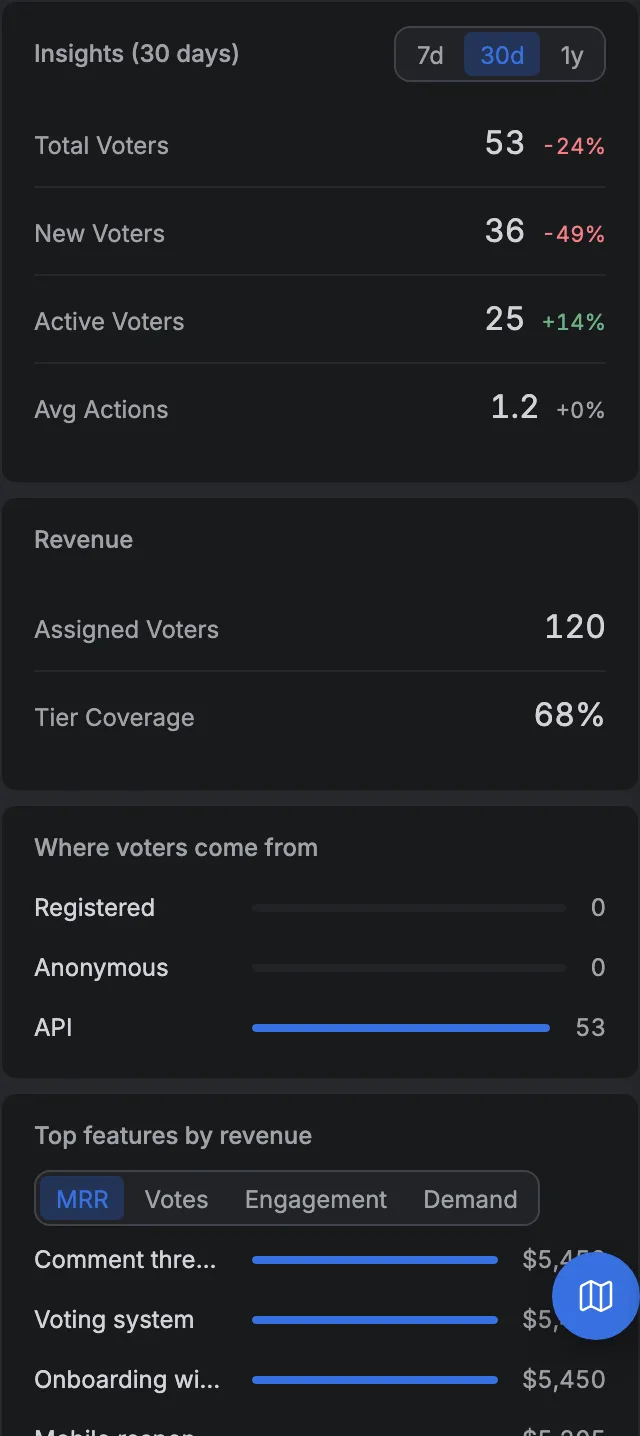
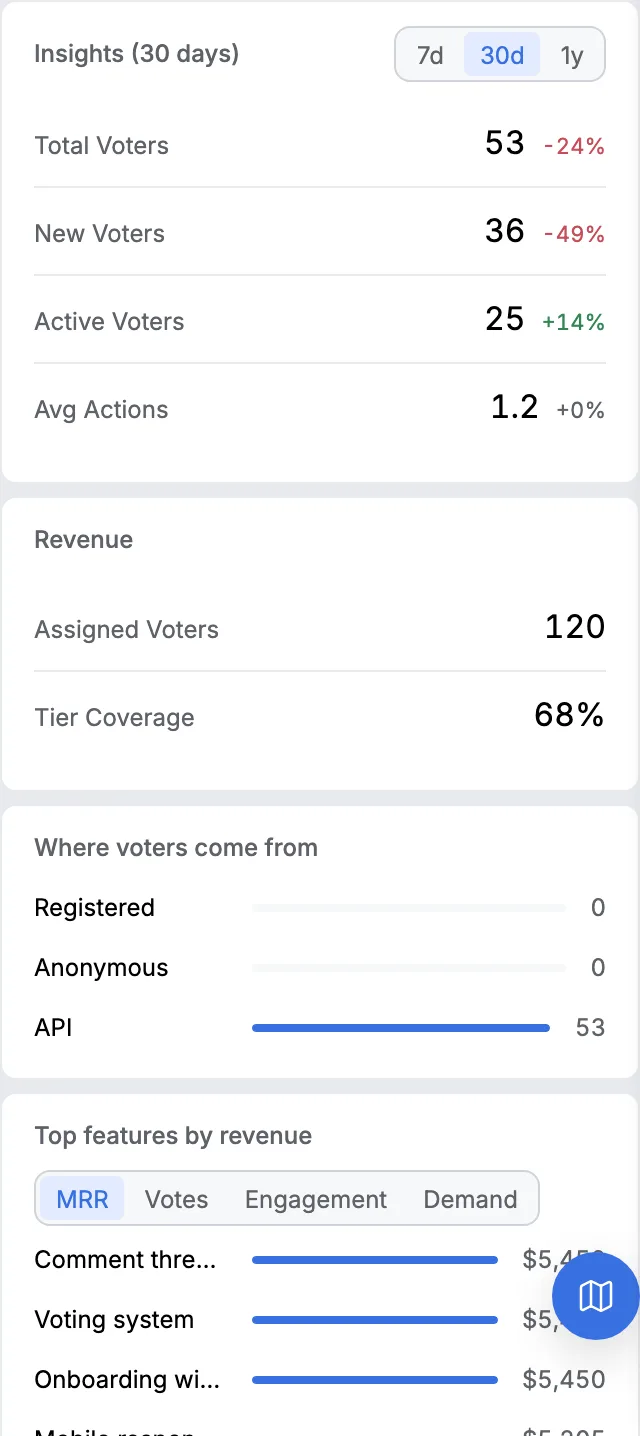
Canny's own help centre counts a company's revenue once per post, however many people from that company vote, and sorts the board by the total. Pendo's roadmap module can show total votes and a dollar value beside an initiative, and its Validate page analyses an idea by votes, accounts, ARR, impact and effort together.
Both are a revenue lens laid over a plain count rather than a weight written onto the vote itself. Eight of the thirty two feedback tools in our own category matrix describe some form of revenue prioritization in their own words, and Canny is one of the eight.
Can I move from one to the other?
Only Canny's side of this is written down anywhere we read.
Canny's export is real and documented rather than a support ticket, and what the file actually contains is written up separately. Neither the Pendo pricing page nor the Pendo alternative page we read states whether feedback or vote data can be exported, so that claim is cut here rather than guessed at.
What usually does not survive a move between any two tools in this category is who cast each vote rather than the running total, the comment threads underneath a request, and every link anybody has bookmarked or shared.
Where we fit, and where we do not
We are not a product analytics platform and we do not read a support inbox or a sales call for anybody. Both of the products above do at least one of those things, and we do neither.
Both Canny and Pendo attach real revenue data pulled from another system to a request, and we do not. Canny will pull recurring revenue in from a CRM. Pendo's roadmap shows ARR against an initiative and its Validate tool weighs an idea by accounts and ARR together. Ours is a whole number you set on a tier yourself, not a figure synced from Stripe or Salesforce.
Both also describe an automated reading of feedback as AI, and we have no AI feature of any kind. Canny's own documentation describes automated conversation analysis that keeps reading new feedback until a spend limit turns it off. Pendo's materials describe its capture and synthesis of tickets, calls and surveys the same way.
What this product does instead is put a multiplier on a tier and write that weight onto the vote the moment it is cast, on the nine dollar plan as well as the thirty nine dollar one, with the plain count still shown beside it.
What is Canny, and what is Pendo?
Canny is a feedback board with a roadmap and a changelog, billed by the tracked user, meaning anybody who posted, voted or commented, your own admins included.
Pendo is a product analytics platform with a feedback module inside it, billed by the monthly active user, meaning anybody who opened your app at all, whether they gave feedback or not.
Does either one have a free plan?
Both do, and they cap different things entirely. Canny's pricing page read on 15 September 2026 gives twenty five tracked users free, with a card required for nothing at that tier.
Pendo's Novus beta, read the same day, caps at five hundred monthly active users and asks for no card, and includes product analytics, in app guides and Pendo branded roadmaps and surveys at that size.
What this costs
Lite
$9 /mo
Pro
$39 /mo
Lifetime
$999 once
Fourteen day trial of Pro, card asked for at signup. Nothing here counts the people who vote, so the bill does not move when the board starts working. The long version, with what happens if you stop paying.
The honest summary
Canny prints a number and stops printing one once your board is large. Pendo never prints one on a paid plan, because its bill is set by a conversation about your whole product rather than by a step on a public ladder.
The two are closer to substitutes than the price pages suggest only if the feedback module is the only reason you are looking at Pendo at all. For most people asking that, it is not.
The Canny alternative page and the Pendo one carry each side on its own.
14 days, a card at signup, then $9 or $39 a month.