Both of these products carry a plan that costs nothing and never runs out, which puts this pair in a smaller group than most of the head to head pages on this site. The difference is where each one draws the line inside that free plan.
Every figure below came from each vendor's own pricing page, checked on 14 September 2026.
What does each one charge?
Fifteen dollars a month, twenty nine dollars a month, and nine, with a genuine free tier sitting under two of those three.
| Vendor | From | Billed per | Free plan | Trial |
|---|---|---|---|---|
| VoteFirst | $7.50/mo | plan | – | 14 days, card |
| WishKit | $12.50/mo | project | 5 requests | – |
| UserJot | $29/mo | workspace | 2 boards | – |
Every price above was checked on each vendor's own pricing page on 14 September 2026.
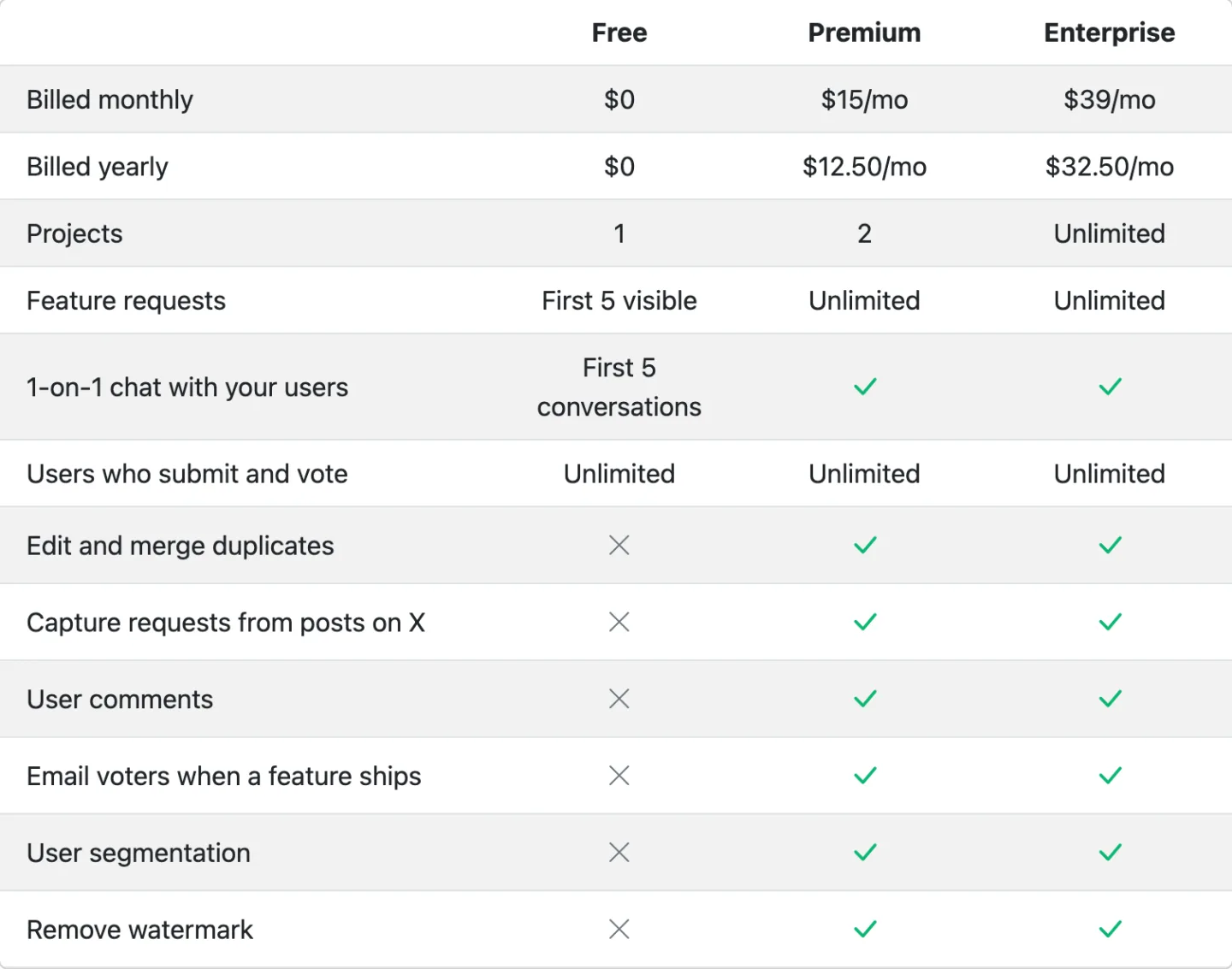
WishKit's meter is the project, and its own pages call a project one board with its own API key. Premium doubles that to two projects for fifteen dollars a month, twelve fifty on the yearly rate, and Enterprise removes the project count entirely for thirty nine.
UserJot's meter is the workspace, and inside that workspace the number that actually moves is the board count. Free holds two boards, Starter jumps to five for twenty nine dollars, and Professional removes the board count entirely for fifty nine.
So both vendors sell an allowance that eventually goes flat. WishKit's ceiling lifts at the third project. UserJot's lifts at the sixth board. Neither one ever starts charging by the person who submits or votes.
How much does WishKit cost compared to UserJot?
Project count decides WishKit's bill and board count decides UserJot's, so the arithmetic below tracks how many apps a developer ships rather than how many colleagues they employ.
| Your situation | WishKit | UserJot |
|---|---|---|
| One app, one board, five or fewer requests to show | Free, Free Forever | Free, one board is inside the two board line |
| Three apps, one board each | $39/mo, Enterprise, since Premium only covers two projects | $29/mo, Starter, which holds five boards |
| Six apps, one board each, plus a custom domain on each | $39/mo, Enterprise, unchanged | $59/mo, Professional |
The middle row is the one worth sitting with. A developer shipping a third small app needs WishKit's top plan immediately, while those same three boards sit comfortably inside UserJot's twenty nine dollar tier.
The bottom row reverses that. Once a developer wants six boards with a custom domain on each, UserJot's allowance runs out and Professional is needed, while WishKit already covered that ground at project three and charges nothing more for apps four through six.
If you would rather look at a board than read about billing, the demo is open without an account.
Which one should you choose?
They answer the same complaint about per person pricing with two different shapes, and each one earns a real compliment here.
WishKit's SDK puts the board inside the app itself as a native screen, not a page reached through a link, shipping for iOS, macOS, visionOS, watchOS and tvOS. Nothing else in this category, including this product, offers that for Apple's own platforms.
UserJot's free plan leaves admin roles, posts and voters completely uncapped and only meters the board count. A company staying at one or two boards can add colleagues and traffic for years without opening a wallet.
Choose WishKit if the board has to live inside a compiled Apple app rather than a browser tab. Choose UserJot if you expect to run more than one small web board and want every other dimension left open.
Nothing here counts the people who vote, so a busy board costs the same.
Why choose WishKit over UserJot, or UserJot over WishKit?
Because one of them is built around an app binary and the other around a browser tab, and each one's price follows the shape of what it actually is.
Choose WishKit when the board is a screen inside an iOS, macOS, visionOS, watchOS or tvOS build. A native screen keeps the visitor inside your own design, with no address bar and no separate login page to load.
An Android build gets the same two line web embed everyone else gets, since the native SDK covers Apple's platforms only.
Choose UserJot when the board lives on the web and you expect to open a second or third one, since the workspace price stays flat while only the board count climbs from two toward five.
A team that fits neither case, one web board with no plan to add a second, gets a free plan from either vendor and the choice barely matters.
Is there a cheaper alternative to both?
Against WishKit's per project rate, a flat workspace price wins the moment a fourth app becomes likely, and this site's own plan is nine dollars a month for one project.
Against UserJot's board allowance, almost nothing beats a plan that is genuinely free, so the comparison only starts once a third board, a custom domain or a company directory login is needed.
The whole field with the unit each vendor bills on is one page, and what either meter costs at a project or board count you choose is worked out here.
What does each do with a vote from a big customer?
Neither vendor's own pages describe multiplying a vote by what its owner pays, and we looked rather than assumed that.
Checked on each vendor's own pages on 14 September 2026. A dash on this page means nobody could read an answer on the pages opened that day, not that the capability is missing.
WishKit does carry user segmentation on every plan, grouping a request by who asked for it, which sorts a list rather than changing what one vote is worth.
UserJot argues against charging per person at all, but its own pages stop short of saying anything about the weight of a single vote once that person is inside.
Counting straight from the vendor matrix behind this site, eight of the thirty two products we track put something about revenue into their own pages, and only four of those eight actually change the weight of a vote rather than just sorting a list by it.
WishKit and UserJot both sit in the other twenty four, so a vote from your biggest account and a vote from a free user move either counter by the same single point.
Can I move from one to the other?
Some of it, and what stays behind is close to the same on almost every move inside this category.
Who cast each vote rather than the running total, the comment thread under a request, and any link a customer already bookmarked rarely survive a move between two feedback boards. WishKit's own words promise that your data is yours to export, but neither vendor's pages we read describe a self serve export button anywhere.
A person leaving either product should expect to write to support and ask, rather than press one control in a settings screen.
Where we fit, and where we do not
Both of these products carry a free plan that never runs out, and we have none at any price. WishKit's holds one project with every voter included and shows five requests. UserJot's holds two boards with every admin role and every voter included too.
WishKit also ships that native SDK, a real screen inside an Apple build rather than a web view bolted on. We embed through a script and an iframe, which is the right shape on a website and the wrong one inside a compiled app.
UserJot puts a private board on Starter at twenty nine dollars. A board of ours is published to everybody or to nobody, at any price, with nothing in between.
What this product does instead is put a whole number multiplier on a tier, write that weight onto the vote itself the moment it lands, and show the plain count beside the weighted total, on the nine dollar plan as well as the thirty nine dollar one.
What is WishKit, and what is UserJot?
WishKit is a feedback SDK built to sit inside a native app, sold per project with unlimited voters on every plan, including a permanent free one.
UserJot is a web based feedback board with a roadmap and a changelog built in, sold per workspace with the board count as the only thing that climbs, and its own pages argue against billing by the person at all.
Does either one have a free plan?
Yes, both, and each one caps a different thing. WishKit's Free Forever plan, read on 14 September 2026, gives one project with unlimited voters and shows only the first five feature requests. UserJot's Free plan, read the same day, gives two boards, three admin roles and unlimited voters, with no card asked at signup.
What this costs
Lite
$9 /mo
Pro
$39 /mo
Lifetime
$999 once
Fourteen day trial of Pro, card asked for at signup. Nothing here counts the people who vote, so the bill does not move when the board starts working. The long version, with what happens if you stop paying.
The honest summary
WishKit's wall sits on what a visitor can see once a board gets busy. UserJot's wall sits on how many boards you run at all. Neither one ever meters the person who submits or votes.
A developer shipping one native app pays nothing on either page. A developer shipping three small apps has already hit WishKit's top plan, while UserJot still has two tiers of room left to grow into.
The WishKit alternative page and the UserJot one carry each side on its own.
14 days, a card at signup, then $9 or $39 a month.