Upvoty's ladder moves when you launch a second product and stays flat no matter how many colleagues touch the board. ProductLift's moves the other way, since boards are cheap and every admin past the second one is fifteen dollars more.
Everything below was read on each vendor's own pricing page on 14 September 2026.
What does each one charge?
Fifteen dollars a month for one Upvoty project, or twenty nine for one ProductLift workspace with two admins in it.
| Vendor | From | Billed per | Free plan | Trial |
|---|---|---|---|---|
| VoteFirst | $7.50/mo | plan | – | 14 days, card |
| Upvoty | $13.50/mo | project | – | 14 days |
| ProductLift | $19/mo | workspace | – | 14 days |
Read on each vendor's own pricing page on 2026-09-14.
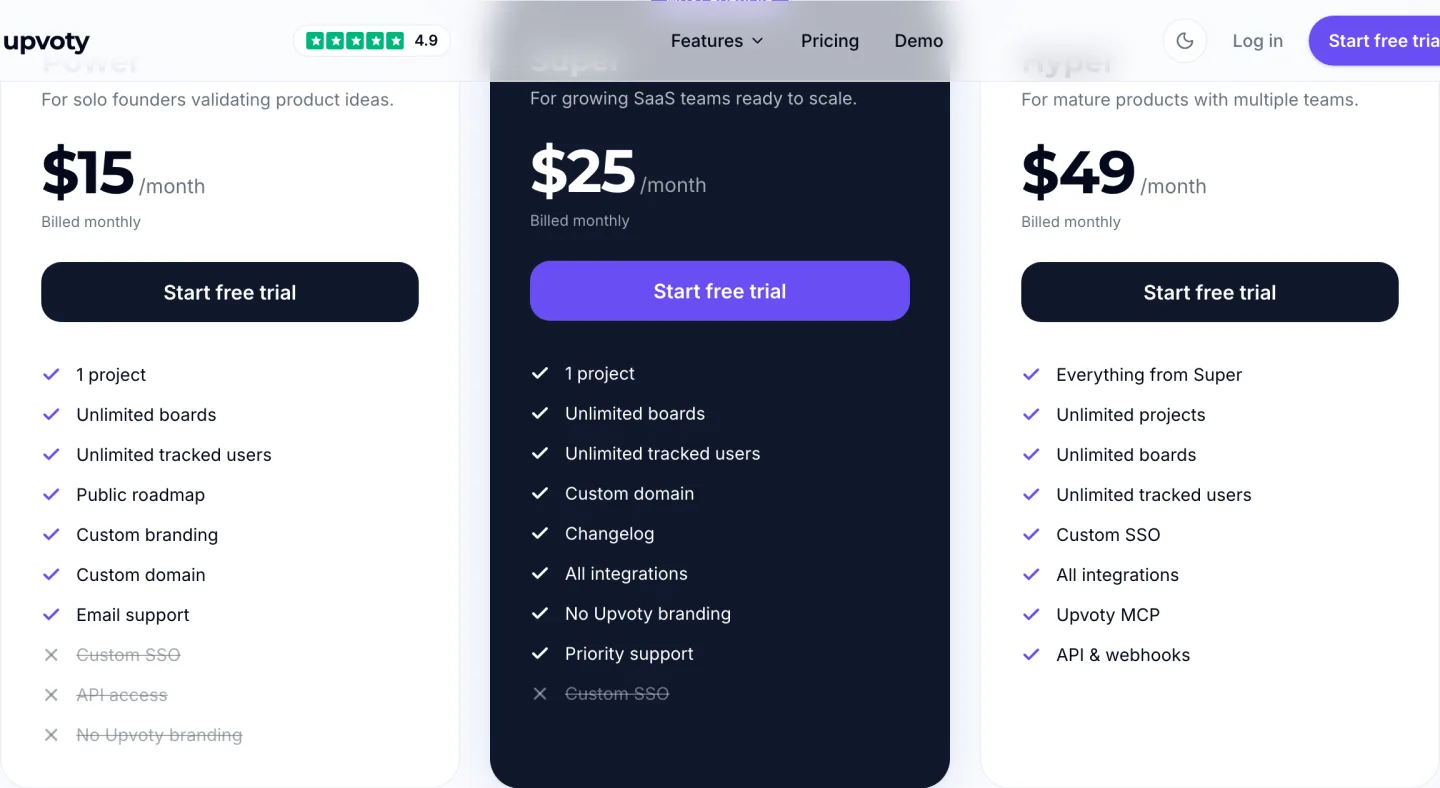
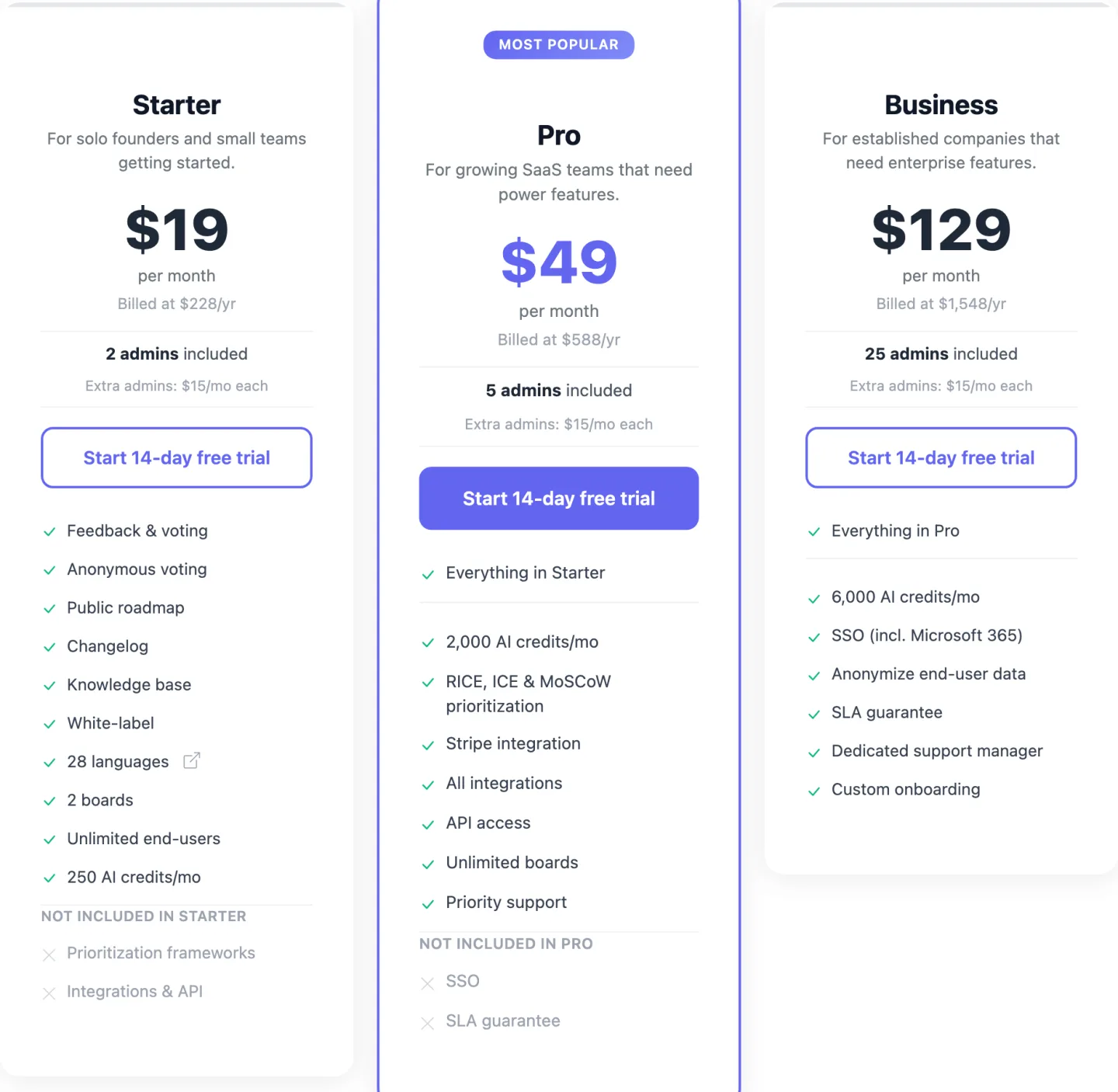
Upvoty's unit is the project. Power and Super each hold one, at $15 a month or $13.50 billed yearly, and Hyper removes the ceiling at $49, or $44.10 yearly. Boards and tracked users are unlimited on all three, so nothing about your audience or your team moves the bill.
ProductLift's unit is closer to a seat than a project. Starter is $29 a month, or $19 billed yearly, and comes with two admins and two boards.
Every admin past that costs fifteen dollars a month more, on any plan, and that fee is printed on their own pricing page rather than hidden in a quote.
How much does Upvoty cost compared to ProductLift?
The two meters run on different axes, so the same company can be cheap on one and expensive on the other.
| Your situation | Upvoty | ProductLift |
|---|---|---|
| One founder, one product | $13.50/mo billed yearly, on Power | $19/mo billed yearly, on Starter, two admins included |
| One product, four admins, wants votes weighted by revenue | $13.50/mo billed yearly, on Power. Weighting is not published at any tier | $49/mo billed yearly, on Pro, which covers five admins and carries the Stripe based weighting |
| Three products, six admins across the team | $44.10/mo billed yearly, on Hyper, unlimited projects | $64/mo billed yearly, on Pro for the unlimited boards, plus one extra admin at $15 |
The middle row is the one that shows the gap. A team of four wanting weighted votes pays ProductLift's Pro rate rather than its entry one, because the Stripe connection sits a whole tier up. Upvoty never reaches that feature at any price its pages state.
The bottom row is where ProductLift's admin fee bites hardest. Six admins cost nothing extra on Upvoty and fifteen dollars extra on ProductLift, on top of the tier that unlimited boards already requires.
If you would rather look at a board than read about billing, the demo is open without an account.
Which one should you choose?
They are built around two different fears, and naming both is the honest answer.
ProductLift's Stripe connection is a genuinely serious piece of engineering, because a weight that updates itself the moment a customer's plan changes needs nobody to maintain it by hand. That is real, and it is the strongest thing on ProductLift's own pricing page.
Upvoty never asks what your org chart looks like, and that restraint is worth naming on its own. A team that grows from three admins to thirty pays exactly the same fifteen dollars, because nothing about your headcount ever appears on an Upvoty invoice.
Nine dollars a month for one project, with weighted voting on it.
Why choose Upvoty over ProductLift, or ProductLift over Upvoty?
Because one of them prices the project and the other prices the org chart.
Choose Upvoty when your team is growing and you do not want a bill that grows with it, because admins, tracked users and boards are all unlimited on every plan they publish.
Choose ProductLift when the revenue weighted vote is the reason you are buying a tool at all, because it is a shipped feature there and it is not on Upvoty's pages at any tier.
Is there a cheaper alternative to both?
Depends on which fee worries you more.
Against ProductLift's per admin charge, anything that never meters your team is cheaper the moment a fifth or sixth colleague joins. Against Upvoty's project ceiling, anything without a project count is cheaper the moment you ship a second product.
This product is nine dollars a month for one project, with no admin fee and no project ceiling below the thirty nine dollar plan.
The full field with the unit each vendor bills on is one page. The calculator works out what a people metered tool would charge you, which is a different question from the one this page answers.
What does each do with a vote from a big customer?
ProductLift reads Stripe and puts revenue behind every vote, in their own published words. Upvoty's pages read on the day say nothing about vote weight, MRR or customer tier either way.
| Vendor | Weighting by revenue | Boards on the entry plan | Single sign on |
|---|---|---|---|
| Upvoty | Not published | Unlimited, inside one project | Custom, on Hyper only |
| ProductLift | Yes, on Pro at $49/mo billed yearly, via Stripe | Two, on Starter | SAML, on Business only |
Read on each vendor's own pricing page on 2026-09-14. Not published means nobody could read the answer on the pages opened that day, never that the capability is absent.
ProductLift's own product page describes the mechanism as reading MRR and plan tier from Stripe against every voter. That is a live figure that moves the moment a customer upgrades, which is a different kind of number from a multiplier somebody chose by hand.
Can I move from one to the other?
Neither vendor's own pages state an importer from the other, and that absence is what both of them publish, not a claim about what either one built.
ProductLift's revenue link is fed by a CSV or a billing connection, and Upvoty's own pages read that day name no export at all. In both directions the requests get rebuilt and every vote count starts again at zero.
Where we fit, and where we do not
We are one project at nine dollars a month, with weighted voting on that plan rather than one or two tiers up, and no admin fee of any kind.
Both of the products above give you more than one board or workspace before you pay for a second project of ours. Upvoty's boards are unlimited inside its cheapest plan, and ProductLift's Starter carries two, against our one at the entry price.
Both of them also reach single sign on eventually, Upvoty's custom SSO on Hyper and ProductLift's SAML on Business. We sign a voter in with a token your own server hands us, on the thirty nine dollar plan, and we have no SAML at any price.
What neither of them does at their entry price, and what we do at ours, is put the weighted vote on the cheapest plan rather than the top one.
What is Upvoty, and what is ProductLift?
Upvoty is a feedback board with a roadmap and a changelog. The bill is set by the project you run, and nobody on your team or your board is ever counted against it.
ProductLift is a feedback board with a roadmap, a changelog and a knowledge base, priced per workspace with a fixed number of admins included and a fifteen dollar charge for every admin past that, on any plan.
Does either one have a free plan?
Neither does. Upvoty's pricing page read on 14 September 2026 offers a fourteen day trial that asks for no card, and the fifteen dollar Power plan is the cheapest thing you can keep.
ProductLift's page, read the same day, states plainly that it offers a free trial and not a permanent free plan. That trial is also fourteen days and also asks for no card, and Starter at nineteen dollars billed yearly is the cheapest thing after it.
What this costs
Lite
$9 /mo
Pro
$39 /mo
Lifetime
$999 once
Fourteen day trial of Pro, card asked for at signup. Nothing here counts the people who vote, so the bill does not move when the board starts working. The long version, with what happens if you stop paying.
The honest summary
Upvoty charges for the project and leaves your team off the bill at any size. ProductLift charges for the admins past two and gives you the Stripe fed weighting once you reach its middle plan. Ours puts that weighting on the cheapest plan we sell and never charges for a colleague.
The Upvoty alternative page and the ProductLift one carry each side on its own.
14 days, a card at signup, then $9 or $39 a month.