Gleap's price moves when a second person logs in or a second product gets added, whichever comes first. Frill's price moves once the ideas sitting open on the board pass a printed line, and nothing else touches it. Everything below was read on each vendor's own pricing page on 14 September 2026.
What does each one charge?
Forty nine dollars a month for Gleap billed annually, twenty two for Frill billed yearly, and nine for us with no seat count and no idea count on either axis.
| Vendor | From | Billed per | Free plan | Trial |
|---|---|---|---|---|
| VoteFirst | $7.50/mo | plan | – | 14 days, card |
| Frill | $22/mo | workspace | – | 14 days |
| Gleap | $49/mo | plan | – | 14 days |
Read on each vendor's own pricing page on 2026-09-14.
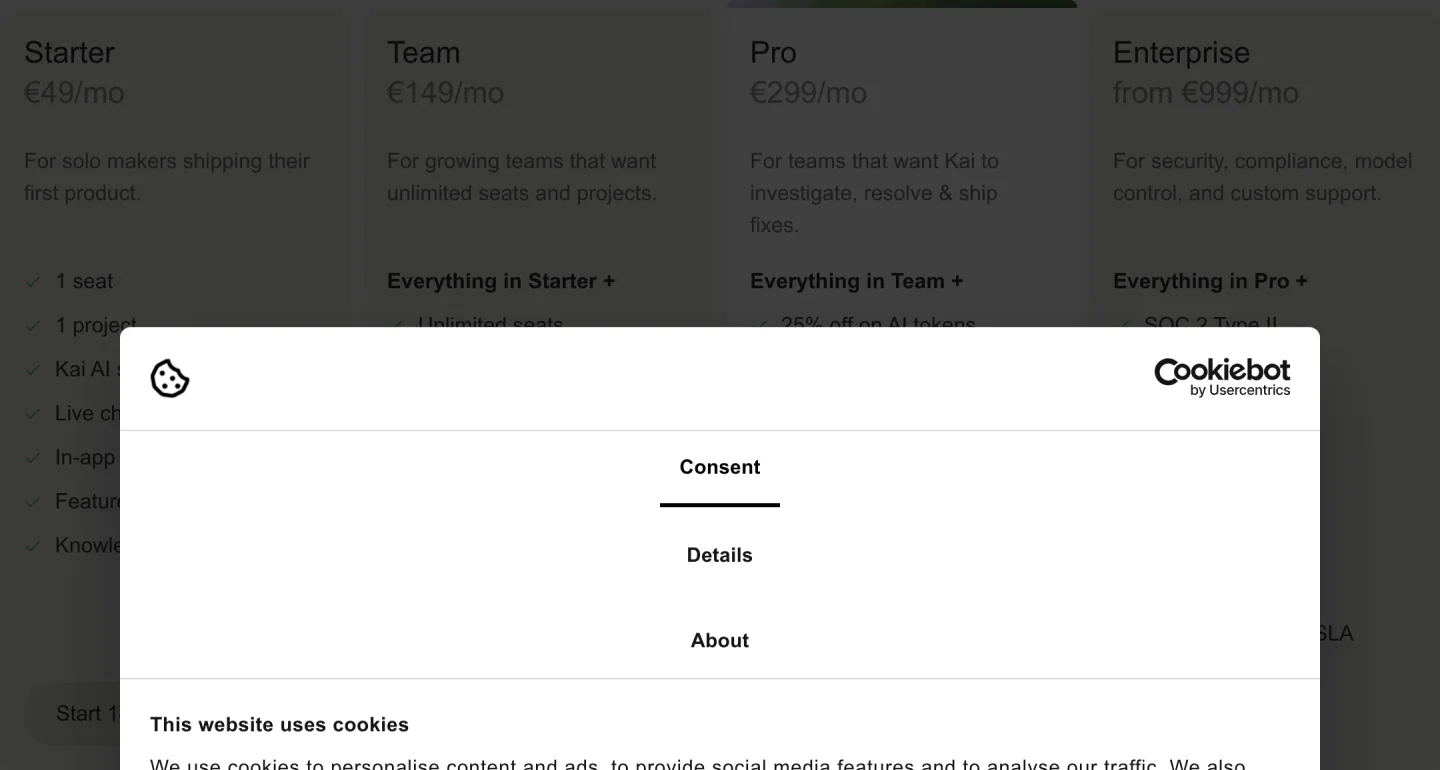
Gleap's Starter plan is one seat and one project for forty nine dollars a month paid yearly, or fifty nine paid monthly. There is no published rate for a second seat alone. The next rung is Team at a hundred and forty nine, with seats and projects both unlimited.
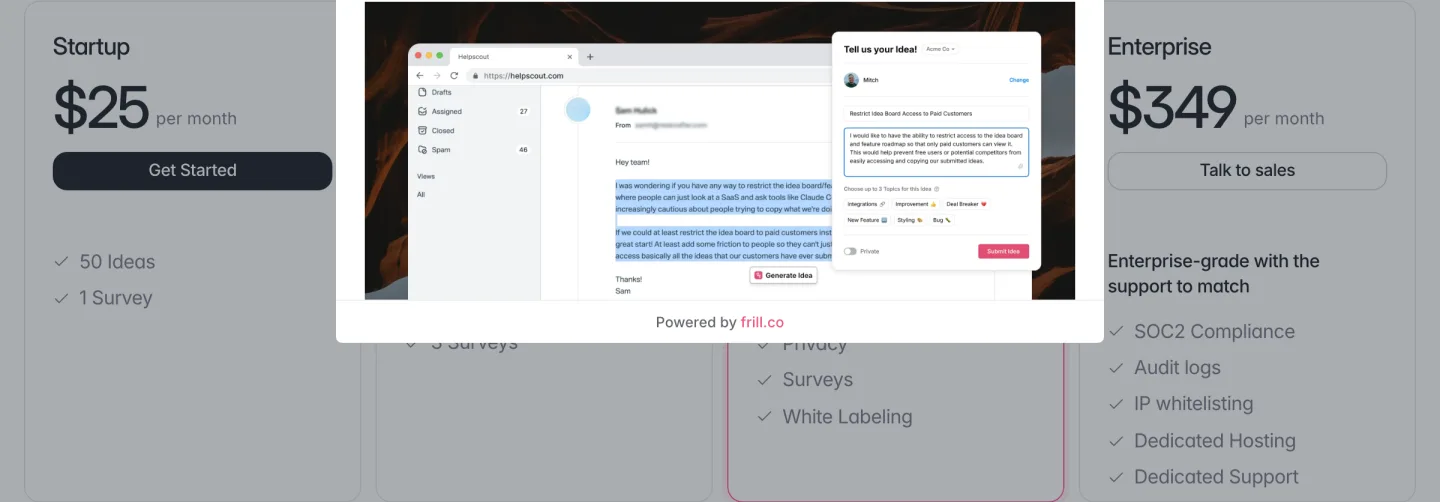
Frill's Startup plan holds fifty active ideas for twenty two dollars a month paid yearly, or twenty five paid monthly, with no cap on colleagues on that same plan. Business removes the idea cap at forty four or forty nine.
How much does Gleap cost compared to Frill?
The two meters do not share an axis, so moving one number at a time shows what actually triggers each bill.
| Your situation | Gleap | Frill |
|---|---|---|
| One founder, one project, 40 open ideas | $49/mo, Starter fits one seat and one project | $22/mo billed yearly, Startup, under the 50 idea line |
| One founder, one project, 60 open ideas | $49/mo, unchanged, Gleap does not meter ideas | $44/mo billed yearly, Business, once the cap is passed |
| Three people, one project, 40 open ideas | $149/mo, Team, the second and third seat force the jump | $22/mo billed yearly, unchanged, Frill does not meter seats |
Adding a colleague moved Gleap's bill by a hundred dollars and left Frill's alone. Adding twenty ideas moved Frill's bill and left Gleap's alone. Neither vendor's page tells you which of those two things your own company will do first.
Gleap prints no rate for a second seat on its own. Starter is exactly one seat and one project. The step past that is Team at a hundred and forty nine, whatever combination of extra people or extra products caused it.
A live board answers questions a spreadsheet cannot, and ours sits open at demo.votefirst.app for anyone who wants to click around before reading any further.
Which one should you choose?
They are not aimed at the same job, and the honest answer says something real about each.
Gleap's bug reports carry the session that produced them, which is a genuinely hard thing to build and a real reason to buy a support suite over a request board. Live chat, a knowledge base and an agent that answers sit in the same subscription.
Frill never charges you for adding a colleague, on any of its four plans. A team of one and a team of twenty pay the same twenty two or forty four dollars, and the only number that moves the bill is your own backlog.
The demo board is open and it asks for no account.
Why choose Gleap over Frill, or Frill over Gleap?
Because one of them is a support desk with a roadmap riding along, and the other is a request board with nothing else riding along except a changelog and surveys.
Choose Gleap when support tickets, bug reports and feature requests all need to land in one inbox, because that is the actual product and the roadmap module is a small part of what the subscription buys.
Choose Frill when the board is the whole job and your team is going to grow, because Frill's seat count never appears on its bill and Gleap's does the moment a second person needs a login.
Is there a cheaper alternative to both?
Often, and which one wins depends on whether the risk in your own company is headcount or backlog.
Against Gleap's one seat ceiling on Starter, a plan that does not charge extra for a second colleague is cheaper the moment your team grows past one. Ours holds at nine dollars a month for one project regardless of how many people log in or how long the board gets.
Run the same question against a vendor that meters your voters instead, and see the whole category lined up by the unit it bills on.
What does each do with a vote from a big customer?
Frill's own copy says plainly that revenue changes what a vote is worth. Gleap has nothing on the topic anywhere we looked.
Read on each vendor's own pages, on the dates in the row above. A cell reading not published is an absence on the page we opened, never proof the feature does not exist somewhere in the product.
Frill's table names the mechanism directly, tying a customer's revenue to the weight their vote carries rather than only sorting a list by the money behind it. That is the same job our own weighting does.
Gleap's own pages talk about routing bugs by severity and letting its agent flag what matters. None of that copy ties a customer's own spend to how loud their request counts.
Can I move from one to the other?
Only one of the two says anything about it.
Frill's own comparison table ticks a bulk importer and an exporter on every paid tier, and it names a Canny source directly among what the importer reads.
Gleap's pricing and alternative pages carry no line about moving feedback data in or out, which we read as silence on the topic rather than a wall against it.
Where we fit, and where we do not
We are one board on one project on the nine dollar plan, with no live chat, no knowledge base and no agent reading anything.
Both Gleap and Frill sell surveys alongside the board, Gleap's inside its support suite and Frill's as five separate types laddered by plan. We have no survey feature and none planned.
Both also publish single sign on, Frill on every paid tier and Gleap on Enterprise at nine hundred and ninety nine dollars a month and up. Our thirty nine dollar plan signs a voter in with a token from your own application, and it is not SAML.
Gleap is the wider case of the two. Someone who only wanted a request board, and nothing else, is paying for live chat, bug reporting with the session attached, a knowledge base and an agent that answers, whether any of that gets used or not.
The one thing missing from both of their pricing pages is a fixed integer per customer tier that rewrites a vote's weight the instant it lands, unweighted count kept right beside it, true here from the nine dollar plan up.
What is Gleap, and what is Frill?
Gleap is a customer support and bug reporting suite, with a feature roadmap and a changelog riding inside it, billed by the number of seats and the number of projects on your account.
Frill is a feedback board, a roadmap, a changelog and a survey product sold together, billed per workspace by how many ideas are sitting open on the board.
Does either one have a free plan?
Neither does. Gleap's own page carries a fourteen day trial with no free tier under it. Frill's page carries the same fourteen days, and its own banner says that trial needs no card.
Gleap's page does not state whether its trial asks for a card, so we are not going to guess either way. Ours is fourteen days of Pro, and ours is the one that asks for a card at signup.
What this costs
Lite
$9 /mo
Pro
$39 /mo
Lifetime
$999 once
Fourteen day trial of Pro, card asked for at signup. Nothing here counts the people who vote, so the bill does not move when the board starts working. The long version, with what happens if you stop paying.
The honest summary
Gleap charges for the people and the products on your account and gives you a support desk, a knowledge base and an agent in return. Frill charges for the length of your own idea list and leaves your headcount off the bill entirely.
Pick Gleap if support and feedback need to live in one inbox. Pick Frill if the board is the whole job and your team is the part that keeps growing. Ours if the vote itself should carry what the voter pays, at nine dollars flat.
Gleap's own page goes further on the support side than this one does, and so does Frill's on the feedback side, each argued from its own pricing card rather than from a rival's summary of it.
14 days, a card at signup, then $9 or $39 a month.