Canny meters the customers who take part, so the bill grows when the board works. Feature Upvote meters the board itself at forty nine dollars a month, so the bill grows when you launch a second product and never when the first one gets busy.
Somebody with one busy board and somebody with four quiet ones get opposite answers from these two pages, and that is what this page is about. If you came here wanting the whole shortlist instead of one pairing, every Feature Upvote alternative with a published price is on one page.
One caution before the numbers. Feature Upvote's site returned a 403 to our browser on 15 September 2026, so nothing of theirs could be re-read today. Every Feature Upvote figure on this page was read on 14 September 2026, and Canny's figures were read the same day.
What does each one charge?
Forty nine dollars a board a month, seventy nine a month, and nine, and only one of the three is a flat rate that never moves.
| Vendor | From | Billed per | Free plan | Trial |
|---|---|---|---|---|
| VoteFirst | $7.50/mo | plan | – | 14 days, card |
| Feature Upvote | $49/board/mo | board | – | 30 days |
| Canny | $79/mo | tracked user | 25 users | – |
Read on each vendor's own pricing page on 2026-09-14.
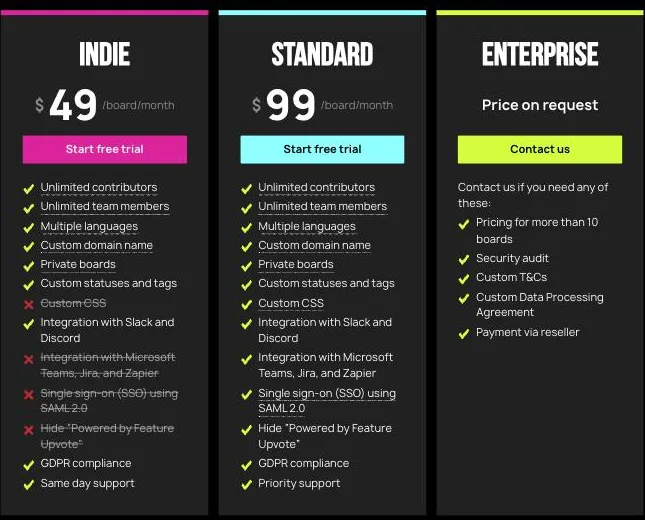
Feature Upvote's Indie plan is forty nine dollars per board per month billed yearly, or fifty nine billed monthly. Standard is ninety nine per board billed yearly, or a hundred and nineteen monthly. Both tiers carry the same feature list, so the fifty dollar step buys support speed rather than capability.
Canny's Pro plan starts at seventy nine dollars a month billed yearly for a hundred tracked users, and a tracked user is Canny's own term for anybody with a post, a vote or a comment attributed to them. Their free plan covers twenty five tracked users.
This site sells a plan rather than either of those units, and it belongs in the same table because the comparison is the point of the page.
How much does Canny cost compared to Feature Upvote?
Run one board at three sizes and the crossover shows up fast, because Canny's meter is the number of people who showed up and Feature Upvote's is not.
| Your situation | Canny | Feature Upvote |
|---|---|---|
| 1 board, 20 customers vote | Free, under the 25 tracked user line | $49/mo, Indie, billed yearly |
| 1 board, 90 customers vote | $79/mo, over the free line | $49/mo, unchanged |
| 1 board, 900 customers vote | Above $79/mo, the rate past 100 tracked users is not published | $49/mo, unchanged |
Canny does not publish the rate above 100 tracked users. Their page carries a slider from 25 to 5,000 tracked users with an optional spend limit, and no printed figure for the steps in between.
A board with 900 voters costs more than $79 a month on Canny and neither their page nor ours can tell you how much more.
Feature Upvote's bill does not move with any of these rows. It moves with something else entirely, which is the next section.
What happens when you run more than one product?
Feature Upvote's rate is per board, so a second product is a second full invoice rather than a step up.
| Boards you run | Feature Upvote, Indie | VoteFirst |
|---|---|---|
| 1 | $49/mo | $9/mo, Lite, one project |
| 2 | $98/mo | $39/mo, Pro, unlimited projects |
| 4 | $196/mo | $39/mo, Pro, unlimited projects |
Feature Upvote's own pricing page states the arithmetic for two and three boards directly: two products is ninety eight dollars a month on Indie, and three is a hundred and forty seven. Four continues that same published per board rate, at forty nine times four.
Ours does the opposite of both meters. One project is nine dollars, and every project after the first is included in the thirty nine dollar Pro plan rather than billed again. A company running four quiet products pays the same thirty nine dollars as a company running one busy one.
Nine dollars a month for one project, with weighted voting on it.
Which one should you choose?
They answer to opposite shapes of company, and the honest answer names what each does well.
Feature Upvote's entry plan carries a custom domain, private boards, unlimited team members and SAML 2.0 single sign on, none of which our nine dollar plan has, and we have no private boards at any price. If your feedback has to sit behind a login, that single row settles it in their favour.
Canny is the better fit if you run one product and expect it to get busy in a way you want reported on, because their revenue impact sorting and their sales tools sync are built for exactly that, and they are ahead of us on both.
Feature Upvote is the better fit if you run several products and want a support team who answers with a person rather than a bot, because that is what they say about themselves and there is no reason to doubt it.
Why choose Canny over Feature Upvote, or Feature Upvote over Canny?
Because one of them prices the people who use your board and the other prices the boards themselves.
Choose Canny when you have one product, expect the board to grow, and want the revenue reporting that comes with counting who voted.
Choose Feature Upvote when you have more than one product and want to know your bill a year out without wondering what a busy month does to it, because a flat forty nine dollars per board does not change when the board gets busy.
Neither choice is about which product works better day to day. Both do the basic job, and the price follows from how many products you run and how many people vote, not from which vendor you like more.
Is there a cheaper alternative to both?
Several, and which one is cheaper depends on whether you are counting voters or boards.
Against Canny's tracked user meter, anything with a flat price is cheaper the moment the board starts working. Against Feature Upvote's per board rate, anything priced per plan rather than per board is cheaper the moment you launch a second product, and ours is nine dollars against their forty nine.
The whole field with the unit each vendor bills on is one page, and what a tracked user costs across the category at a number you choose is worked out here.
What does each do with a vote from a big customer?
Canny sorts by the revenue a feature affects. Feature Upvote does not weight votes at all, and we checked rather than assumed it.
Read on each vendor's own pages on the date in the row above. A dash in the row above means nobody could read it on the pages opened that day, never that the capability is absent.
Feature Upvote's help centre returns nothing for a search on weighting, and no page we read mentions vote weight or customer tiers. Every vote on a Feature Upvote board counts as one, and that is a fact about their product rather than a boast about ours.
On VoteFirst a vote carries its tier's multiplier on every plan including the nine dollar one, and the plain count stays visible next to the weighted total.
Can I move from one to the other?
Both export, and the same four things fail to survive any move in this category.
Who cast each vote rather than the total, the threading on comments, the original timestamps, and every board URL anybody has ever shared. What arrives is the request text, the vote counts and the statuses.
What a Canny export actually contains is written up separately, from the file rather than from their documentation.
Where we fit, and where we do not
There is no private board here at any price, and no password or invite list to admit one named customer. Feature Upvote has both on its entry plan, and Canny has private boards on every plan including Free.
There is no free plan on ours. Canny's free tier covers twenty five tracked users, and Feature Upvote's is a thirty day trial that needs no card rather than a permanent free plan.
There is no SAML single sign on anywhere in this product. Feature Upvote carries SAML 2.0 on its entry plan, and Canny carries single sign on in its base features with SSO integrations on Business.
What this product does instead is put an integer multiplier on a tier, write that weight onto the vote when it is cast, and show the plain count beside the weighted total on the same card, on every plan, at nine dollars.
What is Canny, and what is Feature Upvote?
Canny is a feedback board with a roadmap and a changelog, billed by the customers who take part.
Feature Upvote is a single public feedback board, deliberately without a roadmap or a changelog, billed per board per month. Their own pages read on 14 September 2026 offer neither a public roadmap nor a changelog, which means nobody could read about either rather than that neither exists.
Feature Upvote's public REST API opened to everyone in July 2026, and older comparison pages that say it has none have not been touched since.
Does either one have a free plan?
Canny does and Feature Upvote does not. Canny's pricing page read on 14 September 2026 gives twenty five tracked users free. Feature Upvote offers a thirty day trial that asks for no card, which is longer than most of the category, and then a bill.
What this costs
Lite
$9 /mo
Pro
$39 /mo
Lifetime
$999 once
Fourteen day trial of Pro, card asked for at signup. Nothing here counts the people who vote, so the bill does not move when the board starts working. The long version, with what happens if you stop paying.
The honest summary
Two meters running in opposite directions. Canny's grows with your customers and gets expensive on a busy board with no printed ceiling. Feature Upvote's grows with your product count and stays flat on the busiest board you can build, at forty nine dollars each.
Ours does neither. One price per plan, whatever the board does and however many projects sit on it.
The shortlist of Canny alternatives sits on its own page. The Canny alternative page carries that side on its own, and every Feature Upvote alternative with a published price sits on one page.
14 days, a card at signup, then $9 or $39 a month.