Both of these leave the people who vote off the bill. Nolt says unlimited users, unlimited content and unlimited admins at the top of its pricing page, and Upvoty's tracked users and boards are unlimited on all three plans.
So the question is not what happens when your board gets busy. It is what happens when you launch a second product, and the two answers are twenty dollars apart.
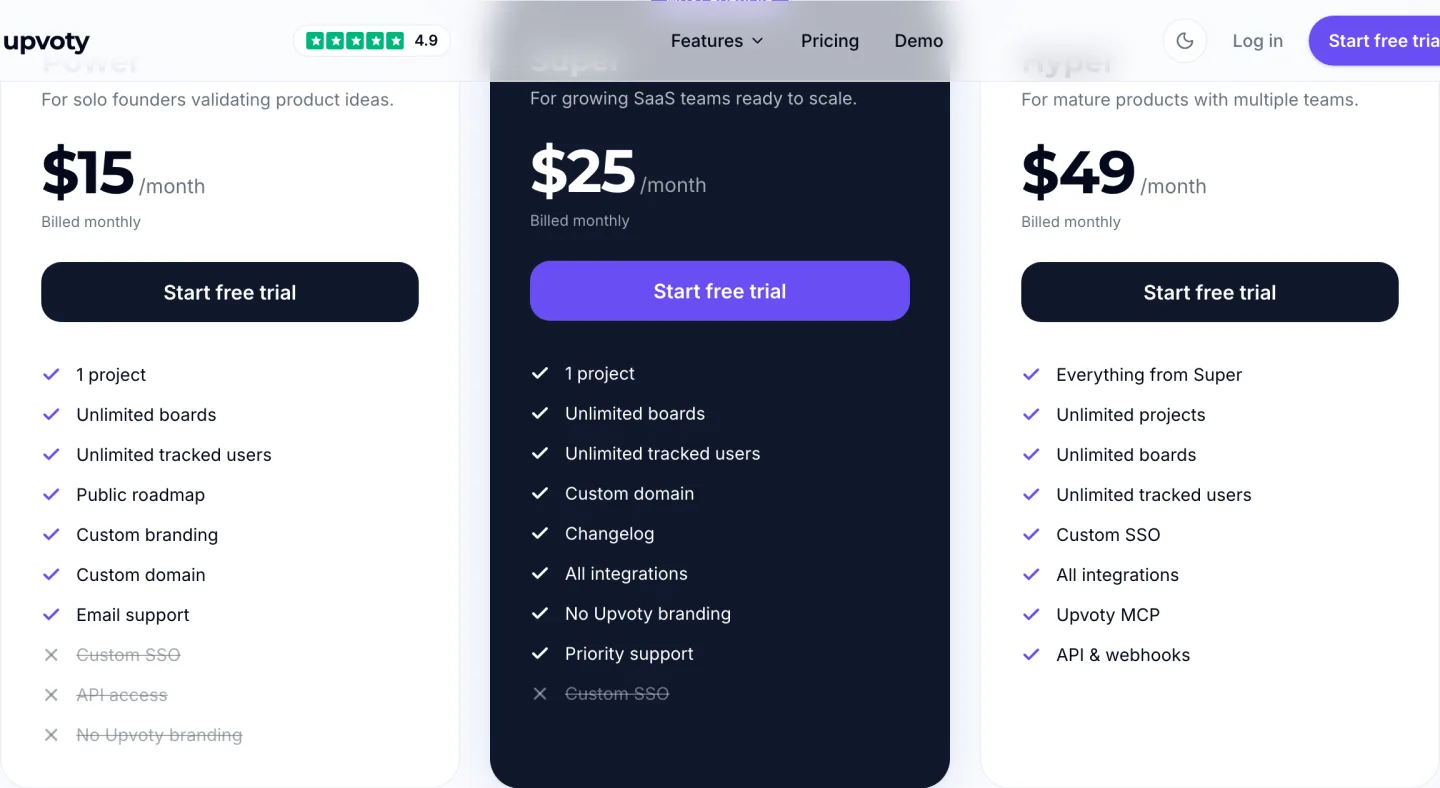
Both pricing pages were opened on 14 September 2026 and every figure below came off them that day.
What does each one charge?
Twenty nine dollars for one board, or thirteen fifty for one project, and neither figure moves with your audience.
| Vendor | From | Billed per | Free plan | Trial |
|---|---|---|---|---|
| VoteFirst | $7.50/mo | plan | – | 14 days, card |
| Upvoty | $13.50/mo | project | – | 14 days |
| Nolt | $29/mo | board | – | – |
Read on each vendor's own pricing page on 2026-09-14.
Nolt has no photograph here. Their site answers our headless browser with a check it never clears, so the Nolt numbers on this page come from notes typed while reading nolt.io by hand on 14 September 2026, with the currency control and the billing control both moved.
Upvoty publishes three plans. Power is $15 a month, or $13.50 billed yearly, and carries one project. Super is $25, or $22.50 yearly, also one project. Hyper is $49, or $44.10 yearly, with unlimited projects. Their annual toggle saves exactly ten percent with no rounding.
Nolt publishes three too. Essential is $29 a month billed yearly, or $348 a year, with one board. Pro is $69 a month billed yearly, or $828 a year, with five. Enterprise is quoted.
How much does Nolt cost compared to Upvoty?
Upvoty is cheaper at one product and the gap widens rather than closes.
| Your situation | Nolt | Upvoty |
|---|---|---|
| One product | $29/mo on Essential, billed yearly | $13.50/mo on Power, billed yearly |
| Two products | $69/mo on Pro, because nothing sits between one board and five | $44.10/mo on Hyper, billed yearly |
| Six products | $69/mo is exhausted at five, so this is the Enterprise conversation | $44.10/mo, still, because Hyper has no project limit |
The third row is the one that decides it for a company with a portfolio. Upvoty's top published plan has no ceiling on projects, so the sixth product costs nothing extra. Nolt's top published plan stops at five, and the sixth is a quote.
The second row is the one that decides it for everybody else. Nolt has no plan between one board and five, so your second product moves you from $29 to $69 and you pay for three boards you will not open.
Billing aside, our own board is open to look at without signing up for anything.
Which one should you choose?
Price says Upvoty and the entry plan says Nolt, and which of those matters depends on one row.
Nolt's entry plan carries private boards, and Upvoty's own pages do not name one at any tier. Essential also carries single sign on through a signed token, custom fields, custom statuses, a roadmap and the Slack, Discord, GitHub and Trello integrations, all at $29.
For a board that has to sit behind a login, that is the comparison and the extra fifteen dollars is not the point.
Upvoty is the cheapest published entry price of the two by a wide margin, and it never charges for a project's audience. Thirteen fifty a month for a public board with a roadmap beside it is the lower end of this whole category.
There is a catch on Upvoty's cheapest card worth knowing before you buy it. Three lines on Power are crossed out on their own page, being custom single sign on, API access and removing the Upvoty badge.
The words are still in the text of the page, so a summary built from a text copy will tell you Power includes them. It does not.
Nine dollars a month for one project, with weighted voting on it.
Why choose Nolt over Upvoty, or Upvoty over Nolt?
Because one of them sells you a private board at the bottom and the other sells you unlimited products at the top.
Choose Nolt when the board has to be private, when password protection or restricting access by email domain matters, or when you want the European product, which is hosted in the European Union on a separate domain at ten more a month in euros.
Choose Upvoty when you run several products, when $13.50 is the right price for one, or when you want your own name on the board for less than Nolt's entry price. Upvoty's badge comes off at $22.50 on Super.
Is there a cheaper alternative to both?
Ours is nine dollars a month for one project and thirty nine for unlimited projects, so it sits below Upvoty's entry price and below Nolt's at every count.
That is the price and not the argument. Neither of these two charges for the people who vote, which is the usual reason to leave a tool in this category, so if the bill is your only complaint you are already on the cheap side of the field.
Every vendor and the unit it charges on sits in one table. For the two that count voters rather than containers, the calculator runs the sum at whatever audience you expect.
What does each do with a vote from a big customer?
Neither of them weights it, and neither of their pages claims to.
Those rows came off the vendors' own pages on 14 September 2026. A cell reading not published means the answer was not on the pages we opened, which is a gap in what they say rather than in what they built.
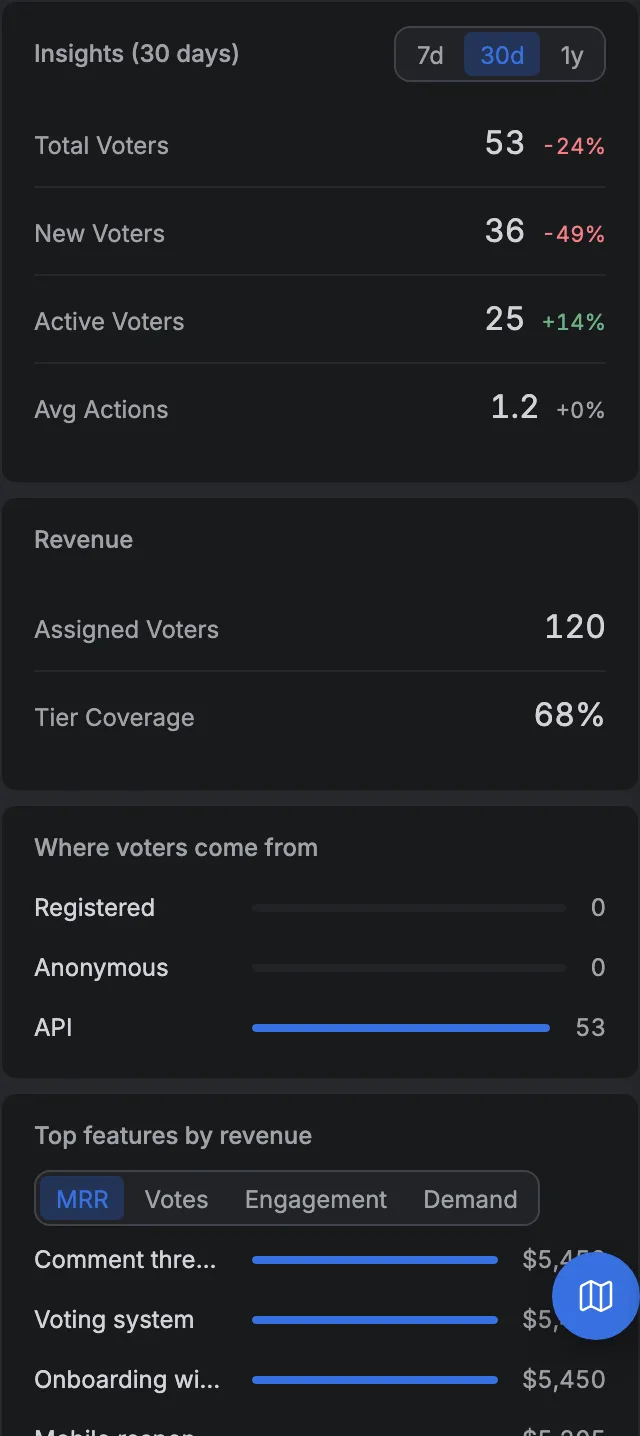
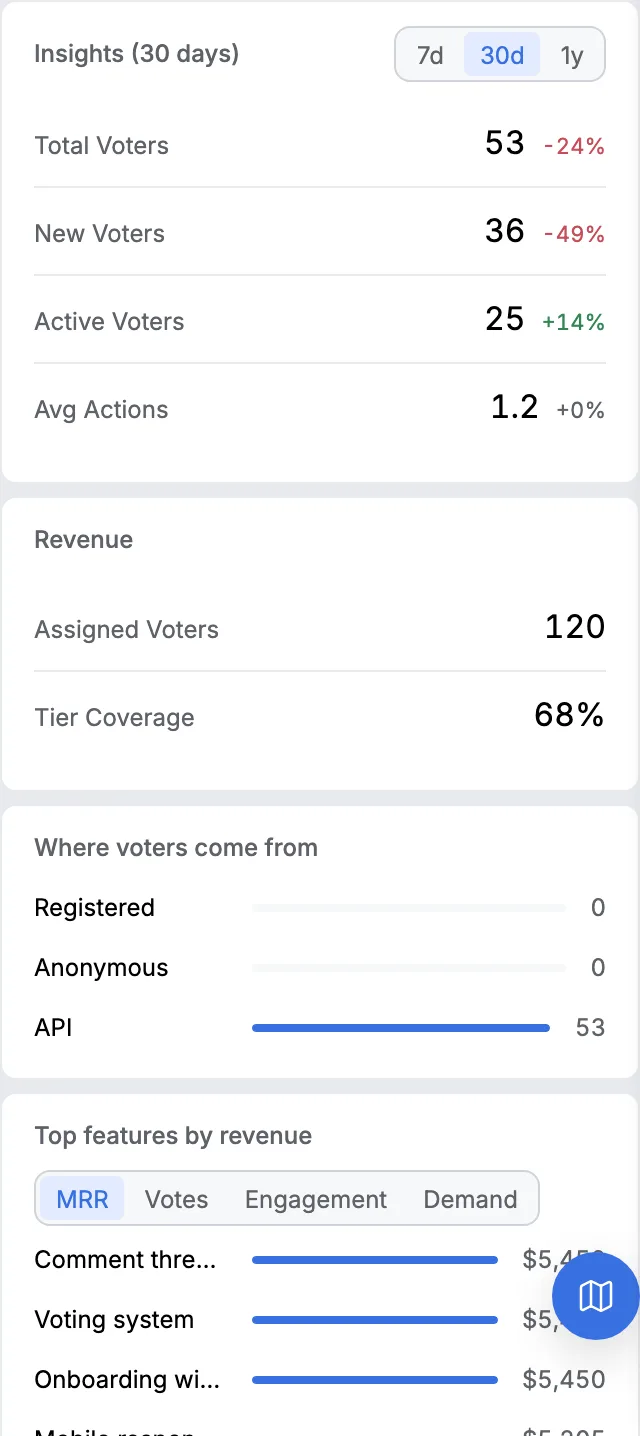
On both products a vote is a vote. The customer paying you two thousand a month and the one who signed up this morning move the counter by the same one.
That is the right model for a community board where the voters are peers. It is the wrong one for a board where most of your revenue sits in a handful of accounts, because the ranking then tells you what is popular rather than what is paid for.
Can I move from one to the other?
Nolt publishes data export APIs on its Pro plan. Upvoty's own pages read on the day do not name an export.
That is the asymmetry worth checking before you commit, because leaving a tool is when you find out what you actually own, and the answer belongs on the pricing page rather than in a support ticket.
In both directions somebody retypes the requests or scripts them in, and every counter restarts at zero. No tool in this category carries across the identity behind a vote or the conversation under it.
We opened a real Canny export and wrote down what was in it. The columns differ by vendor, the missing pieces do not.
Where we fit, and where we do not
Nolt has private boards on its entry plan and password protected boards above it, plus restricting access by email domain. We have none of those at any price, and the nearest thing here is keeping a board unpublished on the higher plan, which is not the same thing.
Upvoty publishes a custom domain on its entry plan. Ours is on the thirty nine dollar plan and not below it.
On Pro, Nolt lists Zapier, Make, Pabbly, Intercom, Microsoft Teams, Jira, Linear, monday.com and Asana. That is a longer list than ours and our own page says so rather than burying it.
The one thing here that neither of them sells is a tier multiplier that is stamped onto a vote at the moment it is cast, and it is on the nine dollar plan rather than three tiers up.
What is Nolt, and what is Upvoty?
Nolt is a hosted feedback board with a roadmap view on the same board, sold as a tier that holds one board or five, with unlimited users, unlimited content and unlimited admins on every plan.
Upvoty is a hosted feedback board with a public roadmap and a changelog, sold per project, with unlimited tracked users and unlimited boards on all three plans.
Above its top published plan there is an enterprise line offering SAML single sign on and a custom data processing agreement, with an email address rather than a price.
Does either one have a free plan?
Neither does, and both trials ask for no card.
Nolt gives every new board a ten day trial of the Pro plan. Upvoty's trial is fourteen days on every plan.
Ours is the same shape with one difference: fourteen days of Pro, and the card is asked for before it starts.
What this costs
Lite
$9 /mo
Pro
$39 /mo
Lifetime
$999 once
Fourteen day trial of Pro, card asked for at signup. Nothing here counts the people who vote, so the bill does not move when the board starts working. The long version, with what happens if you stop paying.
The honest summary
Two products that both refuse to charge for your audience, which is the single most important thing either of them does.
Upvoty is cheaper at every product count and it is the only one of the two with no ceiling on projects below an enterprise conversation. Nolt is the one with a private board on its entry plan, and a second board that costs forty dollars a month because nothing sits between one and five.
Upvoty for several products on a public board. Nolt for one board that has to be private. Ours if you want the vote itself, not just the count, to carry what the voter pays.
The Nolt alternative page and the Upvoty one carry each side on its own.
14 days, a card at signup, then $9 or $39 a month.