Roadmunk and Aha both charge for the people on your own side of the roadmap, never for the customers reading it. Where they split is the smallest bill each one will actually write.
Roadmunk's smallest bill is a single editor. Aha's smallest bill is three seats, whether your team is one person or three. Everything below was read on each vendor's own pricing and alternative pages on 15 September 2026.
What does each one charge?
Nineteen dollars for one editor, and thirty nine dollars a seat with a rule that turns it into a hundred and seventeen.
| Vendor | From | Billed per | Free plan | Trial |
|---|---|---|---|---|
| VoteFirst | $7.50/mo | plan | – | 14 days, card |
| Roadmunk | $19/creator/mo | creator | – | 14 days |
| Aha! Ideas | $39/user/mo | user | – | Yes |
Read on each vendor's own pricing page on 2026-09-15.
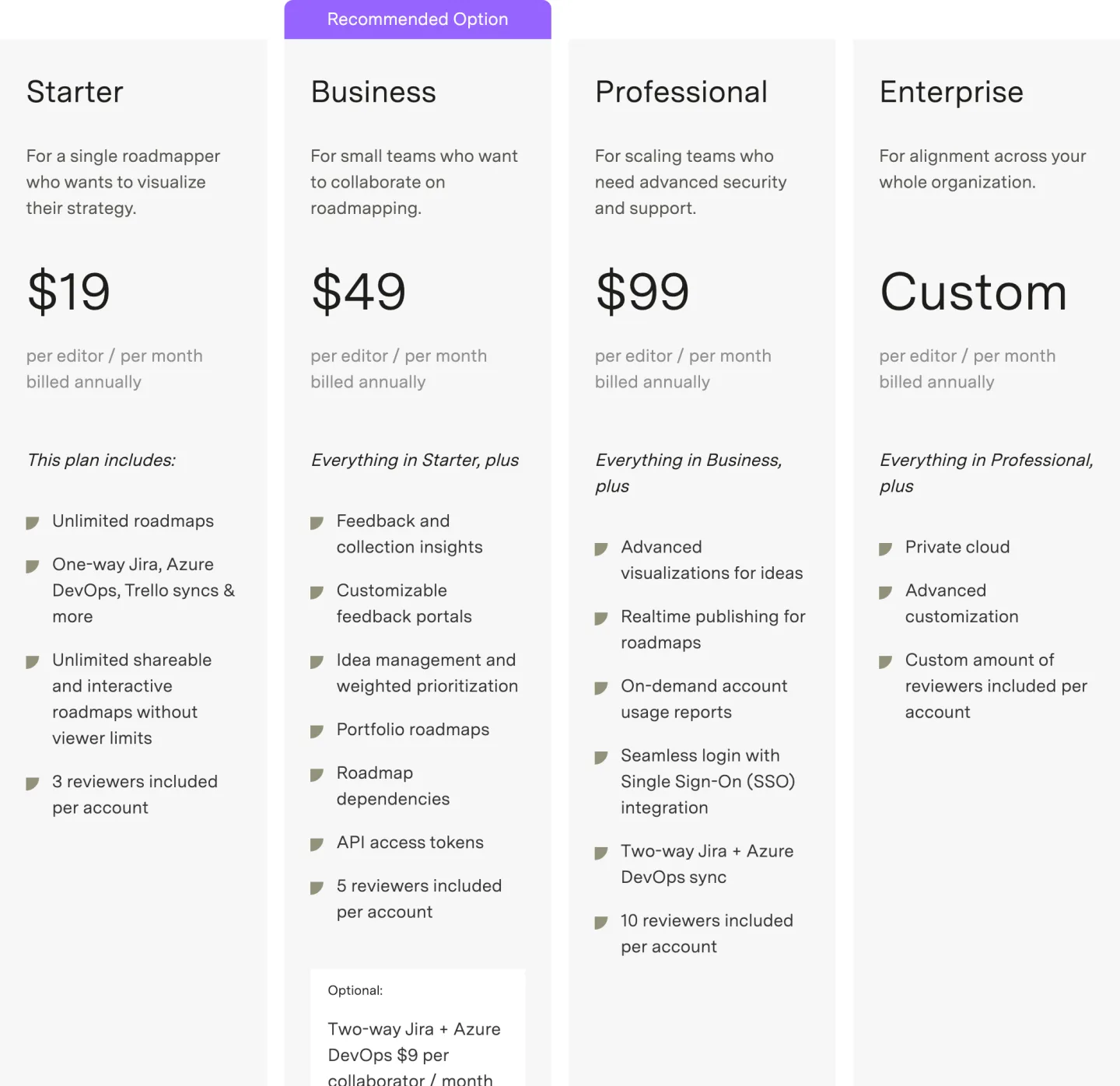
Roadmunk's Starter plan is nineteen dollars for the person editing the roadmap, and includes three reviewers at no charge. A fourth reviewer is five dollars a month, and that meter runs separately from the editor count.
Aha prints its own rule directly under the rate on the pricing card. Thirty nine dollars a user becomes a hundred and seventeen a month the moment the page loads, because Ideas will not sell fewer than three seats, and a contributor, a reviewer and a plain viewer all need one.
How much does Roadmunk cost compared to Aha?
The gap depends on how many of your people only look, because Roadmunk keeps a few of them free and Aha never does.
| Your situation | Roadmunk | Aha Ideas |
|---|---|---|
| 1 editor and 1 reviewer, trying the tool before rolling it out | $19/mo, the reviewer sits inside the three included free | $117/mo, the floor charges for a colleague you have not hired |
| 4 editors and 3 reviewers, a mid sized product team | $76/mo, four editors at $19 each, reviewers still inside the included count | $273/mo, all seven people need a paid seat |
| 2 editors and 14 reviewers, most of the company only watching | $93/mo, two editors at $19 plus eleven reviewers past the included three at $5 each | $624/mo, sixteen people, sixteen seats |
Roadmunk's reviewer meter stays cheap even when your build team is small, because the first three lookers cost nothing at all. That is the shape of company where the gap above is widest.
Aha's floor punishes exactly that same small team, since a single founder pays for two colleagues who do not exist yet. The gap narrows only once your headcount climbs past the low double digits, and even then Roadmunk's five dollar reviewer rate rarely catches up.
Neither vendor prints a monthly total anywhere on the page, only the rate per person, so both of the tables above are arithmetic we did rather than a number either company wrote down for you.
Which one should you choose?
They are built for a similar job, presenting a roadmap to people who did not build it, and they answer that job from opposite directions.
Aha's portal users are unlimited and free on every plan, and that promise never changes as the audience grows. Their own answer to whether portals and portal users are unlimited is a plain yes, so ten thousand customers reading a public roadmap cost exactly what one does.
Roadmunk's two way Jira and Azure DevOps sync on the Professional plan is a real integration that neither this product nor Aha's own pages describe selling. A team that already lives inside Jira gets work moving both directions without a script or a webhook holding it together.
Choose Aha if a portal full of customers, rather than a handful of reviewers, is the audience you are pricing for. Choose Roadmunk if the roadmap stays inside your own company and a live Jira connection matters more than a free viewer seat.
The demo board is open and it asks for no account.
Why choose Roadmunk over Aha, or Aha over Roadmunk?
Because one of them prices a small team kindly and the other prices a small team the same as a big one.
Choose Roadmunk when your team is genuinely small, since a single editor with a couple of reviewers costs nineteen dollars a month and stays there until the fourth reviewer joins.
Choose Aha when you were already going to buy three or more seats, because the floor stops being a penalty the moment your real headcount reaches it, and the rest of the suite behind Ideas becomes the actual reason to buy.
The choice is really about whether your team is under three people right now, since that is the one number that changes which vendor wins the arithmetic.
Is there a cheaper alternative to both?
Yes, once the question stops being about editors and seats and starts being about a public board your customers actually vote on.
Neither Roadmunk nor Aha prices around a small team running one board for the public, because a roadmap presentation tool and an ideas suite are both shaped for something wider than that.
The whole field, with the unit each vendor bills on, sits on one page, and the calculator works the seat arithmetic at a headcount you choose, against a flat nine dollars a month here for one project.
What does each do with a vote from a big customer?
Roadmunk is not one of the thirty two vendors in our own tracked matrix, so nothing below about it comes from that file, only from its own pricing and alternative pages.
Roadmunk's Business plan lists weighted prioritization, a scoring model over criteria such as reach, effort and confidence that a person on your team sets by hand. That model never looks at what a customer pays.
Aha's own wording, read on its product pages, is prioritizing ideas by potential revenue, and that phrase is one of eight vendors in our matrix of thirty two that write something revenue related into their own pages.
Four of those eight go further and change the weight of a vote itself rather than only ordering a list afterward, and Aha's own phrase sits in the ordering group rather than the weighting one.
Neither company multiplies a single customer's vote by what that customer pays the instant it lands, which is the narrower thing this product does on every plan it sells.
Can I move from one to the other?
Neither the Roadmunk pages nor the Aha pages we are allowed to cite say anything about what an export from either one actually contains.
That silence is worth keeping rather than skipping past. Whatever moving between these two involves, it is not written down on the pages that sell them, so a buyer should ask the vendor directly before assuming a clean migration exists.
Where we fit, and where we do not
Neither of these two is a public board where a customer votes, and that gap matters more than either vendor's price.
Both ship a scoring model for ranking ideas that we do not. Roadmunk calls its version weighted prioritization on the Business plan, and Aha's Ideas Essentials plan lists scoring and prioritization among its included tools. Ours has no criteria, no weights a person sets and no ranked score of that kind anywhere.
Both connect to Jira, and we connect to nothing at all. Roadmunk syncs two ways with Jira and Azure DevOps from its Professional plan. Aha sells the same Salesforce, HubSpot, Zendesk and Jira integrations as an add on to its Roadmaps product. We have no integration with any of those four systems.
What we do instead is smaller and different in kind. A customer's plan multiplies their own vote the moment it is cast, on every plan we sell down to the nine dollar one, so a few paying accounts can outweigh a crowd who pay nothing.
What is Roadmunk, and what is Aha?
Roadmunk, sold today as Tempo's Strategic Roadmaps, is a roadmap and portfolio planning product with feedback collection and idea management starting on its Business tier, priced per editor with a separate, cheaper reviewer meter.
Aha is a company that sells eight linked products, and Ideas is the one built for customers to read and vote on, billed per paid seat with a floor of three regardless of who actually needs one.
Does either one have a free plan?
Neither does. Roadmunk's page read on 15 September 2026 offers a fourteen day trial covering the Business package minus API tokens, and nothing free sits under it once that ends.
Aha's pricing page, read the same day, carries a thirty day trial on the Advanced plan that its own copy says asks for no card, and no free tier under that either. The cheapest thing you can keep on Aha is a seat, and you cannot buy fewer than three.
What this costs
Lite
$9 /mo
Pro
$39 /mo
Lifetime
$999 once
Fourteen day trial of Pro, card asked for at signup. Nothing here counts the people who vote, so the bill does not move when the board starts working. The long version, with what happens if you stop paying.
The honest summary
Roadmunk will let a single person pay nineteen dollars and stay there until a fourth reviewer shows up. Aha will not sell you anything smaller than three seats, on day one, whatever your team actually looks like.
Both score ideas by a model a person sets rather than by what the voter pays, and neither is built for a public board where customers cast that vote themselves.
Pick Roadmunk when your team is small and a live Jira connection matters. Pick Aha once your real headcount already clears the floor and the wider suite behind Ideas is what you are actually buying.
The Roadmunk alternative page and the Aha one carry each side on its own.
14 days, a card at signup, then $9 or $39 a month.