ProductLift's invoice moves when a new admin joins the workspace. Canny's invoice moves when a new customer posts, votes or comments, admins on your own side included if they take part. Everything below was read on each vendor's own pricing page on 14 and 15 September 2026.
What does each one charge?
Nineteen dollars a month for ProductLift's Starter plan, seventy nine for Canny's Pro, and nine here, and two of the three climb for a reason that has nothing to do with how popular the board gets.
| Vendor | From | Billed per | Free plan | Trial |
|---|---|---|---|---|
| VoteFirst | $7.50/mo | plan | – | 14 days, card |
| ProductLift | $19/mo | workspace | – | 14 days |
| Canny | $79/mo | tracked user | 25 users | – |
Read on each vendor's own pricing page on 2026-09-14 and 2026-09-15.
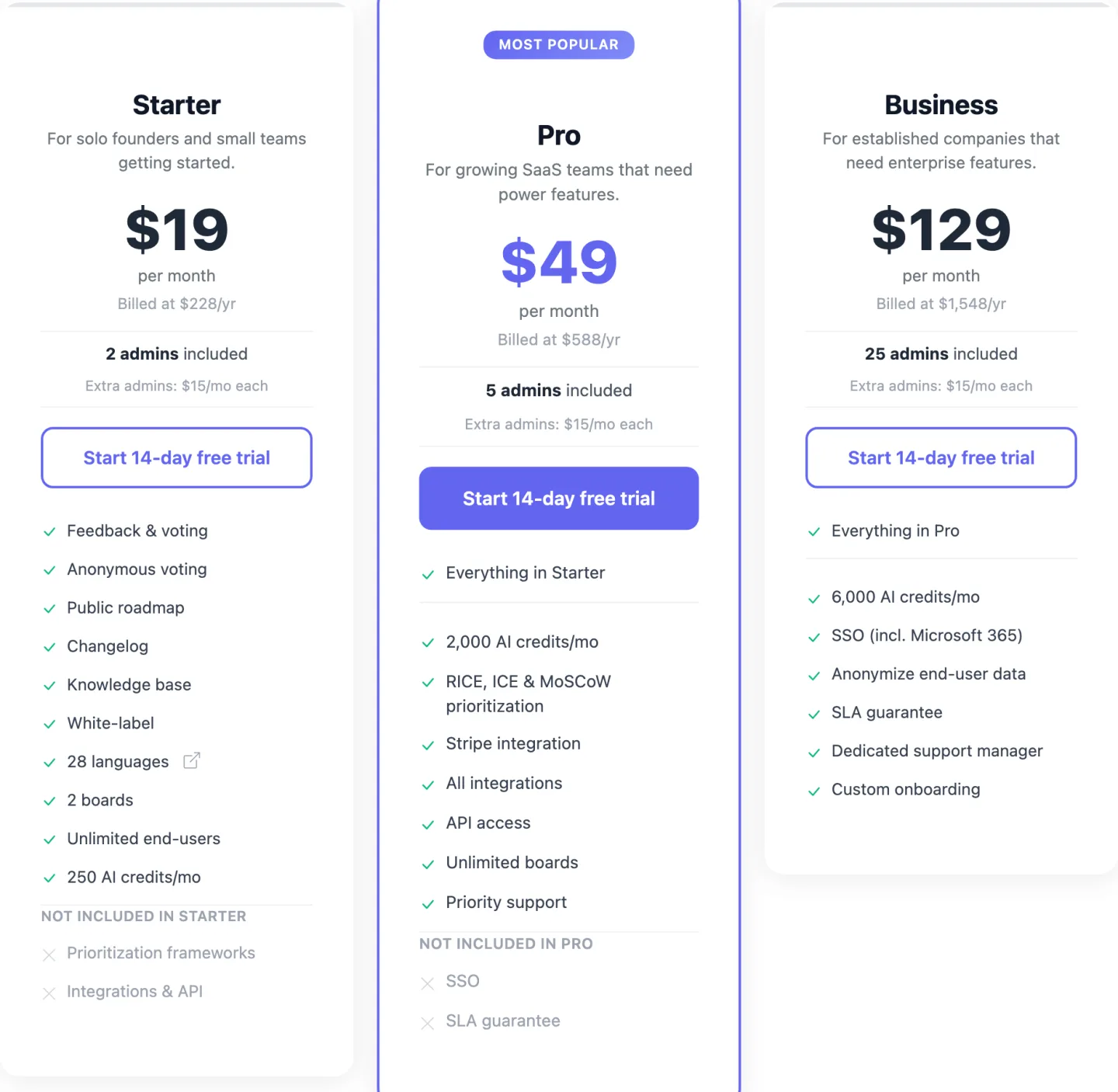
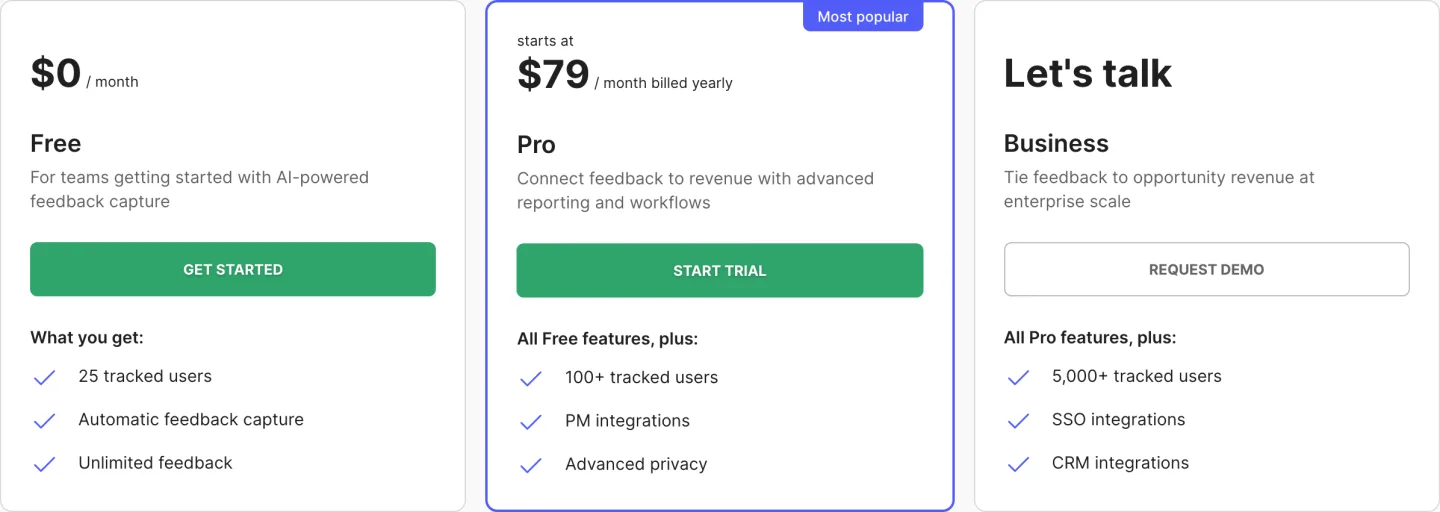
ProductLift's own ladder is built from a workspace with a fixed number of admins baked in. Starter holds two for nineteen dollars a month billed yearly, Pro holds five for forty nine, and Business holds twenty five for a hundred and twenty nine.
Every admin past the line on any of the three tiers costs fifteen dollars more, and that figure sits on their own pricing table rather than behind a sales call.
Canny counts a different person entirely. A tracked user is anybody with a post, a vote or a comment attributed to them, so a quiet team with a loud board pays exactly the same rate as a loud team with a quiet one. Free holds twenty five of those, then Pro starts at seventy nine.
How much does ProductLift cost compared to Canny?
Pick whichever number is likely to grow inside your own company, the roster of people who administer the board or the crowd that shows up to it, and the table below prices three shapes on the published rates alone.
| Your situation | ProductLift | Canny |
|---|---|---|
| 2 admins, 1 board, 40 customers vote | $19/mo billed yearly, on Starter, both admins included | $79/mo billed yearly, over the 25 tracked user line |
| 5 admins, 2 boards, 300 customers vote | $49/mo billed yearly, on Pro, all five admins included | Above $79/mo, at a rate their page does not print between the 100 and 1,000 tracked user steps |
| 9 admins, 1 board, 1,200 customers vote | $109/mo billed yearly, staying on Pro and paying $15 each for four admins past its five, cheaper than moving to Business at $129 | Above $529/mo, at a rate their page does not print between the 1,000 and 5,000 tracked user steps |
The bottom row is where ProductLift's own ladder rewards doing the arithmetic before upgrading. Jumping straight to Business buys twenty five admins for a hundred and twenty nine dollars, but four extra seats bolted onto Pro land at a hundred and nine, twenty dollars cheaper for the same nine admins.
Neither vendor prints a figure for every step of its own meter. ProductLift's admin fee is exact at fifteen dollars each.
Canny's tracked user rate has two long unlit stretches, between a hundred and a thousand and again between a thousand and five thousand. Their own page names the two ends and nothing in between.
If you would rather look at a board than read about billing, the demo is open without an account.
Which one should you choose?
They are built around two different worries, and the honest answer keeps both in view.
ProductLift's own Stripe connection is a genuinely serious piece of engineering, since a weight that updates itself the moment a customer's plan changes needs nobody to maintain it by hand. That mechanism is the strongest thing on their pricing page and it is not faint praise to say so.
Canny is a more finished public board than either ProductLift or us, and its layer that reads support and sales conversations for feedback nobody typed anywhere is a real capability neither of us has built.
Their free tier and their private boards on every plan, including Free, both hold up for a board that intends to stay small.
Why choose ProductLift over Canny, or Canny over ProductLift?
Because one of them prices the roster that runs the board and the other prices the crowd that visits it.
Choose ProductLift when your board will draw a lot of customers but your admin count stays small, because voters cost nothing at any size and the bill only rises when a new colleague needs a login.
Choose Canny when your team is larger than a couple of people but the board itself is likely to stay under twenty five voters for a long while, because Canny never charges for a colleague at all, and its free tier holds there at no cost.
One project is nine dollars a month. Unlimited projects is thirty nine.
Is there a cheaper alternative to both?
It depends on which roster in your business tends to grow, the people who run the board or the people who vote on it.
Against ProductLift's admin fee, a flat single price wins the moment a sixth colleague needs a seat. Against Canny's tracked user meter, a flat price wins the moment the board starts working.
Enter a voter count of your own and see what each meter would have charged for it, and the whole field sits on one page with the unit each vendor bills on. Nine dollars a month buys one project here, whichever roster would have hurt you.
What does each do with a vote from a big customer?
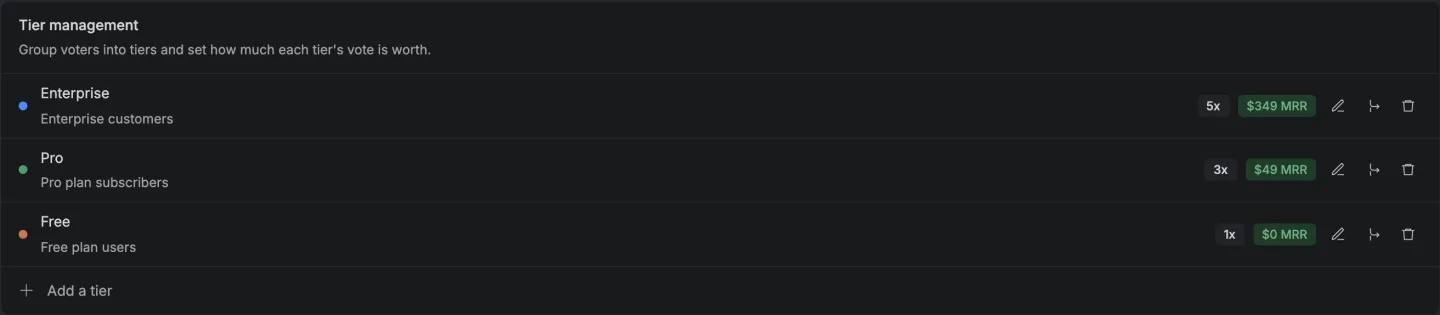
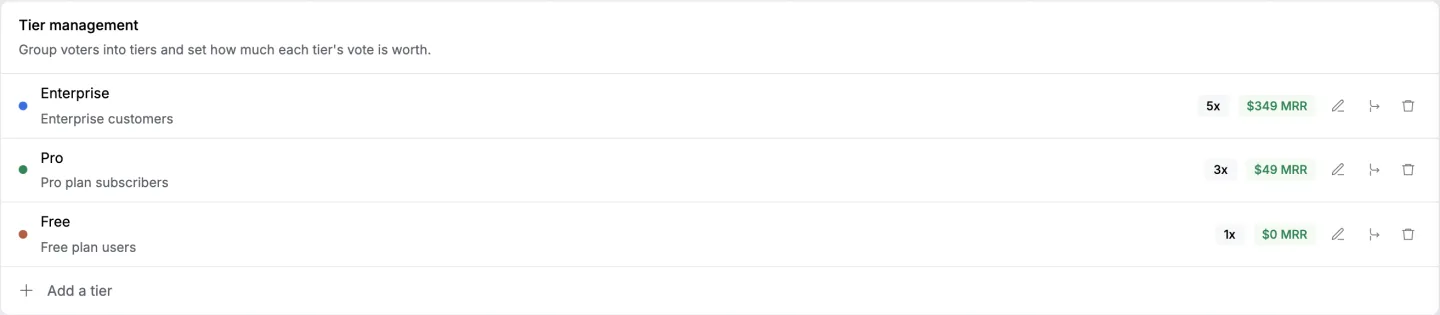
ProductLift multiplies the vote itself, on its forty nine dollar Pro plan. Canny sorts by revenue impact instead, counted once per company rather than per voter. This is the pair on this site where the answer is closest to our own.
| Vendor | Weighting by revenue | Boards on the entry plan | Single sign on |
|---|---|---|---|
| ProductLift | Yes, on Pro at $49/mo billed yearly, reading MRR and plan tier from Stripe | 2, on Starter | Business, including Microsoft 365 |
| Canny | Sorts by revenue impact, once per company rather than per voter | Unlimited, on every plan | Base features on every plan, integrations on Business |
| VoteFirst | All plans, an integer multiplier set by hand | 1, on Lite | Pro, a token from your own app |
Read on each vendor's own pricing page on 2026-09-15. A dash, where one appears elsewhere on this site, means nobody could read the answer on the pages opened that day, never that the capability is absent.
ProductLift's own product page describes the mechanism plainly, reading a customer's MRR and plan tier out of Stripe and writing that figure behind their vote. That is the same claim this product makes about its own weighting, and pretending otherwise on a page built to compare the two of them would be dishonest.
The difference between the two mechanisms is where the number comes from rather than whether one exists. ProductLift's figure is pulled from a live billing record and moves the moment a customer upgrades mid month.
Ours is a whole number a person chooses for a tier, written onto the vote at the moment it is cast, with the plain count still printed beside the weighted one.
Canny does neither. Its sort by MRR impact reorders a list by the revenue behind each request, and their own documentation counts a company's revenue once per post rather than once per voter, which keeps a large team from looking like a large amount of money.
Ordering a list is not the same operation as changing what a single vote is worth.
Can I move from one to the other?
ProductLift's own pages state that it exports to CSV. Canny's export is real and documented rather than left to a support ticket, and what the file actually contains once you open it is written up separately.
Neither vendor's own pages describe an importer built for the other's format specifically, so a move in either direction means rebuilding the request list and starting every vote count again from zero.
What tends not to survive a move between boards shaped this differently is which named person cast which vote, how comments threaded under a request, and the date each one actually happened.
Where we fit, and where we do not
Both ProductLift and Canny ship an AI feature, and we have none anywhere by design. ProductLift meters it as a monthly credit allowance, two hundred and fifty on Starter rising to six thousand on Business.
Canny's version reads support and sales conversations on its own and surfaces feedback nobody typed into the board directly. This product ships no AI features and none are planned.
Both of them also give you more than one board before a second project of ours is needed. ProductLift's Starter carries two, and Canny's boards are unlimited on every plan it sells, against our single project on Lite.
On the claim that actually matters for this pair, we are doing the same thing ProductLift does rather than something different from it. Weighting a vote by what its voter pays is a real mechanism on both sides, ours by a tier multiplier chosen by hand and theirs by a live Stripe figure.
It sits on our cheapest plan rather than one tier up.
What neither of them does at any price is put that weighted total on the nine dollar plan. ProductLift asks for its middle tier at forty nine. Canny does not weight the vote itself at all.
What is ProductLift, and what is Canny?
ProductLift is a feedback board with a roadmap, a changelog and a knowledge base, priced by workspace with a fixed number of admins built in and a fifteen dollar charge for every admin past that, on any of its three plans.
Canny is a feedback board with its own roadmap and changelog, and its invoice is calculated from the tracked users tied to the account, meaning every customer and every one of your own staff who posted, voted or commented.
Does either one have a free plan?
Canny does. ProductLift does not.
Canny's pricing page, read on 15 September 2026, holds twenty five tracked users at no cost, ending once twenty five customers have taken part rather than once a colleague signs in.
ProductLift's page, read the same day, states plainly that it offers only a free trial and not a permanent free plan. That trial runs fourteen days and asks for no card, and Starter at nineteen dollars billed yearly is the cheapest thing after it ends.
What this costs
Lite
$9 /mo
Pro
$39 /mo
Lifetime
$999 once
Fourteen day trial of Pro, card asked for at signup. Nothing here counts the people who vote, so the bill does not move when the board starts working. The long version, with what happens if you stop paying.
The honest summary
ProductLift charges for the roster that administers the board and gives every admin past its allowance a printed fifteen dollar rate. Canny charges for the crowd that shows up and stops printing a rate once that crowd gets large.
Of the two, ProductLift is the one whose weighting mechanism answers the same question ours does, just from a different source and one tier higher up its own ladder.
The ProductLift alternative page and the Canny one carry each side on its own.
14 days, a card at signup, then $9 or $39 a month.