Frill and Upvoty both show a flat monthly figure, and both figures stay flat for reasons that have nothing to do with each other. Frill's price moves once the ideas open on your board pass a printed line. Upvoty's price moves once you run a second project, and nothing else.
Everything below was read on each vendor's own pricing page, most of it on 14 September 2026 and the rest on 15 September 2026.
What does each one charge?
Twenty two dollars a month for Frill billed yearly, thirteen fifty for Upvoty billed yearly, and nine for us with no meter on either axis.
| Vendor | From | Billed per | Free plan | Trial |
|---|---|---|---|---|
| VoteFirst | $7.50/mo | plan | – | 14 days, card |
| Upvoty | $13.50/mo | project | – | 14 days |
| Frill | $22/mo | workspace | – | 14 days |
Read on each vendor's own pricing page on 2026-09-15.
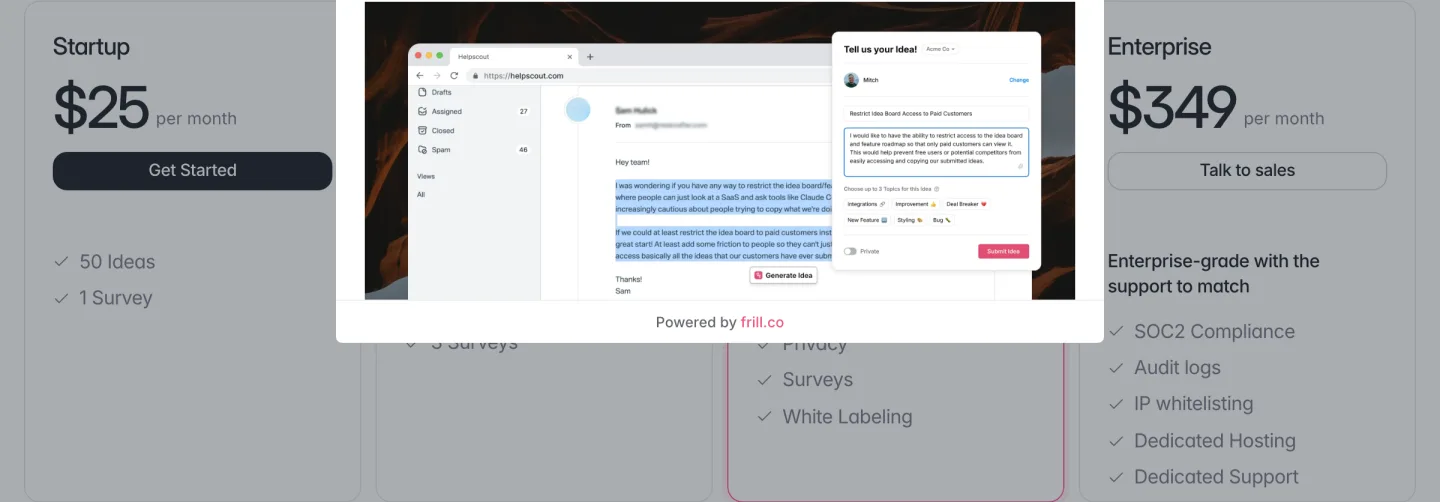
Frill's Startup plan is twenty five dollars a month billed monthly, or twenty two billed yearly, capped at fifty active ideas. Business removes that cap at forty nine or forty four.
Upvoty's Power plan is fifteen dollars a month billed monthly, or thirteen fifty billed yearly, for one project with unlimited boards and unlimited tracked users. Their annual toggle saves exactly ten percent on every plan.
How much does Frill cost compared to Upvoty?
The two meters sit on different axes, so the same company can be cheap on one and unaffected on the other.
| Your situation | Frill | Upvoty |
|---|---|---|
| One project, under fifty ideas open | $22/mo billed yearly, on Startup | $13.50/mo billed yearly, on Power |
| One project, more than fifty ideas open | $44/mo billed yearly, on Business once the cap is passed | $13.50/mo billed yearly, unchanged, because ideas are not metered |
| A second project | Not published. Frill's page prices one workspace and does not say what a second one costs | $44.10/mo billed yearly, on Hyper, which has no project limit |
Upvoty does not charge more as a backlog grows. Tracked users and boards are unlimited on all three of its plans, so the middle row above does not move at all.
Frill does not publish what running two products costs. Their pricing page is built around one workspace, and nothing on it states whether a second product needs a second subscription or something else.
If you would rather look at a board than read about billing, the demo is open without an account.
Which one should you choose?
They meter different things, and the honest answer says something real about each.
Frill's unlimited admins and unlimited tracked users on its cheapest paid plan are a genuine strength. A team of ten and a customer base in the thousands cost exactly the same twenty two dollars as a team of one with a quiet board.
Upvoty is the more disciplined billing model of the two. A busy backlog, a crowded board and a growing team all cost the same thirteen fifty, and the only thing that moves the bill is running a second project.
One project is nine dollars a month. Unlimited projects is thirty nine.
Why choose Frill over Upvoty, or Upvoty over Frill?
Because one of them worries about how long your idea list has grown, and the other worries about how many products you run.
Choose Frill when your team is large or growing, because colleagues cost nothing extra on any of its four plans and the only wall is the length of your open backlog.
Choose Upvoty when you run, or expect to run, more than one project, because tracked users and boards never meter you and the whole ladder is about project count rather than backlog length.
The price follows from your own shape. Neither vendor's pricing page tells you which shape you are.
Is there a cheaper alternative to both?
It depends on which axis is actually the risk for you.
Against Frill's fifty idea cap, anything unmetered on ideas is cheaper the moment your board gets busy. Against Upvoty's project count, anything that does not charge per project is cheaper the moment you launch a second one.
This site is nine dollars a month for one project with no cap on how many ideas the board holds, and the calculator prices the tools that do meter people, on a size you choose.
The full field with the unit each vendor bills on is one page.
What does each do with a vote from a big customer?
Frill weights the vote itself by customer revenue, in their own published words. Upvoty's own pages read on the day do not state a position either way.
Read on each vendor's own pages on the date in the row above. Not published means nobody could read it on the pages opened that day, never that the feature is absent.
Frill's own comparison table says plainly that it weights votes by customer revenue, which is the same operation this product is built around rather than a list sorted by money behind it.
We checked all thirty two vendors we track for this page. Eight of them describe something revenue related in their own words, and Frill is one of the few that uses the word weight rather than sort or filter. It is not the only one, and saying otherwise would be dishonest.
Can I move from one to the other?
Frill publishes a path in. Upvoty's own pages do not publish a path out.
Frill's pricing page lists bulk CSV import as well as export, and names a Canny importer directly, so moving a board into Frill has a stated route already. Upvoty's own pages read on the day do not state an export of any kind, which is an absence rather than proof it cannot be done.
What a Canny export actually contains is written up separately, from the file rather than from either vendor's documentation.
Where we fit, and where we do not
We are one board on one project at nine dollars a month, with no survey product and nothing that reads a support inbox.
Frill and Upvoty both publish custom single sign on, and both gate it behind a higher tier than their cheapest plan, Frill on every paid plan and Upvoty on Hyper. We have no version of that at any price.
The token based login on our thirty nine dollar plan signs a voter in from your own application, and it is not SAML.
Frill and Upvoty both publish webhooks too, Frill on every paid plan and Upvoty on Hyper. We do not have webhooks anywhere in the product.
What we do that neither of them does, on every plan including the nine dollar one, is put a whole number multiplier on a customer tier and write that weight onto the vote the moment it is cast, with the plain count still shown beside it.
What is Frill, and what is Upvoty?
Frill is a feedback board with a roadmap, a changelog and a survey product, billed per workspace by the number of ideas open on the board rather than by who reads it.
Upvoty is a feedback board with a public roadmap and a changelog, billed per project at a flat rate, with tracked users and boards unlimited on every plan.
Does either one have a free plan?
Neither does, and neither trial asks for a card.
Frill's pricing page carries a fourteen day trial and no free tier under it. Upvoty's pricing page carries the same fourteen day trial and no free tier either. Ours is fourteen days of Pro, and ours is the one that asks for a card at signup.
What this costs
Lite
$9 /mo
Pro
$39 /mo
Lifetime
$999 once
Fourteen day trial of Pro, card asked for at signup. Nothing here counts the people who vote, so the bill does not move when the board starts working. The long version, with what happens if you stop paying.
The honest summary
Frill charges for the length of your own idea list and leaves your team and your customers off the bill. Upvoty charges for the number of projects you run and leaves your backlog, your team and your customers off the bill.
Frill for a team that is growing faster than its backlog. Upvoty for one project that will likely stay one project. Ours if you want the vote itself, not just the count, to carry what the voter pays.
The Frill alternative page and the Upvoty one carry each side on its own.
14 days, a card at signup, then $9 or $39 a month.