FeedBear and Frill both sell a board, a roadmap and a changelog, and the number that moves each bill is not the same number. FeedBear's price rises when a second colleague or a second board joins. Frill's price rises once your own list of open ideas passes a printed line.
Both prices below came straight from each vendor's own pricing page, opened on 15 September 2026.
What does each one charge?
Nineteen dollars a month for FeedBear, twenty five for Frill, and nine for us, and the three figures answer to three different triggers.
| Vendor | From | Billed per | Free plan | Trial |
|---|---|---|---|---|
| VoteFirst | $7.50/mo | plan | – | 14 days, card |
| FeedBear | $15/mo | project | – | 14 days |
| Frill | $22/mo | workspace | – | 14 days |
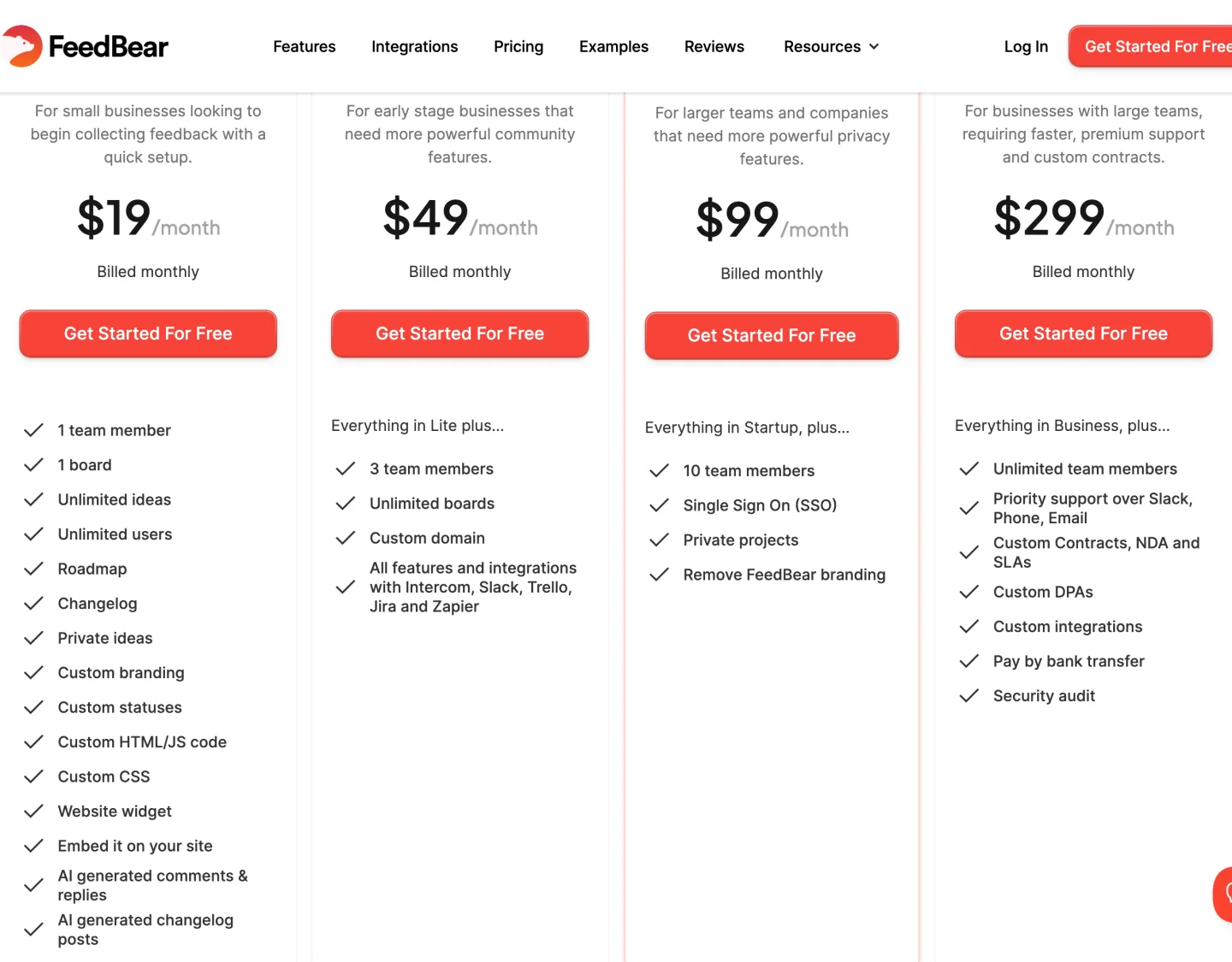
Lite, FeedBear's cheapest plan at nineteen dollars, covers exactly one colleague and exactly one board. Bring in a second of either and the bill jumps straight to Startup, at forty nine.
Frill's cheapest plan, Startup, holds at fifty open ideas for twenty five dollars a month, or twenty two paid yearly, with no printed cap on how many colleagues share the login.
So a company that hires does not move Frill's bill at all, and a company whose board fills up does not move FeedBear's bill at all. Each one is blind to the exact thing the other one meters.
How much does FeedBear cost compared to Frill?
The shape of your own company decides which meter you hit, and here is the arithmetic worked at three of them.
| Your situation | FeedBear | Frill |
|---|---|---|
| Solo founder, 1 board, 35 open ideas | Lite fits, $19/mo or $15/mo yearly | Startup, under the 50 idea cap, $25/mo or $22/mo yearly |
| 4 people, 1 board, 55 open ideas | Team of 4 passes Lite and Startup's cap of 3, needs Business, $99/mo or $82/mo yearly | Business, past the 50 idea cap, $49/mo or $44/mo yearly |
| 9 people, 2 boards, 20 open ideas | Business, for a ninth colleague on two boards, $99/mo or $82/mo yearly | Startup, ideas stay under the cap, $25/mo or $22/mo yearly |
The middle row is the one worth sitting with. A team of four with a busy board pays FeedBear ninety nine dollars for the colleague count alone, while the same board costs Frill forty nine for the ideas alone.
Swap that for a bigger, quieter team and the ranking flips. Nine people on a calm board cost FeedBear ninety nine dollars for the headcount, and cost Frill twenty five, because Frill never counts the people logging in.
Neither vendor prints a rate past Enterprise, so the arithmetic above stops where their own pages stop.
Which one should you choose?
They are built for opposite kinds of growth, and each one earns a genuine compliment here.
Frill never charges you for a second colleague or a tenth one, on any of its four plans. Unlimited admins and unlimited widgets sit on the twenty two dollar tier, which is rare in this category and worth taking seriously if your team is the part that keeps growing.
FeedBear is the more complete product at its own entry price. Lite already carries the roadmap, the changelog, private ideas, custom branding, a website widget and custom CSS, all included at the one tier rather than saved for later. The thing missing from Lite is room for a second colleague or a second board.
Why choose FeedBear over Frill, or Frill over FeedBear?
Because one of them prices who is on your side of the board and the other prices what is sitting open on it.
Choose FeedBear when your team will stay small and you want the fuller feature list for nineteen dollars, because almost nothing on Lite is missing except room for a colleague.
Choose Frill when your team is going to grow or already has, because the entry plan carries any number of admins and the only wall is your own idea count getting long.
Nothing here counts the people who vote, so a busy board costs the same.
Is there a cheaper alternative to both?
Yes, and the right one depends on whether your company grows in people or in requests.
Past FeedBear's one person, one board ceiling, anything that does not charge per colleague wins from the next hire onward. Past Frill's fifty idea line, anything that does not cap the backlog wins the moment the board fills up. The calculator works either question out at a size you choose.
This product is nine dollars a month for one project, priced once and named once. The full field, with the unit each vendor bills on, is one page.
What does each do with a vote from a big customer?
Frill's own comparison table names a Priority Matrix, scoring benefit against cost rather than the money behind a request. FeedBear's own pages, read on 15 September 2026, do not mention vote weight, revenue or customer tiers at all.
| Vendor | Weighting by revenue | Single sign on | API |
|---|---|---|---|
| FeedBear | – | Business | No documented REST API |
| Frill | – | Every paid tier | Every paid tier |
| VoteFirst | All plans | Pro, no SAML | Pro |
An empty cell means nobody could read the answer on the pages opened that day, never that the capability is missing from the software.
Frill's Priority Matrix orders a backlog by what a feature is worth to build, which is a legitimate frame and a different question from whose money is asking for it. FeedBear's pages are simply silent on the point.
Can I move from one to the other?
Only one of the two says much about it.
Frill's own comparison table ticks bulk CSV import as well as export on every paid tier, and names a Canny importer directly among what it reads in.
FeedBear's pages we read carry no line about an export or an import path for requests and votes, which we read as silence rather than a wall against it.
Whichever you leave, who cast each vote rather than the total, the comment threads underneath a request, and the original timestamps rarely survive a move between any two boards in this category.
Where we fit, and where we do not
We are one board on one project on the nine dollar plan, with no drafting assistant and no survey product anywhere in it.
Both FeedBear and Frill sell single sign on, FeedBear on Business at ninety nine and Frill on every one of its four paid tiers starting at twenty five. Our thirty nine dollar plan signs a voter in with a token from your own application, and it is not SAML.
Both also carry a feature we would call an AI feature. FeedBear's Lite plan writes generated comments, generated replies and generated changelog posts. Frill's own comparison table lists smart merge, which reads and groups similar ideas for you. We ship neither, on either plan, and none of it is planned.
What we do differently is attach an integer to a customer tier and let that number rewrite the vote itself the moment it lands, live from the nine dollar plan up. On the pages we read, neither FeedBear nor Frill does that to the vote.
What is FeedBear, and what is Frill?
FeedBear is a board, a roadmap and a changelog sold as one product. What decides the plan is how many colleagues log in and how many separate boards you run.
Frill is the same shape of product plus a survey tool, billed per workspace, with active ideas as the one number that decides which plan you need.
Does either one have a free plan?
Neither does. FeedBear's pricing page carries a fourteen day trial that its own page says asks for no card, and Lite at nineteen dollars is the cheapest thing you can keep.
Frill's pricing page carries the same fourteen days with the same no card banner, and Startup at twenty five is the cheapest thing under it.
What this costs
Lite
$9 /mo
Pro
$39 /mo
Lifetime
$999 once
Fourteen day trial of Pro, card asked for at signup. Nothing here counts the people who vote, so the bill does not move when the board starts working. The long version, with what happens if you stop paying.
The honest summary
Two meters aimed at different parts of your company. FeedBear stays cheap while your board is busy and gets expensive the moment your team grows past one person or one board. Frill stays cheap while your team grows and gets expensive once your own backlog passes fifty open ideas.
A solo founder with one busy board pays FeedBear less than Frill's Business tier. A small team that already has several colleagues pays Frill less than FeedBear's Startup tier. Ours costs nine dollars flat and does not move with either number.
The FeedBear alternative page and the Frill one each carry their own side of this further than one page can.
14 days, a card at signup, then $9 or $39 a month.