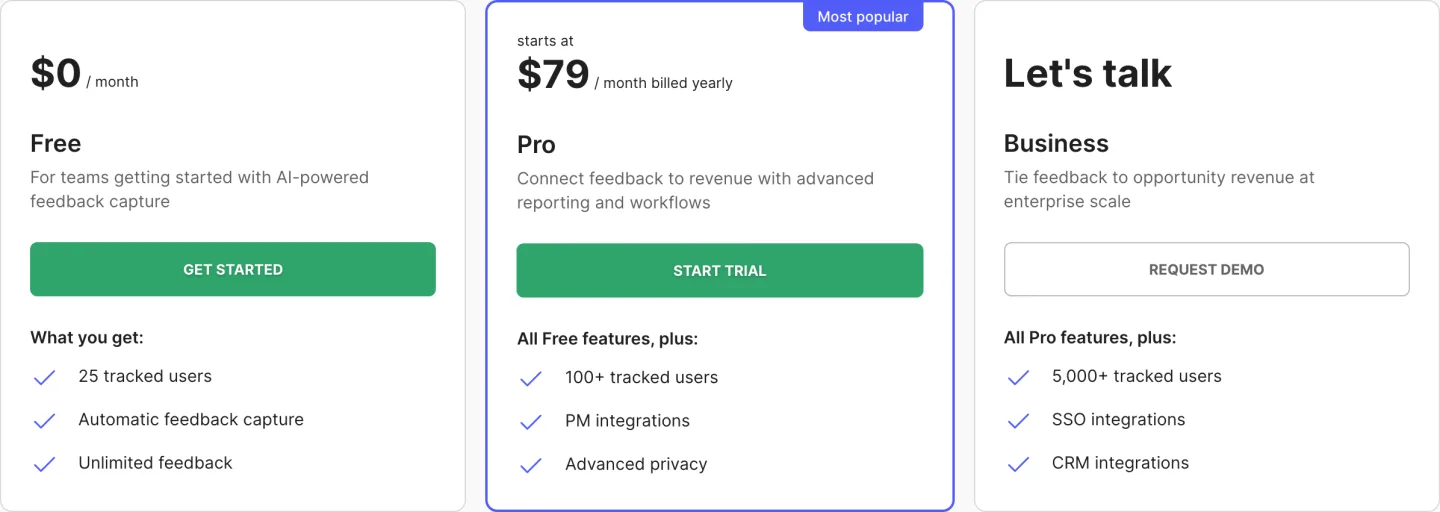
Features.Vote's own pricing page states plainly that its bill never scales with votes, voters or tracked users. Canny's bill is built entirely on that one number. Everything below was read on each vendor's own pages on 15 September 2026.
What does each one charge?
Nine dollars a month for Features.Vote's entry plan, seventy nine for Canny's, and nine here, and only one of the three climbs with how many people show up.
| Vendor | From | Billed per | Free plan | Trial |
|---|---|---|---|---|
| VoteFirst | $7.50/mo | plan | – | 14 days, card |
| Features.Vote | $9/mo | project | – | 14 days |
| Canny | $79/mo | tracked user | 25 users | – |
Read on each vendor's own pricing page on 2026-09-15.
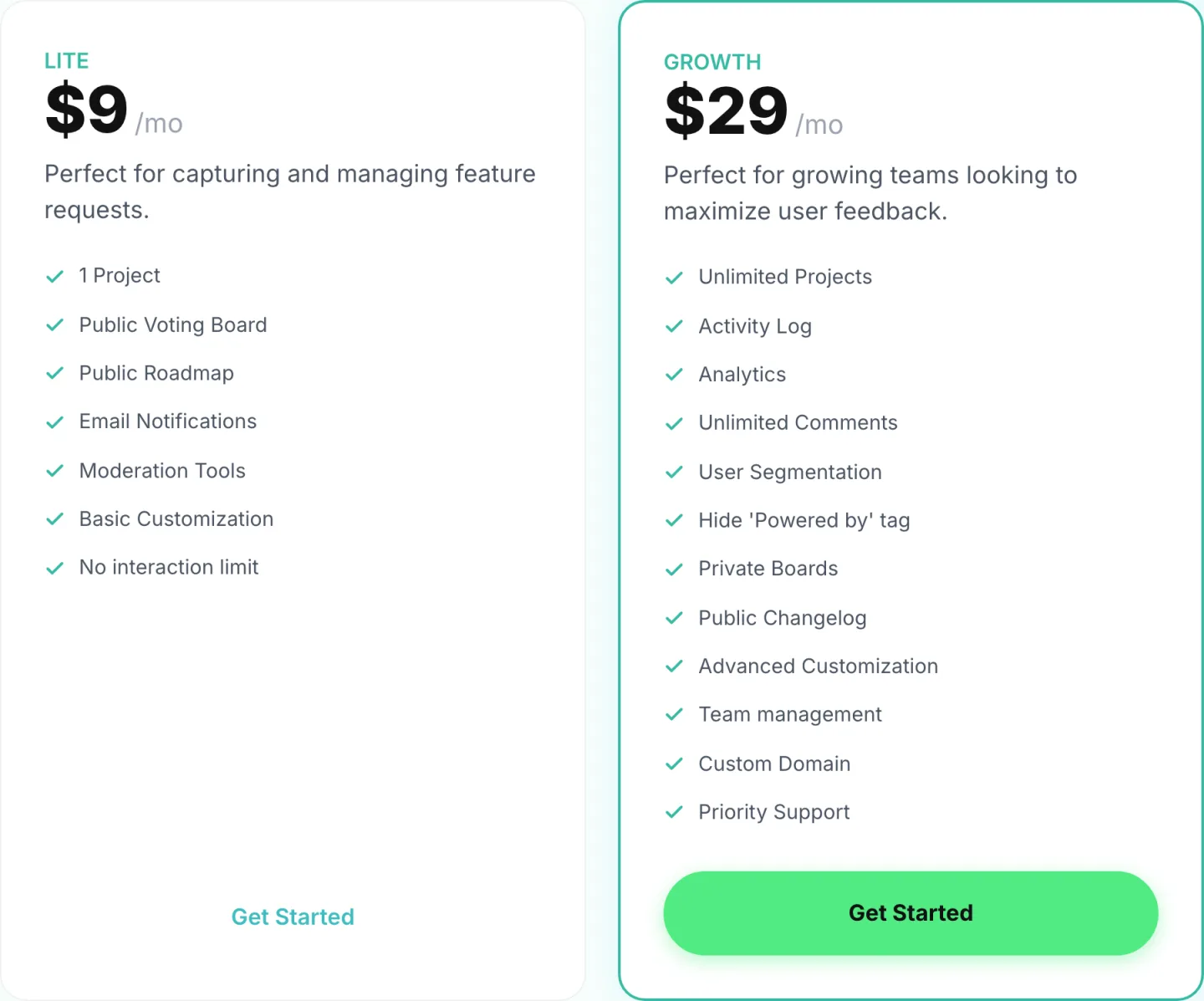
Features.Vote's own words for its unit are the clearest in this whole comparison. Lite is nine dollars for one project, Growth is twenty nine for unlimited projects, and neither number moves for a person who votes.
Canny's meter is any user with a post, a vote or a comment attributed to them, your own admins included. Free covers twenty five of those, then Pro starts at seventy nine.
How much does Features.Vote cost compared to Canny?
Pick whichever number in your own business is likely to move, projects or voters, and the table below prices three shapes on the published rates alone.
| Your situation | Features.Vote | Canny |
|---|---|---|
| 1 project, 12 customers vote | $9/mo on Lite | Free, under the 25 tracked user line |
| 1 project, 1,000 customers vote | $9/mo on Lite, unchanged | $529/mo billed yearly, at the 1,000 tracked user step |
| 5 projects, 40 customers vote | $29/mo on Growth, for the projects past the first | $79/mo billed yearly, over the 25 tracked user line |
Row two is the one worth sitting with. Going from twelve voters to a thousand costs Features.Vote nothing extra. The same jump costs Canny five hundred dollars a month more.
Canny prints no figure between its hundred tracked user step and its thousand tracked user step, or past five thousand. Their page names $79, $529 and $1,079 and leaves every increment between them blank.
Which one should you choose?
They bill on opposite units, and the honest answer keeps both in view.
Features.Vote is the better answer for a small number of busy boards. Voters are unlimited on both its plans, so a board that gets popular costs exactly what it cost on day one.
Canny is genuinely the more finished public board, and its automated discovery, which pulls unwritten feedback straight out of support and sales conversations, is a real capability that neither Features.Vote nor we have. Its free tier and its private boards on every plan, including Free, are both real for a board that will stay small.
Why choose Features.Vote over Canny, or Canny over Features.Vote?
Because one of them prices your product count and the other prices your crowd.
Choose Features.Vote when you expect a busy board and only one or two products, because voters are free forever and the bill only rises when you add a second project or want a custom domain.
Choose Canny when your board will likely stay under twenty five voters for a long time, because its free tier holds there at no cost and its feature set is deeper than Features.Vote's at every price point above zero.
Is there a cheaper alternative to both?
It depends on which number in your own business tends to grow.
Against Canny's meter, a flat rate wins as soon as the board is busy. Against Features.Vote's project count it is a closer call, since a flat rate that also ignores headcount is not obviously ahead of another flat rate that ignores headcount too.
Enter your own voter count and see what each meter charges for it, and every vendor in the field sits on one page with the unit it bills on. Nine dollars a month buys one project here, for comparison.
Nothing here counts the people who vote, so a busy board costs the same.
What does each do with a vote from a big customer?
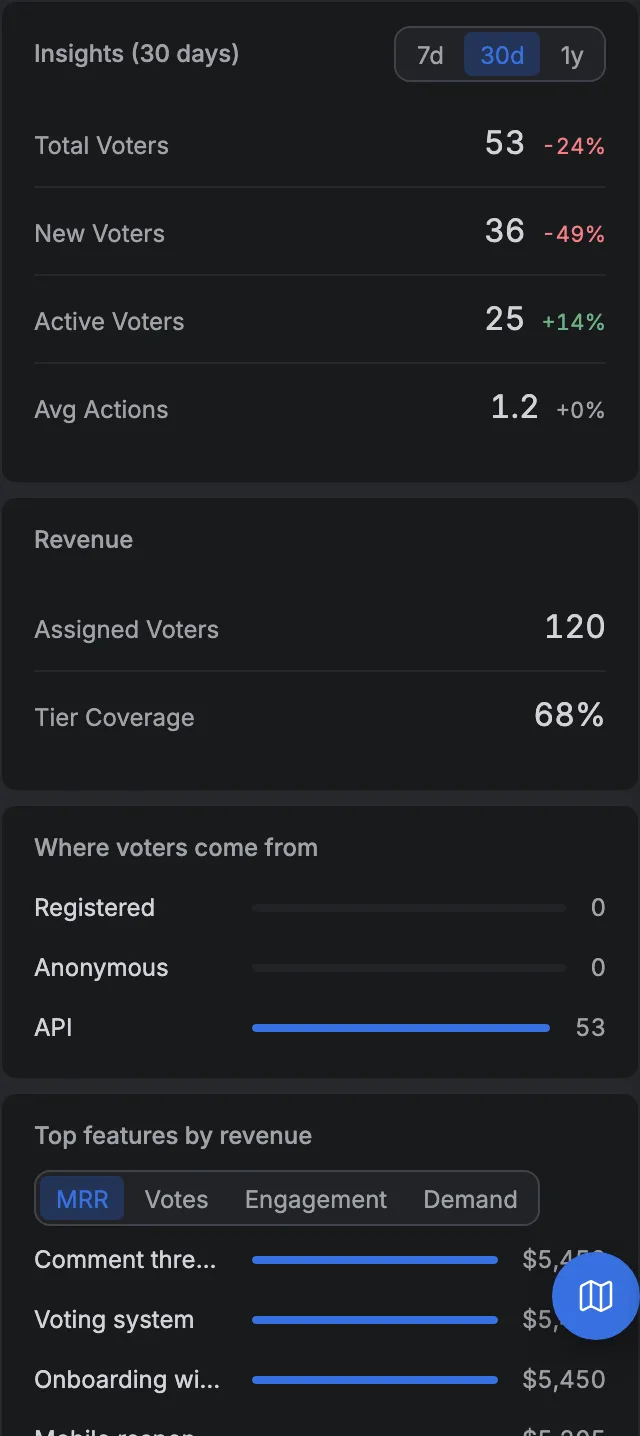
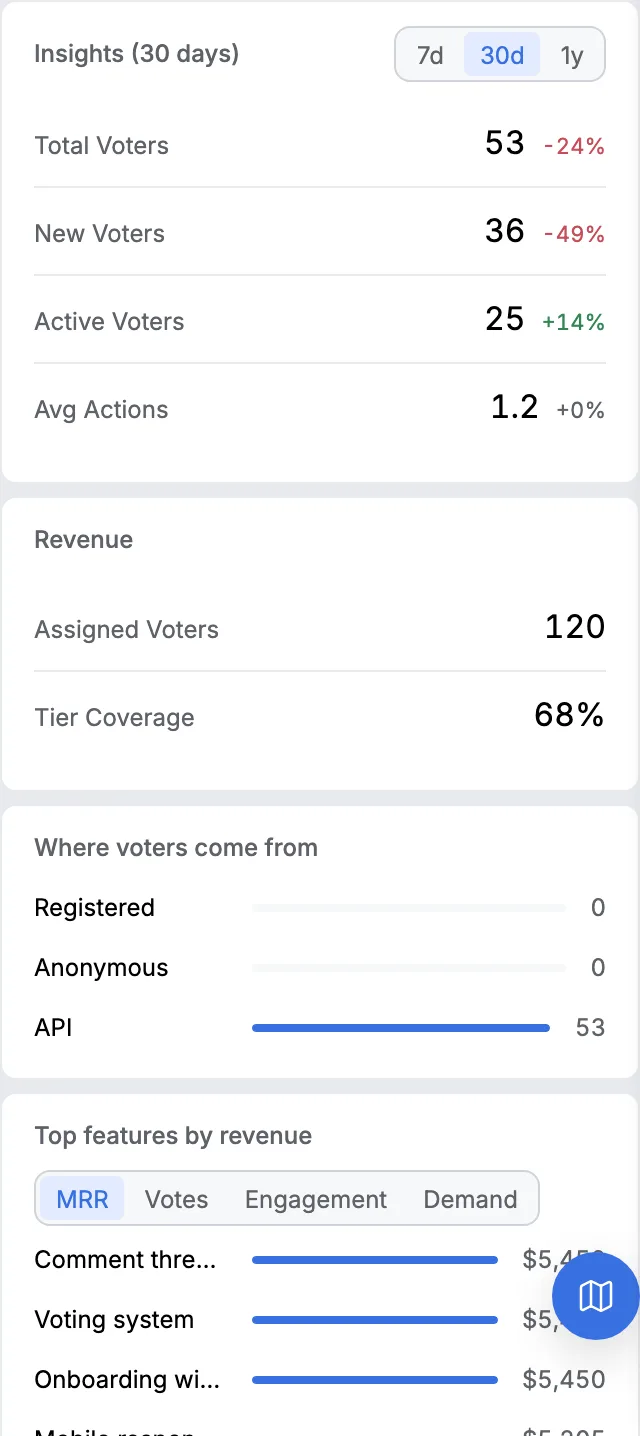
Canny orders a list by the revenue tied to it. Features.Vote's pages read on 14 September 2026 say nothing about vote weight, MRR or a customer tier at all.
| Vendor | Weighting by revenue | Anonymous voting | Custom domain |
|---|---|---|---|
| Features.Vote | – | Yes, no signup or email at all | Growth |
| Canny | Sorts by revenue impact | No, a name and an email are required | Yes |
| VoteFirst | All plans | Yes, an anonymous cookie on first load | Pro |
Read on each vendor's own pages on 2026-09-15. A dash means nobody could read it on the pages opened that day, never that the capability is absent.
Features.Vote's Growth plan sells user segmentation, which filters who you are looking at rather than changing what a single vote counts for. Ordering a list and filtering one are both different operations from multiplying the weight of the vote itself, which is what our own mechanism does instead.
Can I move from one to the other?
Canny writes its export down in documentation rather than leaving it to a support ticket. We opened the file itself and went through what it contains. Nothing we read on features.vote names what a Features.Vote export holds, so that claim stays out rather than being filled in with a guess.
A move between boards shaped this differently tends to lose the same things regardless of direction: which named person cast which vote, how comments threaded under a request, and the date each one actually happened.
Where we fit, and where we do not
Set beside the rest of this field, Features.Vote is the one whose bill looks most like ours. A flat monthly number, nothing that climbs with a vote or a voter, a wall built from project count instead, and a click that needs no account.
Anyone here purely to compare billing mechanics is looking at two answers that already agree.
Features.Vote and Canny both sell a private board, and that option does not exist here at any price. Features.Vote puts it on the twenty nine dollar Growth plan. Canny puts it on every plan it sells, Free included. Ours is open to the world or closed to everyone, with no password screen and no guest list in between.
Both of them also give you a way to slice the voter list by who a person is, and we give you none. Features.Vote sells that as user segmentation on Growth. Canny's own writing ties its login requirement to the segments and the revenue detail that requirement buys it. There is no filter here beyond the tier multiplier itself.
Features.Vote adds a third thing worth naming: a ninety nine dollar one time setup, for a buyer who would rather pay somebody else to install the board. Nothing equivalent is sold here.
What is on offer instead is narrower and specific. A whole number sits on each pricing tier, that number gets multiplied into the vote the moment somebody casts it, and the raw count stays printed next to the weighted one so nobody has to take our word for the math.
What is Features.Vote, and what is Canny?
Features.Vote is a voting board with a public roadmap and a changelog, built for a project count rather than a crowd, and it ships a native SwiftUI SDK for an iOS or macOS app alongside the web version.
Canny is a public feedback board with its own roadmap and changelog, and its invoice is calculated from the tracked users, meaning every customer and every one of your own staff who posted, voted or commented.
Does either one have a free plan?
Canny does. Features.Vote does not.
Canny's own pricing page, checked on 15 September 2026, holds twenty five tracked users at no cost, and that ceiling arrives once twenty five customers have taken part, not once a colleague signs in.
Features.Vote skips a free tier entirely. Its page offers a fourteen day trial with no card requested, then the nine dollar Lite plan is the least you can pay to keep the board running.
What this costs
Lite
$9 /mo
Pro
$39 /mo
Lifetime
$999 once
Fourteen day trial of Pro, card asked for at signup. Nothing here counts the people who vote, so the bill does not move when the board starts working. The long version, with what happens if you stop paying.
The honest summary
One bill tracks how many projects exist and ignores how loud any of them get. The other tracks the crowd and eventually stops printing a figure for it. A single loud board is cheaper on Features.Vote. A quiet board under twenty five voters costs nothing on Canny.
Of the two, Features.Vote is the one whose billing shape actually matches ours, flat and unconcerned with vote count. Neither of them multiplies what a vote is worth by who cast it, which nine flat dollars here does on every plan.
The Canny side of this is written up on its own, and so is the Features.Vote one.
14 days, a card at signup, then $9 or $39 a month.