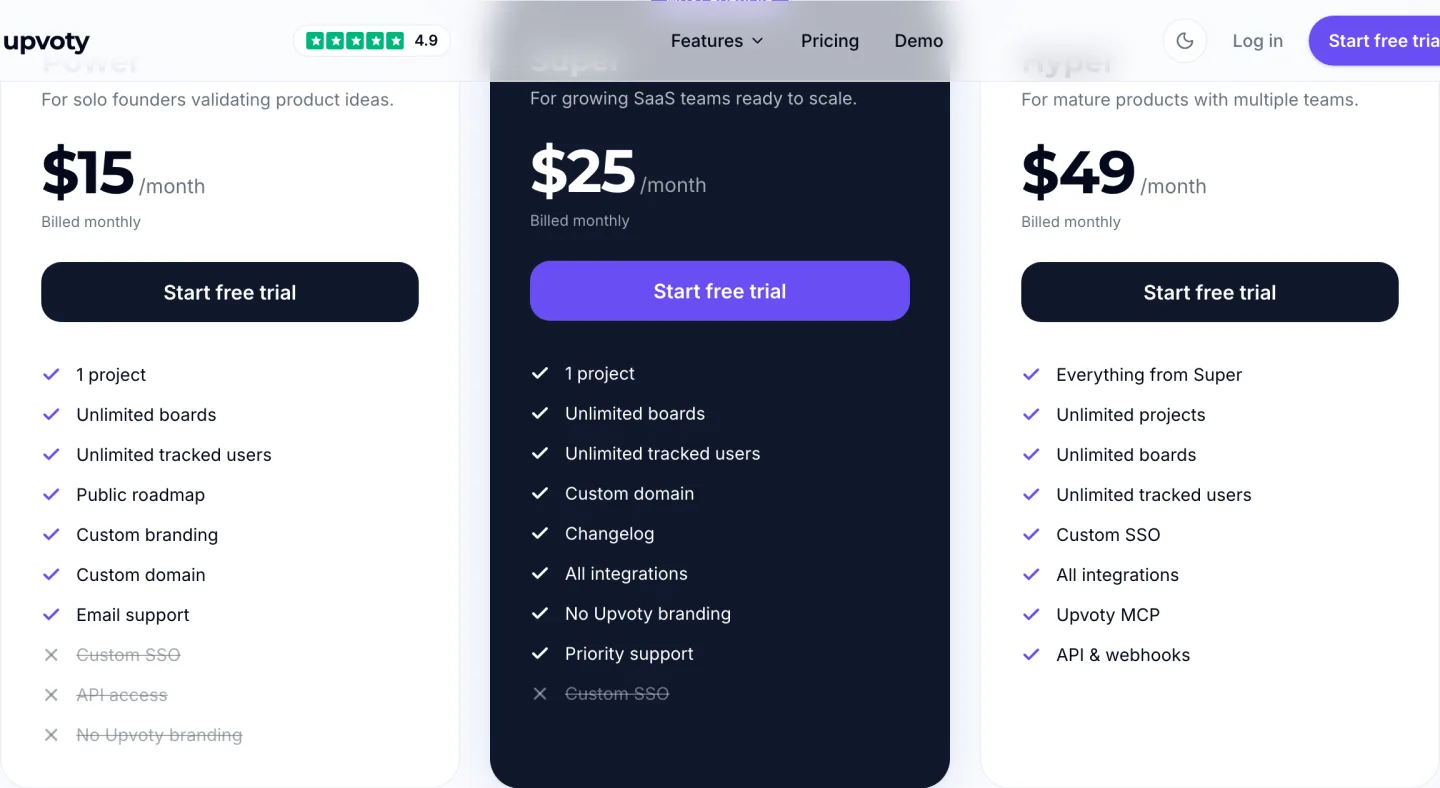
VoteFirst is $9/mo for one project, with revenue weighted voting on every plan. Upvoty is the closest rival on price: $15 a month, or $13.50 billed yearly, for one project with unlimited boards and unlimited tracked users, on its Power plan (upvoty.com/pricing, read 2 October 2026). Neither bills by how many people show up to vote. The difference is what happens after that, and what a second project costs.
What a board costs, at justRead's size and at any size
justRead, a reading app built by VoteFirst's own makers, runs its public roadmap on VoteFirst at a real address. On 2 October 2026 its board held 131 cards and 874 votes, from 252 people measured as having voted on 16 September. None of that changes what either product would charge, because neither meters tracked users. justRead's board costs VoteFirst's $9/mo at that size, and it would cost Upvoty's flat $15 a month, or $13.50 billed yearly, for the same reason, on Upvoty's Power plan. A board ten times that size would cost the same on both. A board on Canny is priced by its tracked users, and the board audit reads a Canny or Featurebase board by its address and prices it.
What each project costs, at one and at more than one
| Projects | VoteFirst | Upvoty |
|---|---|---|
| 1 | $9/mo (LITE) | $15/mo, $13.50 billed yearly (Power) |
| 2 or more | $39/mo (PRO) | $49/mo, $44.10 billed yearly (Hyper) |
Upvoty's middle plan, Super at $25 a month, still caps at one project. It adds a changelog, integrations and the removal of Upvoty's branding. API access and webhooks wait for Hyper. The wall both products put up sits in the same place, between a single project plan and an unlimited one, except VoteFirst's unlimited plan starts ten dollars a month cheaper than Upvoty's.
The comparison table
Dates in the row above are the days those pages were opened. Where a cell says not published, nobody could read the answer that day, which is a fact about the page and not about the software.
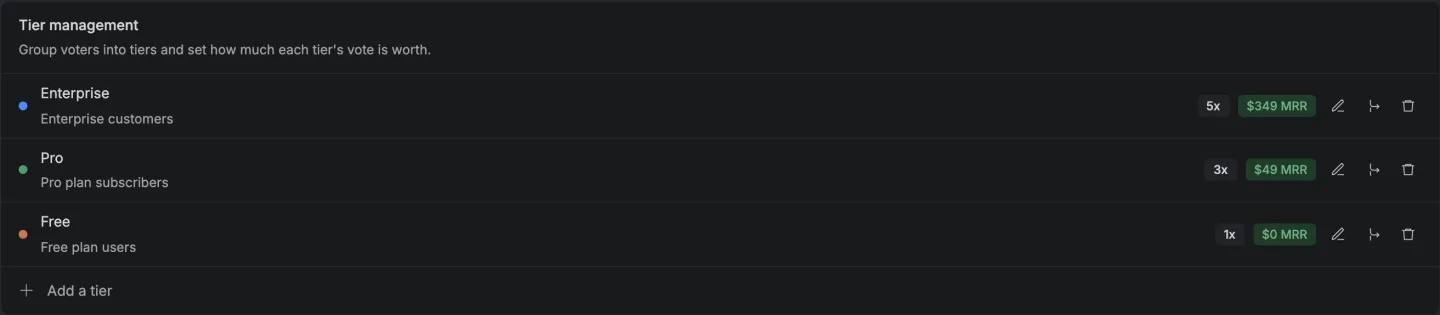
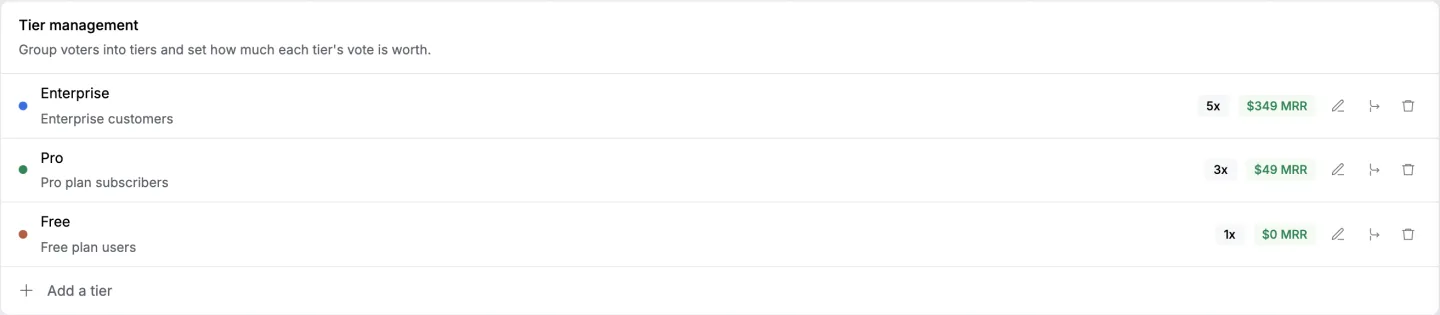
Upvoty's pricing page, read on 2 October 2026, and its product pages, read on 14 September 2026, do not use the words vote weight, MRR or customer tier anywhere. A vote from a company's largest account and a vote from someone who signed up an hour ago move its counter by the same amount. VoteFirst puts every voter on a tier with a whole number multiplier, on every plan including the $9 one.
What VoteFirst does not do
- No SAML or OIDC. Single sign on is a signed JWT handoff only, on PRO.
- No Slack, Zapier or outgoing webhooks.
- No AI clustering, summarization or automated conversation analysis.
- No Android or Kotlin SDK.
- No private boards on any plan. A board is public to everyone or to nobody.
- Custom domain serves three paths only, the public roadmap, the public voting board and one named board, not the changelog or the most wanted list.
- No free plan. A 14 day trial, card required at signup.
Where Upvoty is still the better tool
- A custom domain from its $15 entry plan, Power. VoteFirst's custom domain needs PRO, $39.
- A 14 day trial that asks for no card, against VoteFirst's trial, which asks for one.
- SAML single sign on, on its Enterprise plan, which is priced by email. VoteFirst has no SAML on any plan.
- Webhooks and an MCP server, on Hyper at $49. VoteFirst has neither.
If a card free trial or a custom domain on the cheap plan matters more than the headline price, Upvoty is the better answer.
Switching from Upvoty
Upvoty is not an import source. There is no button that reads an Upvoty board the way Settings reads a Canny or Featurebase one, so a board already on Upvoty moves by hand: requests are retyped or pushed through the API, and every vote count restarts at zero. What does come across is the customer list and the revenue behind it, by CSV or a billing connection, because that is what the weighting reads. The five steps, and the endpoint each one calls, are written out in full; leaving Upvoty uses the same five.


Is VoteFirst cheaper than Upvoty?
For one project, yes. $9 against $15 a month, or $13.50 billed yearly. At two or more projects it is $39/mo against Upvoty's $49 Hyper plan, the only one of its three with more than one project. The API follows the same line, on PRO at $39 against Hyper at $49.
Does Upvoty weight votes by revenue?
Not that its own pages publish. Every vote on an Upvoty board counts as one. VoteFirst puts every voter on a tier with an integer multiplier, on every plan including the $9 one.
Can I bring my Upvoty board over?
Not with a button. Requests move by retyping them or pushing them through the API, and votes restart at zero. The customer list and the revenue behind it come in by CSV or a billing connection.
Does Upvoty have a free plan?
No. Its pricing page, read on 2 October 2026, carries a 14 day trial that asks for no card, and $15 a month is the cheapest plan it keeps.
Which is cheaper for three projects?
Upvoty's Hyper plan at three projects is still $49 a month, or $44.10 billed yearly, because Hyper covers unlimited projects. VoteFirst's PRO plan is $39 a month regardless of how many projects it covers.
Related comparisons
Every Upvoty alternative with a published price is on one page, and the full pricing ladder, with the lines a cheaper plan crosses out, is on Upvoty's pricing page. Canny and Upvoty bill on opposite meters, and Upvoty and Feature Upvote bill on opposite units too. VoteFirst is also set against Canny, Feature Upvote and Fider.
14 days, a card at signup, then $9 or $39 a month.