The first thing to know about Hellonext against Canny is the name. Hellonext and FeatureOS are the same product, the same company and the same sitemap, and searching for the old name is how most people still arrive. Their pricing lives at featureos.com and everything below was read there on 14 September 2026.
The second thing is stranger. We fetched 148 comparison pages from featureos.com and not one of them names FeatureOS. They compare Ada to Canny, Aha to Canny and AnnounceKit to Canny, at a median of 538 words each.
The comparison a person actually types, their own product against the market leader, is the one page the vendor with 148 of them did not write.
What does each one charge?
Seventy nine dollars a month, sixty, and nine, and the three figures meter three different things.
| Vendor | From | Billed per | Free plan | Trial |
|---|---|---|---|---|
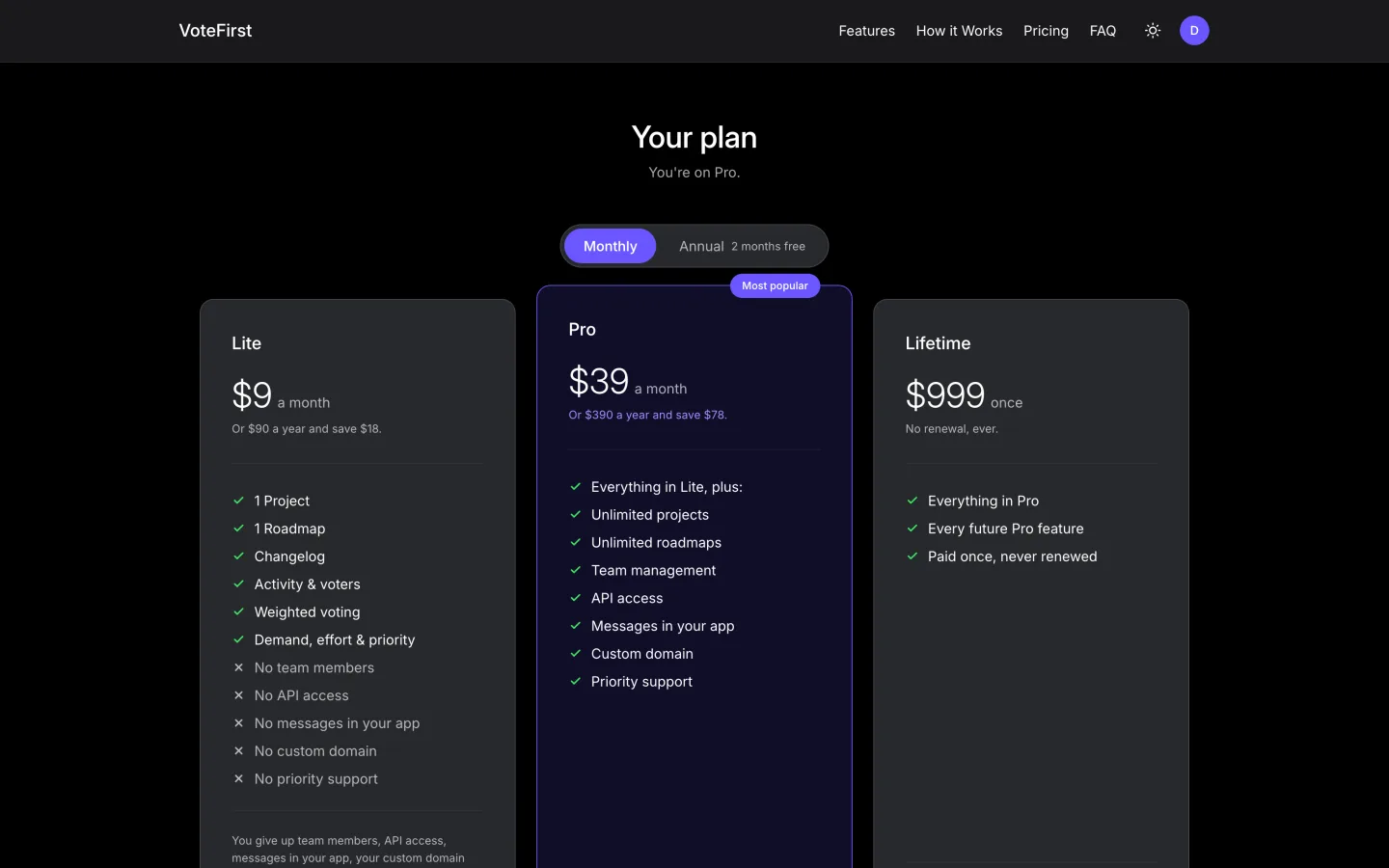
| VoteFirst | $9/mo | plan | – | 14 days, card |
| FeatureOS | $60/mo | plan | – | 30 days |
| Canny | $79/mo | tracked user | 25 users | – |
Read on each vendor's own pricing page on 2026-09-14.
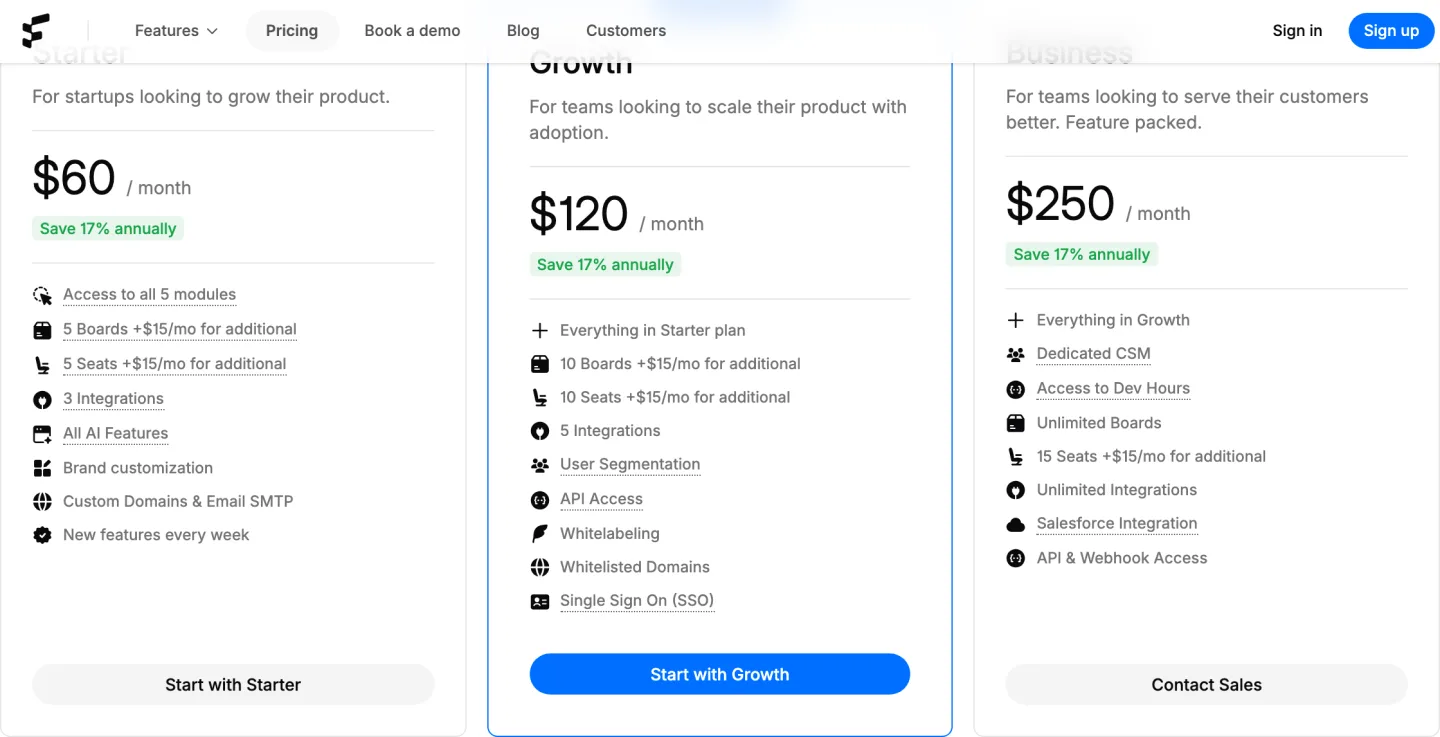
FeatureOS meters two things at once, and this is the part their own page states plainly and nobody repeats. Starter is sixty dollars for five boards and five seats. A sixth board is fifteen.
A sixth teammate is fifteen. Both counters run against the same plan, so a team of eight running three products pays sixty plus forty five, which is a hundred and five, before anybody has looked at a feature list.
Canny's counter runs the other way. Your colleagues are free and your customers are the meter, and Canny's own definition of a tracked user is any user associated with feedback.
If you would rather look at a board than read about billing, the demo is open without an account.
Which meter costs you more?
The one that matches the shape you already are.
| Your situation | Canny | FeatureOS |
|---|---|---|
| 4 people, 1 product, 60 customers vote | $79/mo, because 60 is over the 25 free line | $60/mo, inside the allowance |
| 4 people, 1 product, 900 customers vote | above $79, at a rate their page does not print | $60/mo, unchanged |
| 12 people, 3 products, 60 customers vote | $79/mo | $60 plus $105, so $165/mo |
FeatureOS wins on a busy board with a small team. Canny wins on a large team with a quiet board. Neither is cheap for a company that is both, which is most companies two years in.
Canny does not publish the rate above 100 tracked users. Their page carries a slider from 25 to 5,000 and an optional spend limit, with no figure between the two ends. That is the single most important number on either page and it is not printed.
What does each one include for the money?
Four capabilities, and the plan each one arrives on separates the three products further than the entry price does.
| Vendor | Weighting by revenue | Single sign on | API | Changelog |
|---|---|---|---|---|
| Canny | Orders by revenue | All plans | Pro | Yes |
| FeatureOS | – | Growth | Growth | Starter |
| VoteFirst | All plans | Pro, no SAML | Pro | All plans |
Read on each vendor's own pricing page on 2026-09-14.
A dash means nobody could read it on the pages opened that day, never that the capability is absent.
FeatureOS puts the API and single sign on on Growth at a hundred and twenty. That is double the entry price for two things Canny includes at seventy nine and this product includes at thirty nine, and it is the row where FeatureOS is the most expensive of the three.
FeatureOS ships five modules on the entry plan, being the board, the roadmap, forms, the changelog and a knowledge base, plus their AI feature set. That is more product for sixty dollars than either of the other two gives you, and it is the honest reason people buy it.
Is Hellonext the same as FeatureOS?
Yes. Same product, renamed, and the old domain still serves the new sitemap.
If you have an old Hellonext board, an old invoice or an old bookmark, none of it stopped working. The alternative page answers both names because both are still typed.
Where we fit, and where we do not
This product has one module, not five. There is no knowledge base, no forms product and no AI layer reading anything.
What it does is put a multiplier on a tier, write that weight onto the vote when it is cast, and show the plain count beside the weighted total on the same card.
Neither of the two above does that. Two of the twenty eight products we read on 14 September describe the same thing in their own words, Frill and ProductLift, so it is a difference rather than something we alone have.
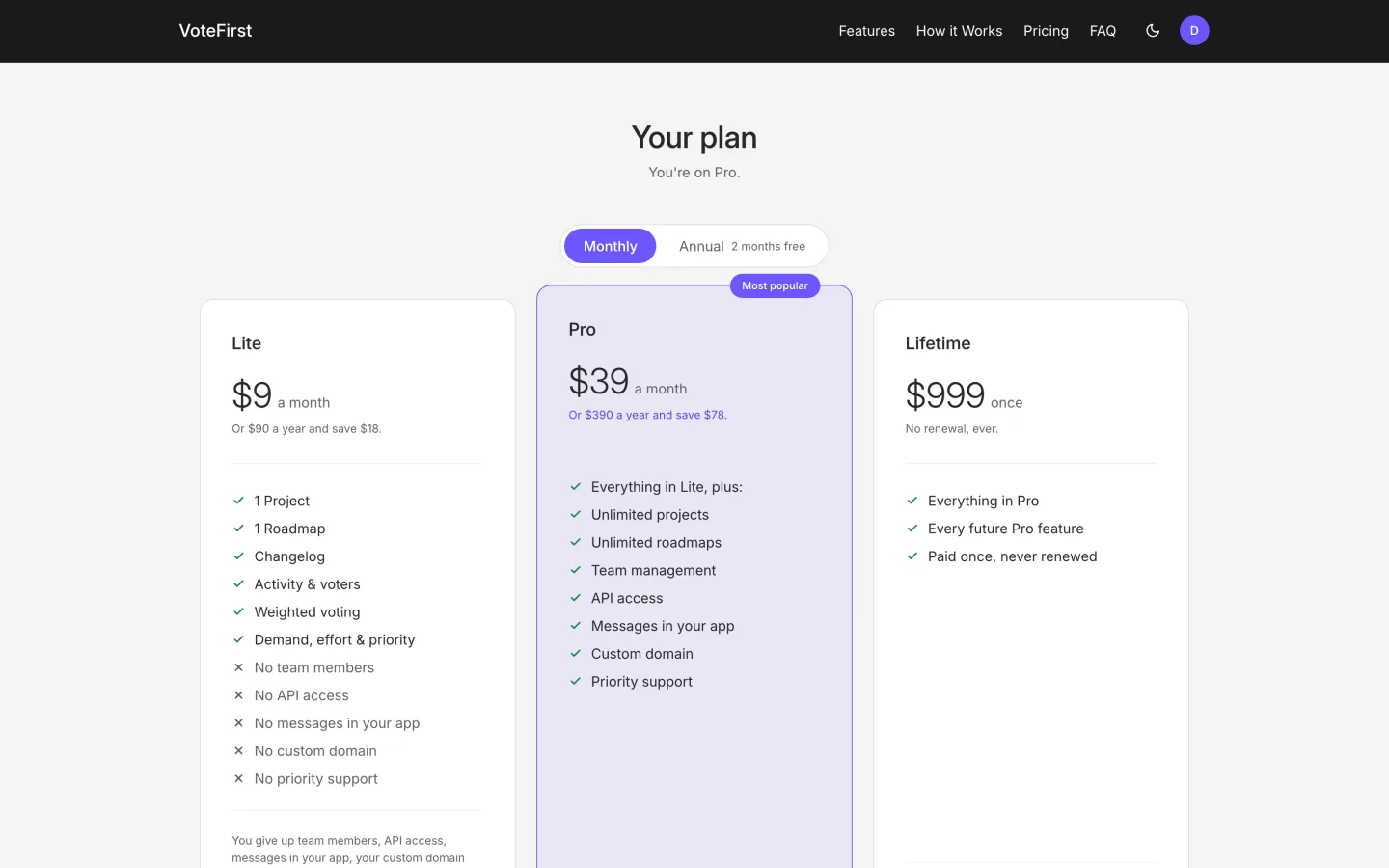
Our meter is a plan. One project on the nine dollar plan, unlimited on the thirty nine dollar one, and it does not move when a thousand customers vote or when a sixth person joins your team.
What is Canny, and what is FeatureOS?
Canny is a feedback board with a roadmap and a changelog, billed by the number of customers who take part.
FeatureOS, which most people still arrive looking for as Hellonext, is five modules sold together, being a board, a roadmap, a changelog, a knowledge base and a forms product, billed by an allowance of boards and seats.
Does either one have a free plan?
Canny does and FeatureOS does not. Canny's pricing page read on 14 September 2026 gives a free tier capped at twenty five tracked users, which ends when twenty five customers have voted rather than when you invite a colleague.
FeatureOS offers a thirty day trial that asks for no card, and the sixty dollar Starter plan is the cheapest thing you can keep.
Which one should you choose?
Choose Canny if the board is the whole job and your voter count is small enough that the meter stays cheap.
Choose FeatureOS if you will use more than one of the five modules, because paying sixty dollars for the set is better value than buying a board and a help centre separately. The arithmetic above is what decides between them at your own numbers.
Why choose Canny over FeatureOS, or FeatureOS over Canny?
Because one bills for the people who take part and the other bills for the things you run.
Choose Canny when the board will stay small and you want the more finished product, because the meter only hurts once a lot of people arrive.
Choose FeatureOS when you expect the board to be busy, because an allowance of boards and seats with a fixed price for each extra one is a bill you can predict a year out.
That is the whole of it, and it is a question about your own growth rather than about their feature lists.
Is there a cheaper alternative to both?
Yes, and the comparison turns on how many people take part rather than on the headline.
Anything billed per workspace or per project is cheaper than a tracked user meter as soon as the board is working, and there are twelve such vendors on the unit table. What each one costs at a number of voters you choose is worked out here, and the full field is one page.
The honest summary
FeatureOS gives you the most product per pound and charges for boards and seats twice over. Canny gives you the cleanest public board and charges for the customers who use it, at a rate it will not print. Neither weights a vote by what the voter pays.
The Canny alternative page and the Hellonext price list carry each side on its own.
14 days, a card at signup, then $9 or $39 a month.