LoopedIn and Frill share one trait almost nobody else in this category shares. Neither one raises your price when a customer votes. LoopedIn's meter is the furniture around the board, being workspaces, roadmaps, updates feeds, a knowledge base and the teammates who run them.
Frill's meter is the backlog itself, being how many ideas are sitting open. Everything below was read on each vendor's own pricing page on 14 September 2026.
What does each one charge?
Twelve dollars a month for LoopedIn's cheapest paid plan, twenty two for Frill billed yearly, and nine for us with no meter on either axis.
| Vendor | From | Billed per | Free plan | Trial |
|---|---|---|---|---|
| VoteFirst | $7.50/mo | plan | – | 14 days, card |
| LoopedIn | $12/mo | plan | 1 of each | – |
| Frill | $22/mo | workspace | – | 14 days |
Read on each vendor's own pricing page on 2026-09-14.
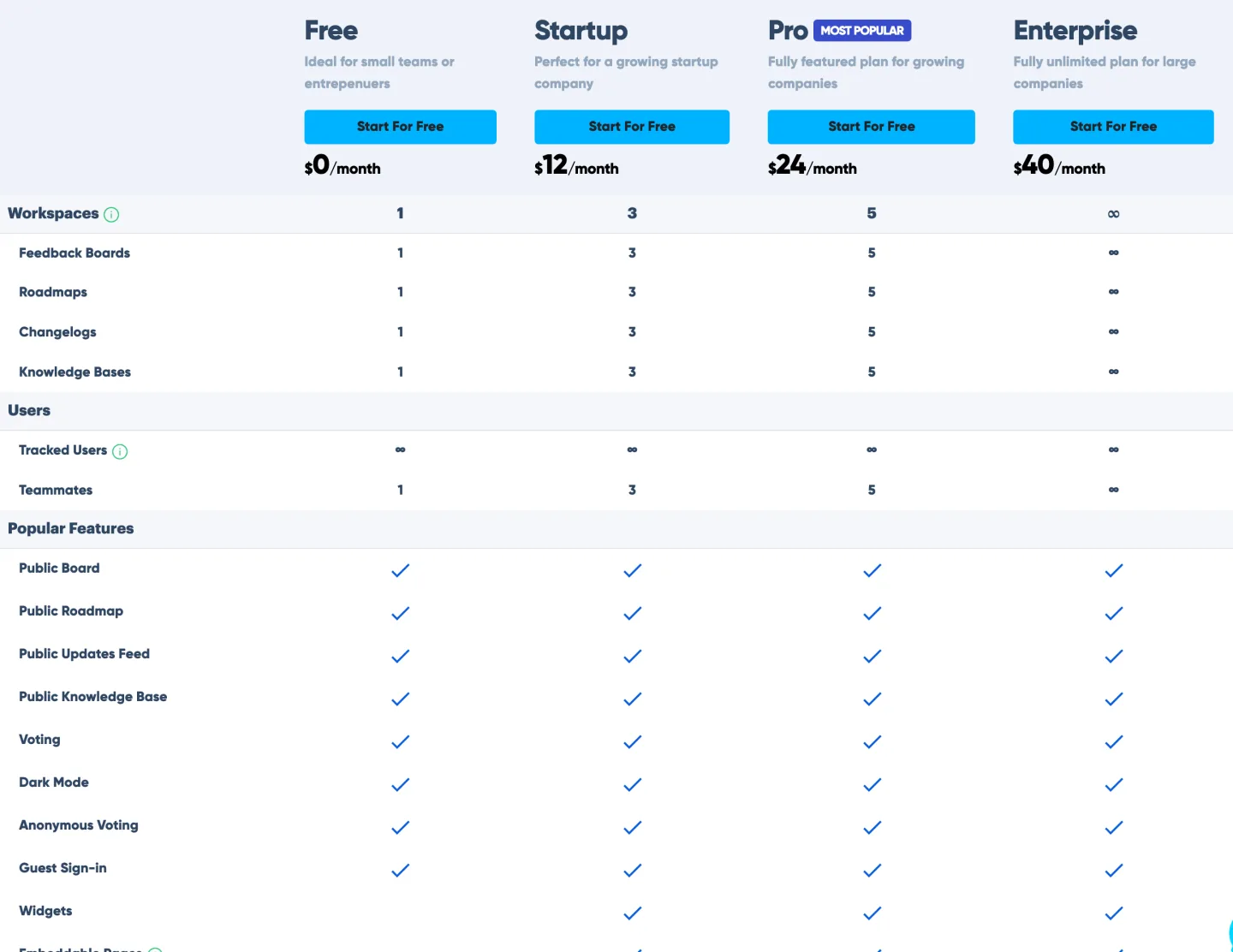
Frill carries its own proof image on its alternative page rather than here, so we are not repeating the same figure a second time on this page. Its numbers are typed out below instead.
LoopedIn's four plans read Free at zero, Startup at twelve, Pro at twenty four and Enterprise at forty, each one giving you three, five or unlimited of every object at once, teammates included.
Frill's four plans read Startup at twenty five paid monthly or twenty two paid yearly, capped at fifty active ideas, then Business at forty nine or forty four with the cap removed, then Growth and Enterprise above that.
How much does LoopedIn cost compared to Frill?
Neither bill answers to the same trigger, so the arithmetic depends entirely on which axis your own company happens to grow on.
| Your situation | LoopedIn | Frill |
|---|---|---|
| 2 people, 1 board, 45 open ideas | Startup fits both counts, $12/mo, or $9.60/mo paid yearly | Startup, under the 50 idea line, $22/mo paid yearly |
| 6 people, 2 boards, 70 open ideas | Enterprise, a sixth teammate is past Pro's cap of five, $40/mo, or $32/mo paid yearly | Business, past the 50 idea line, $44/mo paid yearly |
| 12 people, 1 board, 8 open ideas | Enterprise again, for the headcount alone, $40/mo, or $32/mo paid yearly | Startup, ideas stay low, $22/mo paid yearly |
The third row is the one worth sitting with. A team of twelve with a quiet board pays LoopedIn's top plan for the people alone, while the same board costs Frill its cheapest plan, because Frill's bill has never once looked at how many colleagues are logged in.
LoopedIn's Pro plan caps out at five teammates and five of every object, and Enterprise is the only published step above that. Their page names no figure between five and unlimited, so a team of six and a team of six hundred pay the same forty dollars.
Which one should you choose?
They ladder on opposite things, and the honest answer gives credit to both.
Frill genuinely does not charge you for hiring. Unlimited admins sit on its cheapest paid plan, twenty two dollars a month, and a team of one and a team of fifty pay the same figure for that row.
LoopedIn's free plan is a real product rather than a stripped demo. One workspace, one board, one roadmap, one updates feed and one knowledge base, with unlimited tracked users and no card required, at no cost at all.
Why choose LoopedIn over Frill, or Frill over LoopedIn?
Because one of them worries about how many colleagues and products you are running, and the other worries about how long your open backlog has grown.
Choose LoopedIn when a knowledge base, a roadmap and an updates feed under one login matter more than the exact size of your team, because the bundle is priced as one thing and the free plan lets you try it first.
Choose Frill if more hires are coming, because none of its four tiers price a colleague and the length of your backlog is the only limit left to hit.
Nine dollars a month for one project, with weighted voting on it.
Is there a cheaper alternative to both?
Sometimes, and the answer turns on which number in your own company grows fastest, the headcount or the backlog.
Once a sixth teammate joins, a plan that never prices a colleague beats LoopedIn's Pro ceiling. Once your open ideas pass fifty, a plan with no idea cap beats Frill's Startup tier.
Try the same math at your own numbers here. This product holds at nine dollars a month regardless of team size or backlog length, and every vendor in the category, lined up by what it bills on, sits on one page.
What does each do with a vote from a big customer?
Frill's own comparison table names weighting a vote by customer revenue directly. LoopedIn's pricing page never mentions vote weight, revenue or a customer tier anywhere on it.
| Vendor | Weighting by revenue | Single sign on | Webhooks |
|---|---|---|---|
| LoopedIn | – | Enterprise | Pro |
| Frill | Weights the vote | Every paid tier | Every paid tier |
| VoteFirst | All plans | Pro, no SAML | – |
Read on each vendor's own pricing page on the date at the top of this page. A dash means nobody could read it on the pages opened that day, never that the capability is absent.
We checked all thirty two vendors we track for this kind of claim. Eight of them write something revenue related into their own pricing or feature pages, and four of those eight, Frill among them, commit to the word weight for what happens to the vote itself rather than to a sorted list.
LoopedIn's Enterprise plan offers user segmentation, which filters who you are looking at. That is a different operation from changing what one vote is worth against another, and their page does not claim the second thing.
Can I move from one to the other?
Only one of the two says much about it on the pages we read.
Frill's own comparison table marks bulk import and export as included on every paid tier, and Canny sits by name on the short list of sources it reads.
LoopedIn's pricing and alternative pages have no line anywhere about carrying requests or votes in or out, and we treat a missing line as an unanswered question rather than as a wall.
Where we fit, and where we do not
We are one board on one project on the nine dollar plan, with no knowledge base and no survey product of any kind.
Single sign on is a named line item on both of their price lists, held back for LoopedIn's forty dollar Enterprise tier and included from Frill's cheapest paid plan at twenty two. What signs a voter in here, on the thirty nine dollar plan, is a token issued by your own application, never SAML.
Webhooks appear on both lists too, LoopedIn's at twenty four dollars and Frill's from twenty two upward. Nothing in our own pages describes a webhook feature on any plan we sell.
What this product does instead is attach a fixed integer to a customer tier and rewrite the vote itself the moment it lands, unweighted count kept beside it, live from the nine dollar plan up. Neither of the two above does that to the vote in the same way we do.
What is LoopedIn, and what is Frill?
LoopedIn is a feedback board, a roadmap, a changelog and a knowledge base sold together, billed by how many of each you keep and how many teammates run them.
Frill is a feedback board, a roadmap, a changelog and a survey product sold together, billed per workspace by how many ideas are sitting open on it.
Does either one have a free plan?
LoopedIn does and Frill does not. LoopedIn's pricing page read on 14 September 2026 gives one workspace, one board, one roadmap, one updates feed and one knowledge base, with unlimited tracked users at no cost.
Frill's pricing page carries a fourteen day trial that its own banner says needs no card, with no free tier under it.
What this costs
Lite
$9 /mo
Pro
$39 /mo
Lifetime
$999 once
Fourteen day trial of Pro, card asked for at signup. Nothing here counts the people who vote, so the bill does not move when the board starts working. The long version, with what happens if you stop paying.
The honest summary
LoopedIn sells four products bundled at one price and gives away a real first tier while your team stays small. Frill sells a board built for a growing team and starts charging only once your own list of open ideas gets long.
Neither one has ever raised its price because a customer voted, which puts this pair on the same side of an argument most of the category loses. Ours costs nine dollars flat and weights that same vote by what the voter pays.
The LoopedIn alternative page and the Frill one each carry their own side of this further than one page can.
14 days, a card at signup, then $9 or $39 a month.