Both of these are feedback boards with a public roadmap and a changelog. Put them side by side and the features overlap almost completely. The bills do not overlap at all, and the reason is a single design decision each of them made about what to count.
Canny counts tracked users. UserJot counts boards. Everything below was read on each vendor's own pages on 14 September 2026.
What does each one charge?
| Vendor | From | Billed per | Free plan | Trial |
|---|---|---|---|---|
| VoteFirst | $7.50/mo | plan | – | 14 days, card |
| UserJot | $29/mo | workspace | 2 boards | – |
| Canny | $79/mo | tracked user | 25 users | – |
Read on each vendor's own pricing page. UserJot publishes no annual rate anywhere, so every UserJot figure on this page is a monthly one.
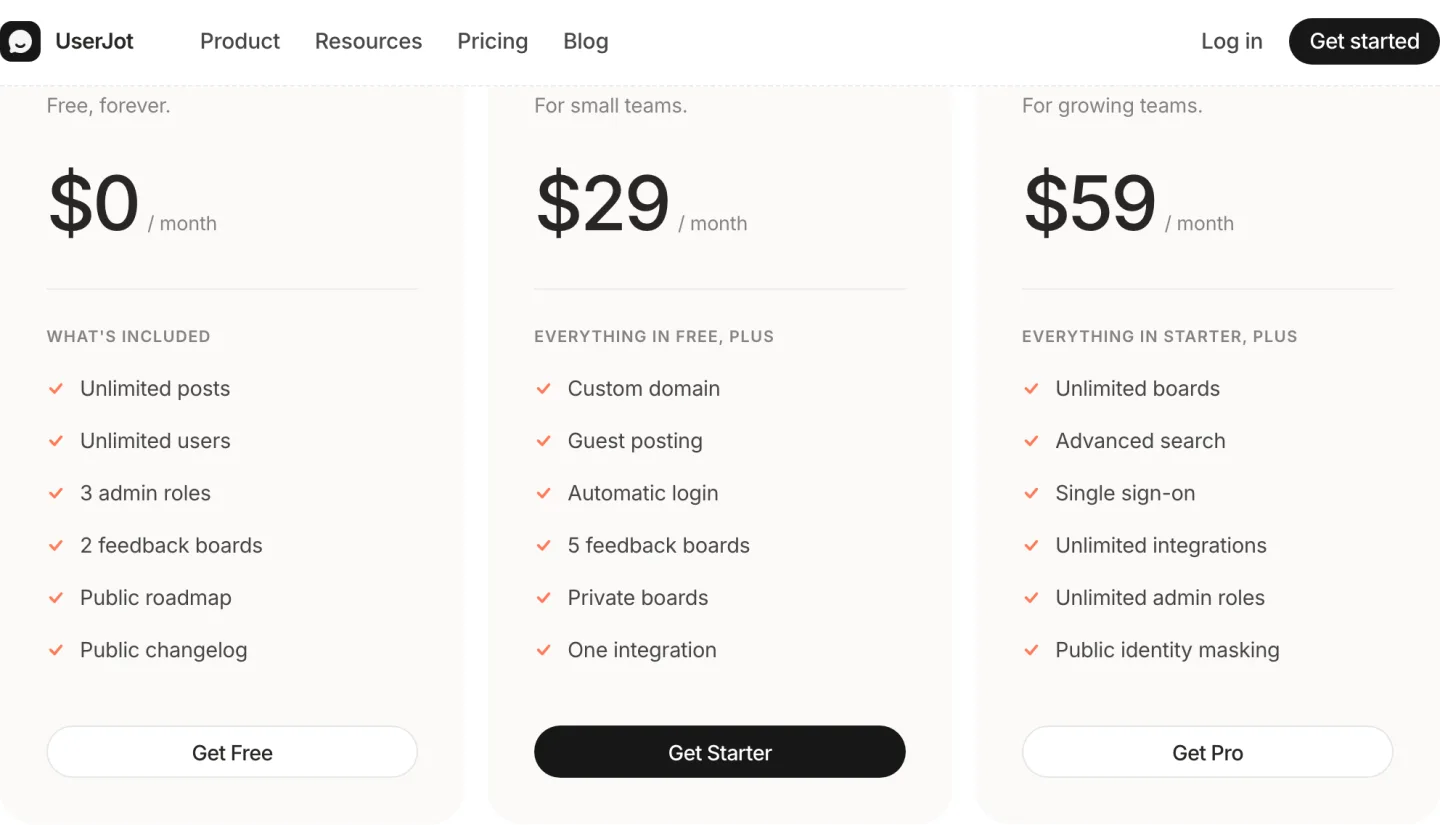
| Plan | UserJot | What it gives |
|---|---|---|
| Free | $0/mo, forever | Unlimited posts, unlimited users, three admin roles, two feedback boards, public roadmap, public changelog |
| Starter | $29/mo | Adds a custom domain, guest posting, automatic login, five boards, private boards, one integration |
| Professional | $59/mo | Adds unlimited boards, advanced search, single sign on, unlimited integrations |
Canny's entry paid plan is seventy nine dollars a month and its free plan ends at twenty five tracked users.
A tracked user, in Canny's own definition, is anybody associated with feedback. Somebody who posts is one. Somebody who only votes is one. Somebody who leaves a comment is one. So the free plan does not end at twenty five requests, it ends at the twenty fifth person who touches the board.
How much does Canny cost compared to UserJot?
The gap opens as soon as anybody uses the board, which is the awkward part.
| Your board | Canny | UserJot |
|---|---|---|
| 20 customers have voted, one board | Free, under the 25 tracked user line | Free, under the two board line |
| 60 customers have voted, one board | $79/mo | Free |
| 1,000 customers have voted, one board | $529/mo billed yearly, their own worked figure at 1,000 tracked users | Free |
| 1,000 customers, three boards, a custom domain | $529/mo plus whatever the domain sits on | $29/mo |
The third row is the one that decides most evaluations. A thousand people voting is a board that is working. On Canny that is five hundred and twenty nine dollars a month, on their own published worked example. On UserJot it is nothing, because the thousand people are not a unit UserJot charges for.
Canny does not print a rate between one hundred tracked users and its enterprise tier. Their page carries a slider from twenty five to five thousand with an optional spend limit and no figures for the steps in between. The five hundred and twenty nine is their own answer at exactly one thousand, not an estimate of ours.
The demo board is open and it asks for no account.
Why does UserJot refuse to count people?
Because they think the unit is wrong, and they put the argument on the page rather than leaving it implied. Their position is that charging per user for a feedback tool is like charging per customer for a store, and that they price the tool rather than your reach.
It is worth saying plainly that this site agrees with them. Of the thirty two tools whose prices were read for this programme, two bill by participation on your own board and a third bills by how many people see your changelog. On all three, the thing you were hoping for is the thing that raises the invoice.
So a reader choosing between UserJot and this product should know that the disagreement is not about that. It is about what happens after the votes arrive.
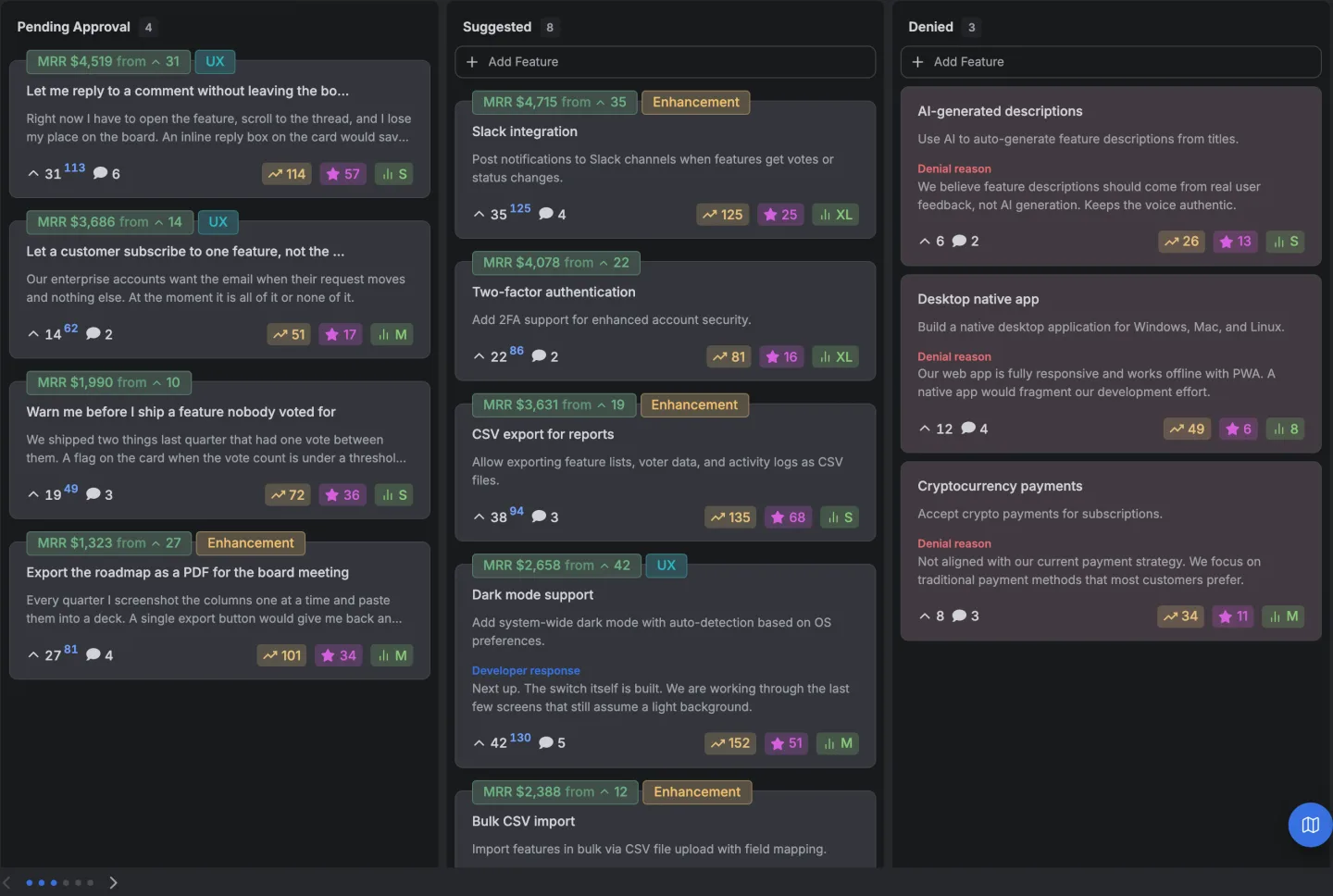
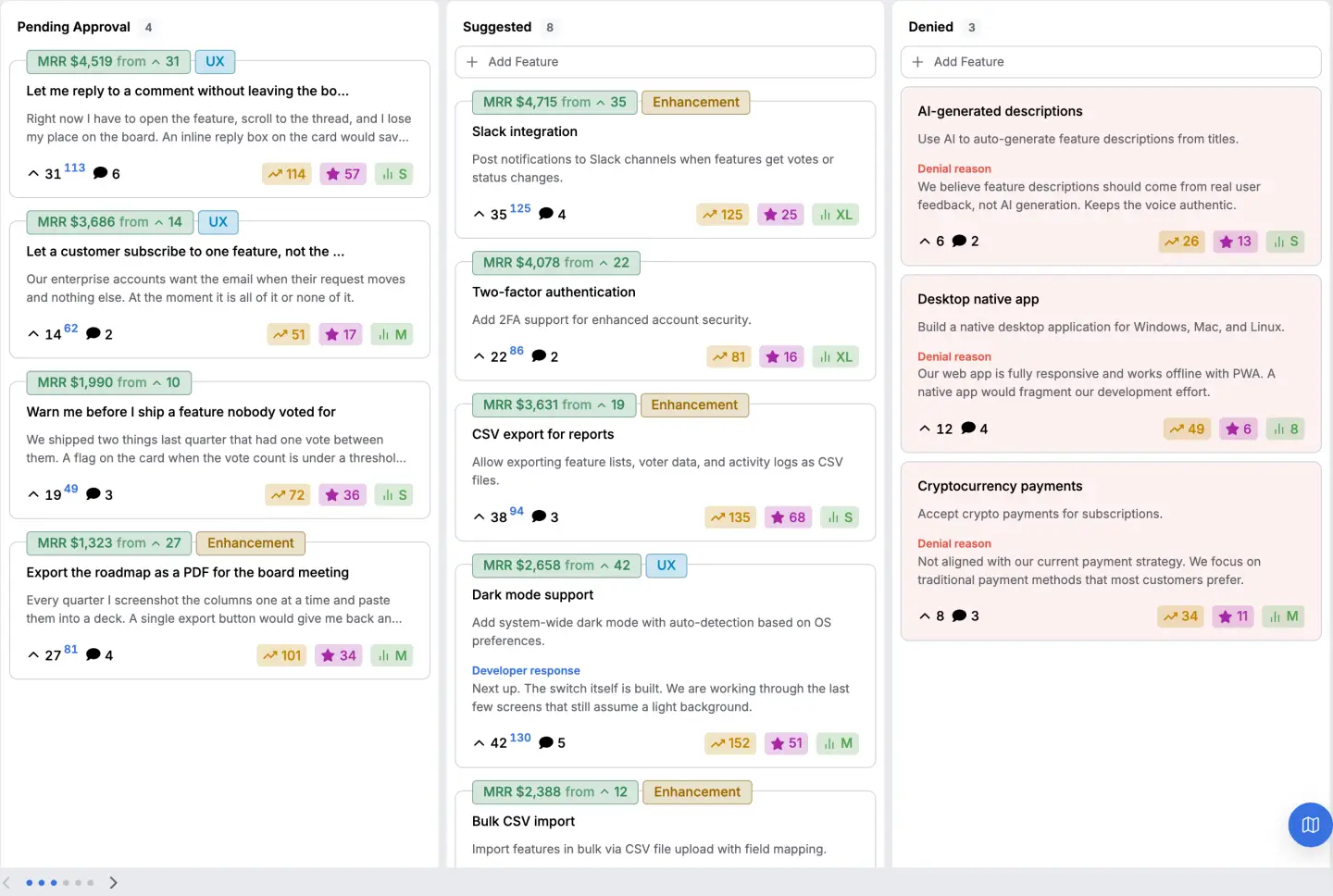
What does each one do with a vote from a paying customer?
Canny has a priority and a value field you can set by hand, and an integration path for customer data on its higher plans. UserJot sorts by votes and by recency.
Neither of them writes the money onto the vote at the moment it is cast, which is the thing this product does. Each customer tier carries a multiplier, the weight is stamped on the vote when it happens, and the plain count stays visible beside the weighted total so nobody has to trust the arithmetic without seeing it. Revenue arrives from Stripe, Paddle or a CSV.
That is available on the nine dollar plan, not held back for a tier with sales attached.
Which one should you choose?
UserJot, if your board is one or two boards and the budget is zero. The free tier is genuinely free, it carries unlimited users and unlimited posts, and getting started takes an email and a workspace name with no card. For a founder collecting the first fifty requests that is very hard to beat.
Canny, if you are buying the ecosystem around it. It is the best known product in this category, it is well built, and its integrations and its maturity are why larger teams pick it. The bill is the price of that.
This product, if the votes need to be sorted by what the voters pay you. Nine dollars a month for one project, thirty nine for unlimited ones, nothing counting the people who vote, and a fourteen day trial with a card at signup.
Why choose Canny over UserJot, or UserJot over Canny?
Choose Canny when the board has to sit inside a wider set of tools you already run, and when somebody else approves the invoice.
Choose UserJot when the board is the whole job and you would rather the price stayed still while the board fills up. Their pricing page returns a genuine 404 and the numbers live on the home page instead, which is worth knowing before you go looking for them.
Choose neither when the question you actually have is which of these requests is worth building, because both of them answer it with a count of hands.
What this costs
Lite
$9 /mo
Pro
$39 /mo
Lifetime
$999 once
Fourteen day trial of Pro, card asked for at signup. Nothing here counts the people who vote, so the bill does not move when the board starts working. The long version, with what happens if you stop paying.