You are past the stage where one person remembers every request. Two or three of you are splitting support, sales and onboarding, and three different customers have now asked for three different things in three different channels. A feedback board gives those requests one public page and a vote count instead of a place in somebody's inbox. Three questions decide whether it helps a team this size: which plan fits two or three people, what a board this young really looks like, and when a call is still the better tool.
Which plan fits a team of two or three
Lite is nine dollars a month for one project, and it has no team members. There is no setting that adds a second person to the account, so two founders on Lite share one login and one password.
That works for a while. It stops working once you both moderate the queue and answer comments, and nobody can tell from the board which of you did what.
Pro is thirty nine dollars a month, and for a founding team the team is the reason to move. Pro adds team members with no seat count, so a third co-founder or your first support hire gets their own login rather than the shared one, on the same project. Unlimited projects and the REST API come with it, but for a founding team specifically, team members are the feature that makes Pro the plan rather than Lite with a shared password.
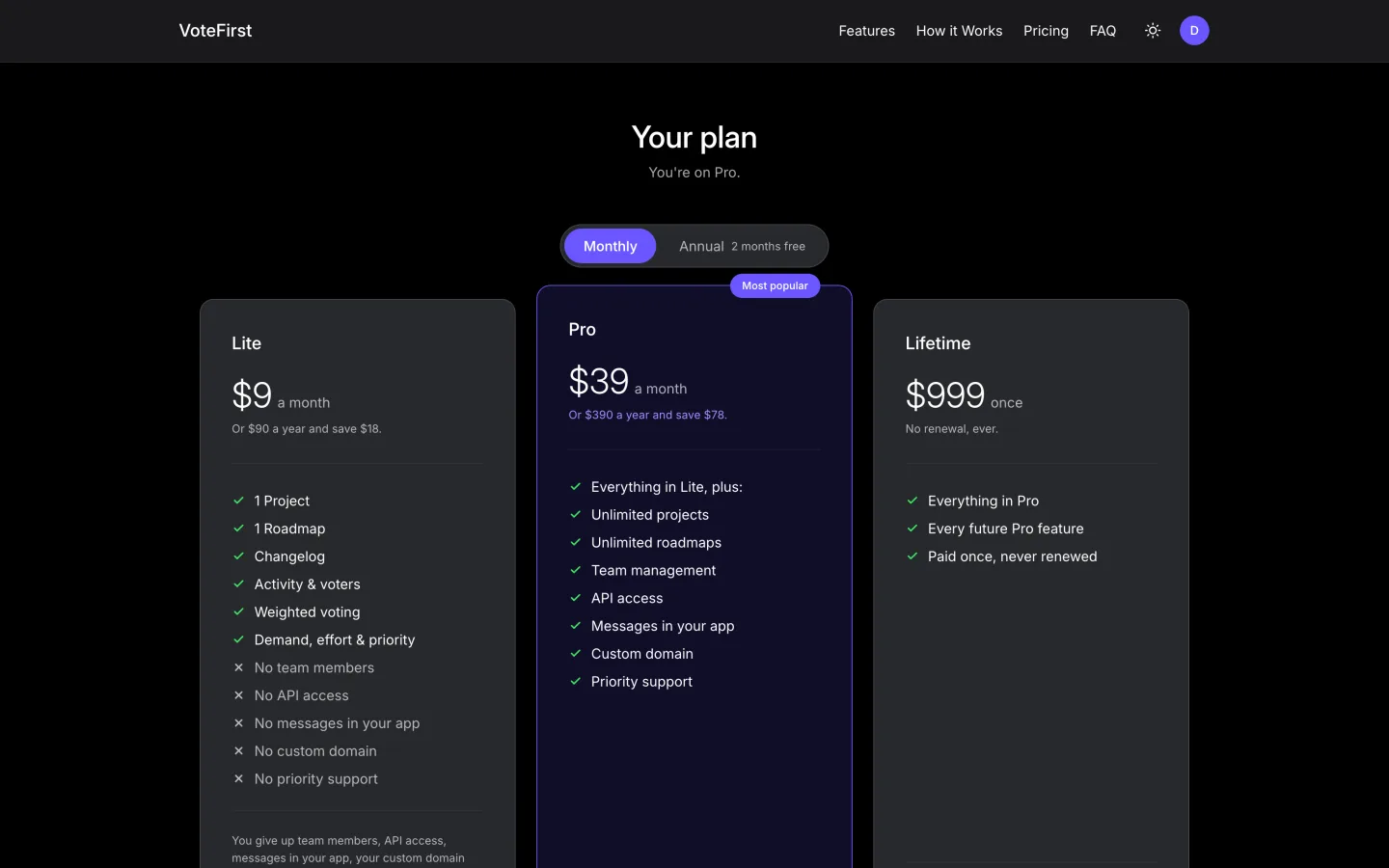
If it is genuinely one of you running the board day to day and the other co-founder only glances at it, Lite and a shared login is a fair trade for nine dollars. If you are both in the moderation queue, both replying to comments, or you are about to add a third person who should not have your password, that is the signal to move to Pro.
What a board this young actually looks like
justRead, a reading app built by the same people who build VoteFirst, runs its own public feedback board on VoteFirst. It is a real board, not a demo, and reading it today is the fastest way to see what a young product's requests actually look like once they start arriving.
Read on 2026-10-02, justRead's board holds 131 cards across its five columns: 13 Suggested, 14 Denied, 4 In Review, 1 In Progress and 99 Completed. Across every card, the vote counts total 874, the median card holds 2 votes, the mean is 6.7, and the top card holds 47. Sixty nine of the 131 cards, 53 percent, carry two votes or fewer.
A fuller read taken on 2026-09-16 counted 129 cards and 793 votes from 252 distinct voters, the same median of 2 and a mean of 6.1, with a top card at 53 votes that day. The two readings, two and a half weeks apart, agree on the shape even where the exact numbers moved: a handful of cards pull well ahead, and most of the board sits at two votes or fewer, because that is what a young board looks like when the people asking are the ones you already have.
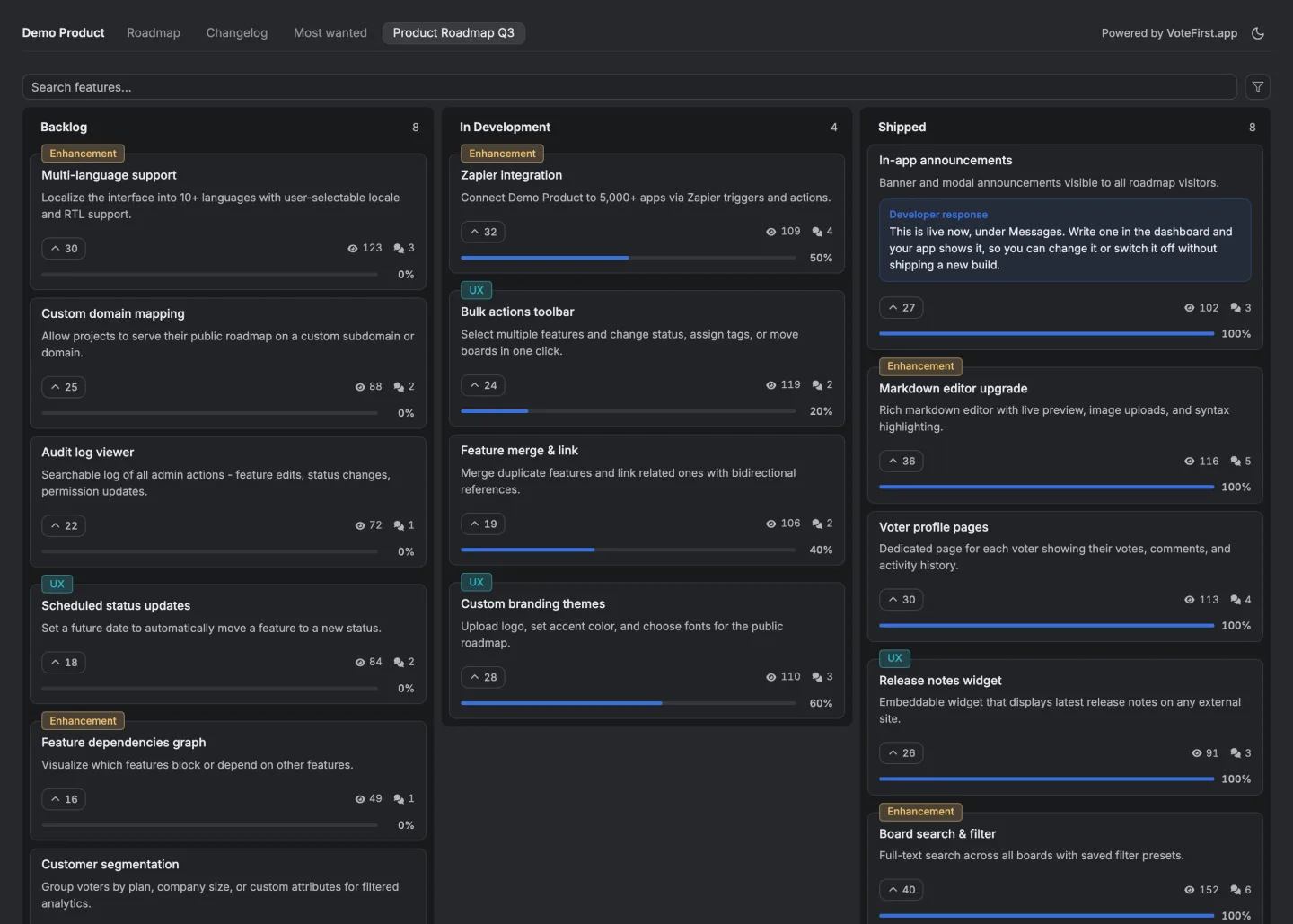
Reading a board where most requests have two votes or fewer
The instinct, looking at a board like that, is to treat the gap between a 2 and a 3 as meaningful. At this size, it almost never is. One more person deciding to vote, or not getting around to it, is the whole difference, and a sample that small moves on nothing more than who happened to visit the board that week.
What the small numbers are good for is noticing repeats. A request with three votes that keeps getting the same request posted again under a slightly different title is telling you something a vote count alone will not: the same ten or twenty customers are hitting the same wall from different angles, and merging the duplicates is more informative than comparing 3 against 2.
Below five or so votes, read the comments before the count. A two vote card with a comment explaining exactly which workflow breaks without the feature is worth more than a four vote card where everyone just clicked and left. The vote tells you how many; the comment tells you why, and at this size why is the part you can act on.
Why the customer paying ten times more should count for more
At ten to fifty customers, you likely already know that not all of them are the same size. One customer on an annual plan worth ten times what your smallest customer pays is not a rounding error, and a plain headcount treats their vote the same as everyone else's.
Weighted voting is built for exactly that gap, and it is included on Lite, not held back for Pro. Import what each customer pays from Stripe, Paddle or a CSV, set a whole number multiplier per tier, and every vote that customer casts afterward counts at that multiplier.
The board you see as the owner shows both numbers side by side, the plain count and the weighted one. The public board, the page your customers themselves look at, shows only the plain count. A customer paying ten times more never sees their own vote carrying extra weight, and nobody can work backward from the public number to guess what anyone else pays.
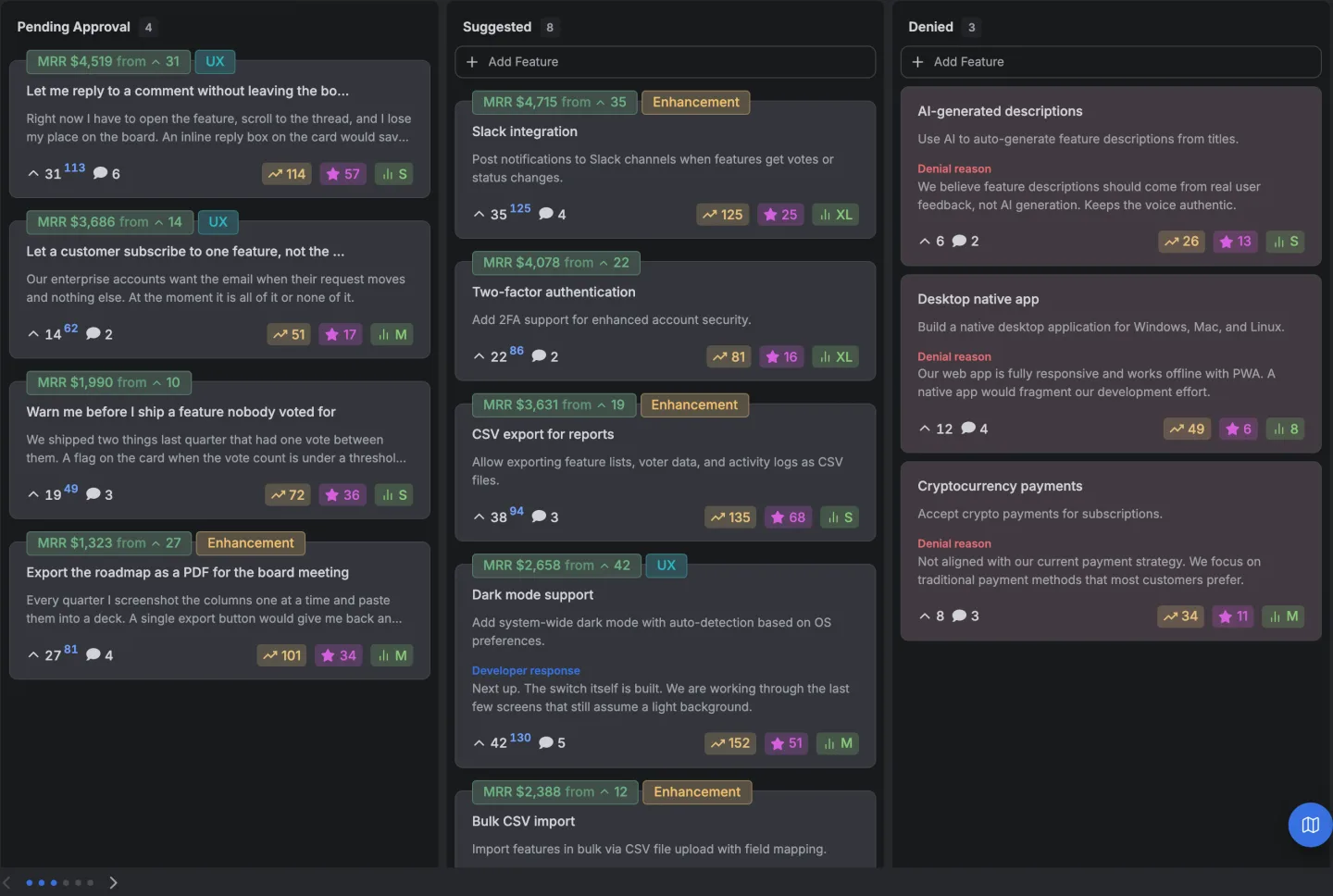
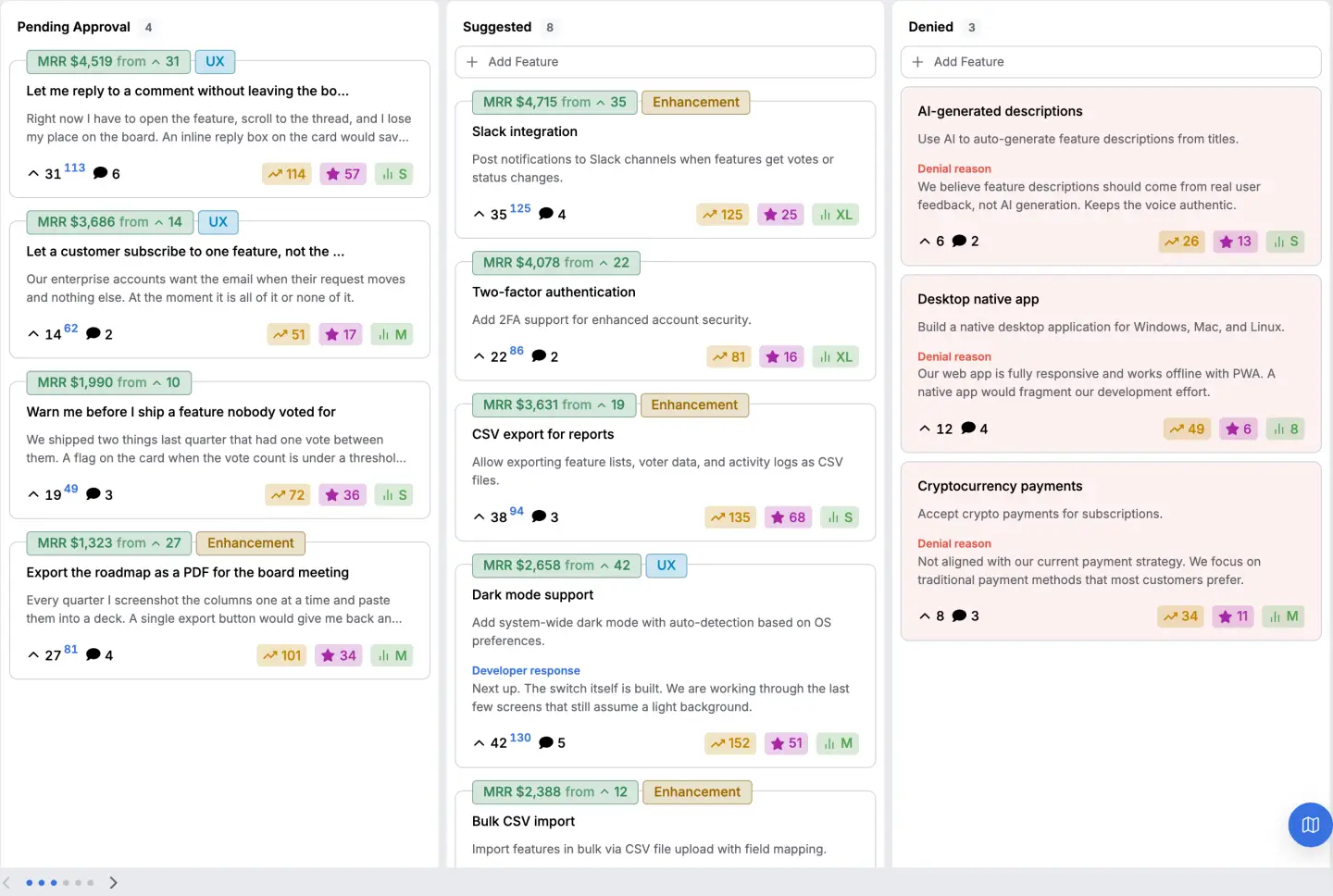
At ten customers this might feel like overkill. It stops feeling that way the first time your biggest account asks for something and the board shows three smaller customers outvoting them.
When talking to the customer still beats the board
With ten to fifty customers, you can still call most of them. That is an advantage a company with a thousand customers does not have, and a board is not the thing that should take it away from you.
A board is good at holding a request so it does not get lost between the DM, the support email and the comment on your launch post. It is bad at explaining why someone asked, how urgent it actually is to them, or whether the thing they described is really the thing they need. A ten minute call answers all three, and at this size you have time to make those calls.
The split is this. Use the board to stop re-litigating what has already been asked for, and to let a request accumulate support from people you have not personally talked to yet. Use the call, or the email thread, when you need to understand a request well enough to build the right version of it the first time.
What this costs, and the limits either plan has
Lite is nine dollars a month for one project, no team members, no API, no custom domain, with weighted voting included. Pro is thirty nine dollars a month, adds team members with no seat count, unlimited projects, the REST API, a custom domain and JWT single sign on. Both carry a fourteen day trial with a card asked at signup, and the price does not move with how many customers vote.
If the plan ever lapses, the board stays up and readable, votes keep working, comments turn off, and a badge naming VoteFirst appears on the public pages.
What this costs
Lite
$9 /mo
Pro
$39 /mo
Lifetime
$999 once
Fourteen day trial of Pro, card asked for at signup. Nothing here counts the people who vote, so the bill does not move when the board starts working. The long version, with what happens if you stop paying.
Other use cases
Feedback board for indie hackers, for the one person version of this same question. Feature voting software, for the fuller comparison once you have more than one plan to weigh. Anonymous voting, if you are not sure whether to require an account to vote.