A public roadmap is a small, repeated promise: here is what people asked for, here is what is happening to it. For a team, keeping that promise is a process with an owner. For a solo founder, the owner is also the person writing the code, answering support and sleeping sometimes. Running one alone without it turning into a lie you tell your own customers comes down to a few habits.
Which columns to show, and why there are no dates
Five columns cover it: Suggested, Denied, In Review, In Progress, Completed. What each one does is a separate page. The practice question is which of them a solo founder can actually keep honest, and the answer is all five except the one thing people keep wanting to add: a date.
A date on a card is a commitment made by one person who also has to ship it, fix the bug that shows up the day after, and answer the email that arrives an hour after that. Any of those can slip a date by a week, and a slipped date on a public page reads as a broken promise even when the only thing that actually happened is normal software work. A column says what is true right now. A date says what you hope will be true later, and later is the part you do not control alone.
Keep the columns. Drop the urge to add a date to any of them, including Denied and In Review, which is where people put dates when they run out of other ways to look organized.
How often to move a card, running it alone
Move a card when its state actually changes, not on a schedule. There is no cadence that fits both a quiet week and a week where three things ship, and inventing one, a Monday review or a Friday update, is a chore you will skip the first time you are behind on something that pays the bills.
The rule is smaller: move a card to In Progress the day you start it, move it to Completed the day it ships, and do nothing to it in between. A card sitting untouched in Suggested for two months is the board correctly reporting that nothing happened to that request yet, which is true, and more useful to the person who asked than a card nudged every Friday to look alive.
What to do with Denied
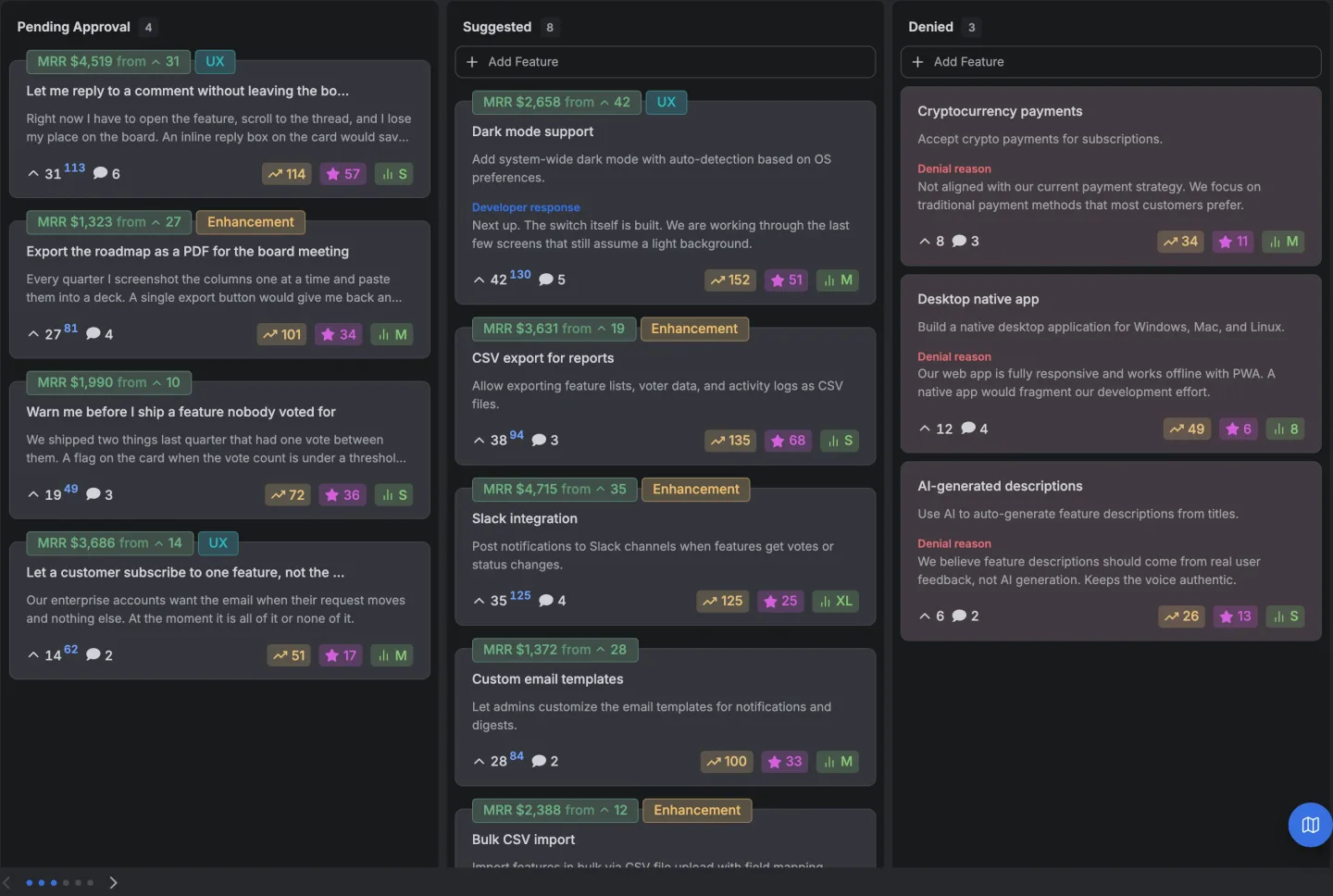
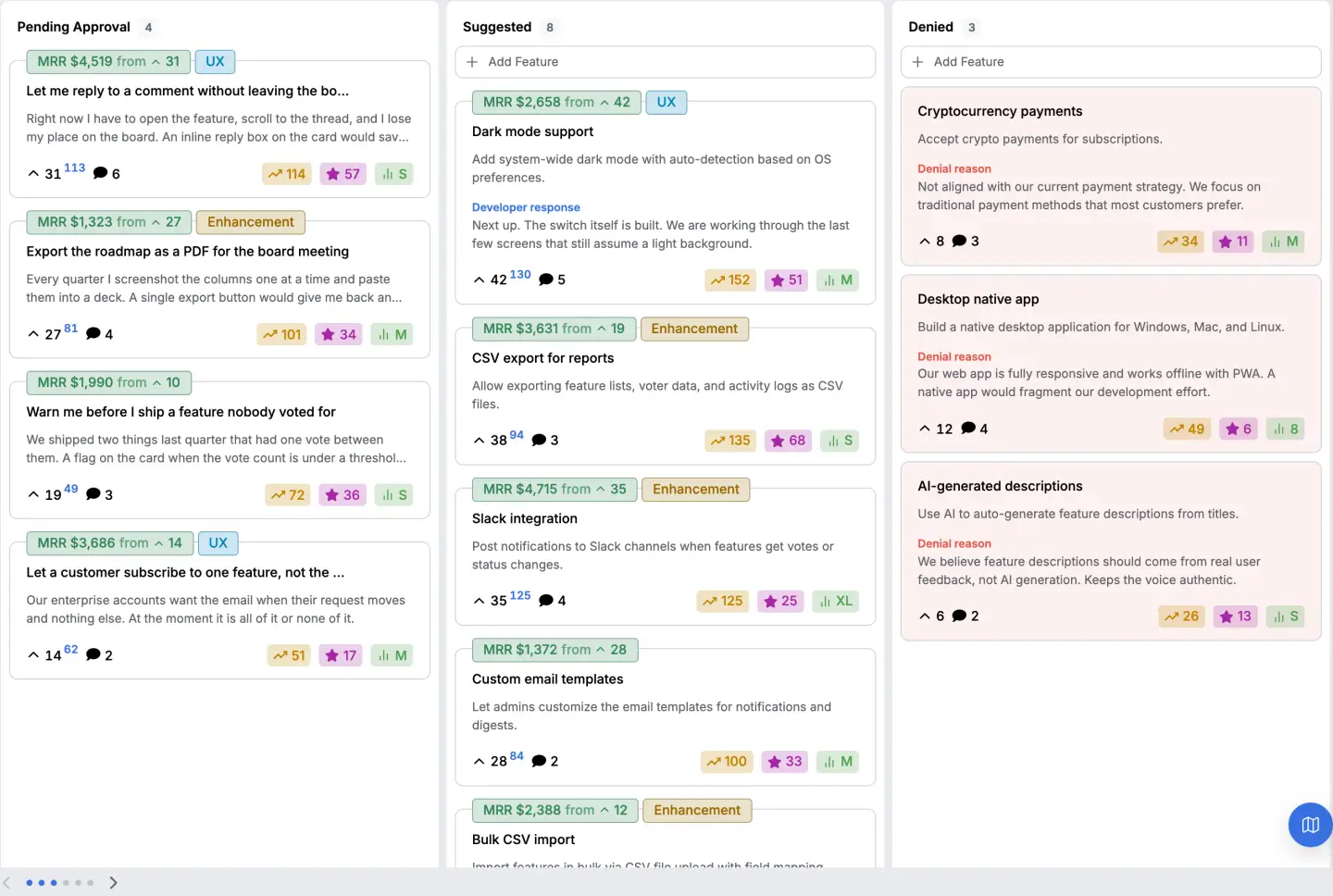
Denied is visible by default on VoteFirst, which is unusual in this category. A declined request can carry the reason in public, right on the card.
Running this alone, the temptation is to leave Denied empty and just let requests sit unanswered in Suggested forever, because writing "no" to someone feels worse than writing nothing. It is the wrong trade. An unanswered request still gets votes from people who think it is being considered, and eventually somebody asks you about it directly, which costs more of your time than writing one sentence would have.
A denial reason does not need to be long. "This conflicts with how imports work and would break existing boards" is a complete answer. "Not planned for now, revisit if this gets more votes" is also a complete answer, and an honest one, because it tells a voter exactly what would change your mind. What it should not do is pretend the request is still open when it is not. A Denied column with three cards in it, each with a real sentence, tells a reader more about how seriously you take the board than a Suggested column with forty cards nobody ever answers.
How the changelog closes the loop
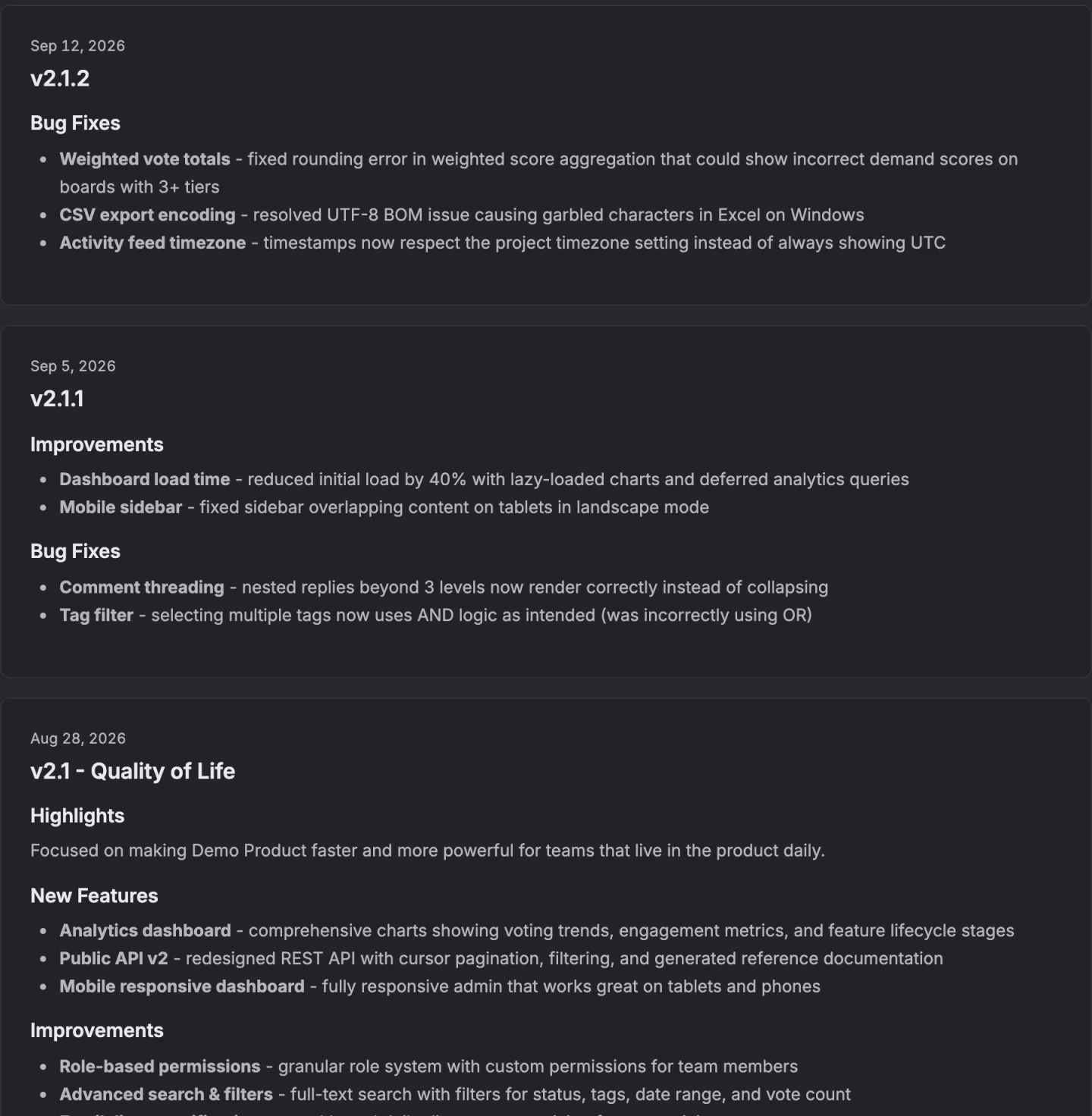
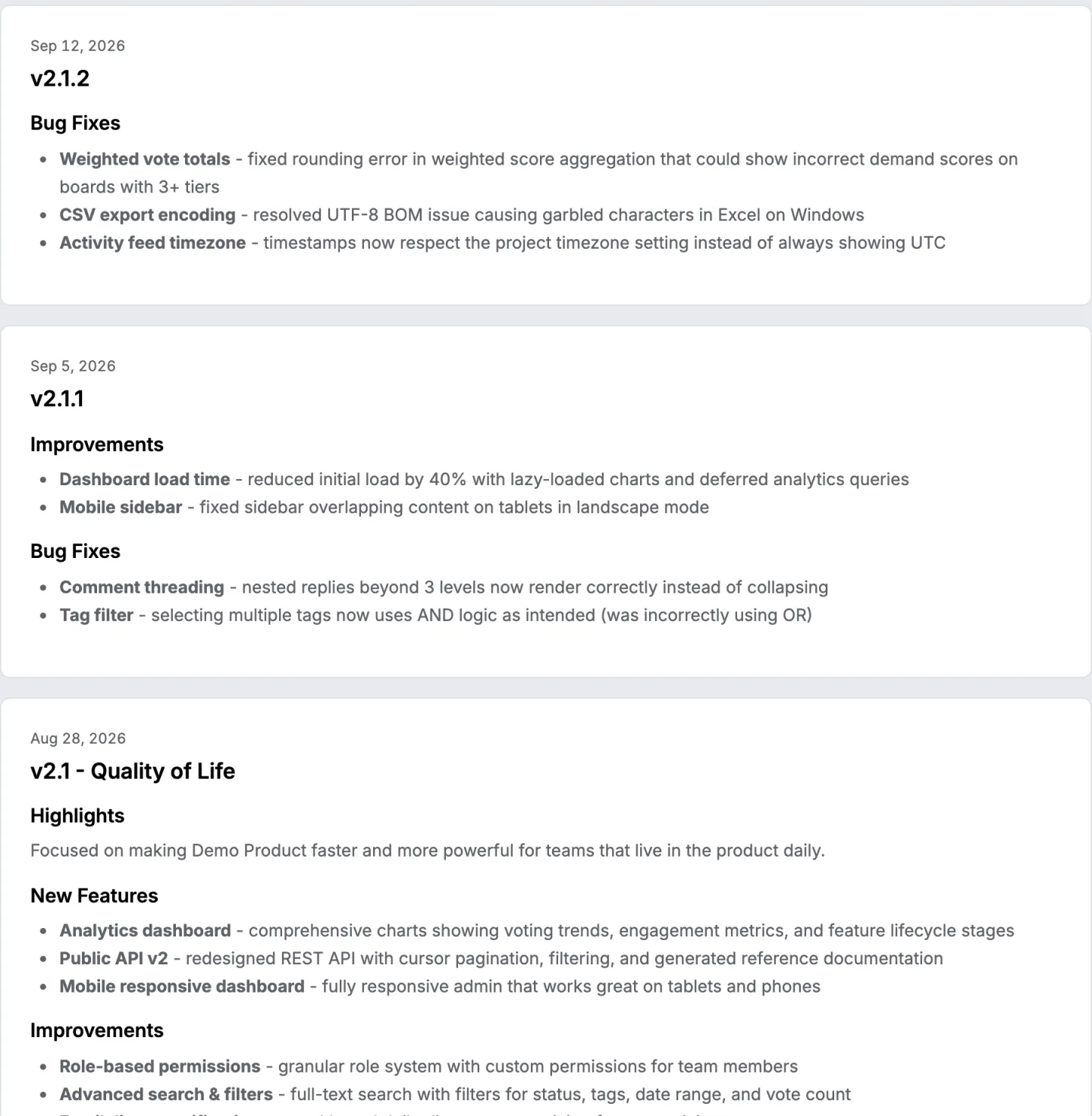
Shipping something and saying so in public are two different actions, and a roadmap without the second one is just a queue. The changelog is where Completed turns into an announcement, and it does one thing a status column cannot: it emails the people whose own vote is in that release.
Only the people whose own vote is in that release, and only the ones who voted with an account. Somebody who voted anonymously, with no sign up, gets nothing when the thing they asked for ships, because there is no address to send it to. That is the trade a public board makes: voting with no account removes the only friction between a visitor and a vote, and it also means that visitor will not hear from you again unless they come back and look. If getting your early users an email the day something ships matters to you, that is the argument for asking people to sign in before they vote.
For one person, the changelog is also the cheapest marketing you will do all month. A customer who gets an email saying the exact thing they asked for just shipped is a customer who trusts the next thing you tell them, and you already did the work writing the release note.
How many cards a one person roadmap can really carry
The real shape of a small board is not evenly spread across five columns, and the clearest evidence for that is a real one. justRead, a reading app built by the same people who build VoteFirst, runs its public roadmap on VoteFirst, read live on 2 October 2026 at app.votefirst.app/en/public/roadmap/justread. That day it held 131 cards: 99 Completed, 14 Denied, 13 Suggested, 4 In Review and 1 In Progress. 874 votes sat across all of them, a median of 2 votes a card and a top card at 47. Sixty nine of the 131 cards, better than half, carried two votes or fewer.
Two things follow from that shape, and they are both useful if your own board looks nothing like a thriving company's marketing screenshot. First, most of a healthy small board is Completed, because shipped work accumulates and open requests do not, if you are actually working through them. A board that is mostly Suggested after a year is collecting a backlog nobody is touching. Second, almost every request gets a handful of votes, not a crowd. A card with 2 votes next to one with 47 is what a real board looks like next to the one loud request everybody happens to agree on.
In Progress holding exactly one card on the day this was read is also the honest number for one person. You can ship on more than one thing at a time, but writing it on the board does not make it true, and a column with six cards in it marked In Progress from a single founder usually means none of the six is actually being worked on today.
A Trello board, a Notion page, GitHub Projects, or a hosted tool
Before paying for anything, weigh what each one actually does for a board run by one person.
A public Trello board costs nothing for a single user; Standard is $5 a user a month if you ever add a second person, read on Atlassian's pricing page 2 October 2026. The catch, covered in full on the Trello alternative page, is that voting on a public board needs the voter to have a Trello account, and a public board is not indexed by search engines because Atlassian's own robots file blocks it. For a handful of customers already emailed directly, that friction barely matters. For a board meant to be found by strangers, it is the whole problem.
A Notion page works the same way: free for personal use, easy to share as a public link, and genuinely good at holding a list with a status property next to each row. It has the same vote problem Trello has, in a different shape. A Notion page has no native upvote on a row that a stranger can click without a Notion account, so "voting" usually becomes a comment or an emoji reaction, which is not counted anywhere and cannot be sorted by.
GitHub Projects is free on every GitHub plan and is the right choice if every single person who might ask for something already has a GitHub account, because that is the one case where its login requirement costs nothing. Outside of a developer tool with a developer audience, that requirement is the same wall Trello and Notion both have.
A hosted roadmap tool exists for the one thing none of the three above does: a stranger votes with no account, on a public page search engines can actually index. VoteFirst is $9 a month for a single project and includes weighted voting, the board, the roadmap and the changelog on that one plan, with a 14 day trial and a card asked at signup. Other hosted tools are priced against each other on one page.
When a Trello board or a Notion page is already enough
If the people asking for features are the same three or four customers you already talk to by name, a Trello board or a Notion page someone can read without signing up for anything is enough, and paying for a hosted tool at that size is solving a problem you do not have yet. The gap only matters once strangers start arriving, people you have never emailed and never will, and the sign up wall in front of a vote starts quietly filtering out most of them before they ever click.
The signal to move off a free page is the first time you suspect somebody wanted to vote and did not bother, because creating one more account for one request was not worth it to them.
What this costs
Lite
$9 /mo
Pro
$39 /mo
Lifetime
$999 once
Fourteen day trial of Pro, card asked for at signup. Nothing here counts the people who vote, so the bill does not move when the board starts working. The long version, with what happens if you stop paying.
Other use cases
Feedback board for indie hackers, on what the board itself costs before the roadmap practice matters at all. Feedback board for open source projects, for a maintainer weighing the same board next to GitHub issues. Feature voting software, for the fuller picture once there is more than one plan to weigh.