Continuous discovery is the practice of talking to customers on a weekly rhythm, by the people who build the product, rather than in a research phase before a project starts.
The word continuous is carrying the argument. Discovery done as a phase produces a document that is correct on the day it is written and decays from then on. Discovery done every week never produces a document and never goes stale, which is a trade most teams have not consciously made.
What does continuous discovery actually involve?
A small set of habits, and the small ones are what make it survive a busy quarter.
A recurring conversation with customers, usually short, usually weekly, and usually the same people from the team every time. A standing way of recruiting people to talk to, so nobody has to go hunting when the week is full.
Notes that go somewhere shared rather than into one person's head. And a decision, somewhere in the loop, that actually changed because of what was heard.
The last one is the test. A team can run interviews for a year and change nothing, at which point it is a ritual with a calendar invitation.
Why weekly rather than when it is needed?
Because the cost of asking drops to almost nothing once it is a habit, and the cost of a bad assumption does not.
A research phase has a fixed setup cost every time it starts. Recruiting, scheduling, writing a guide, remembering how any of it works.
Done once a quarter that cost is paid in full each time, which is why it keeps getting postponed. Done weekly the setup collapses, because the recruiting is standing and the questions are already in somebody's head.
The second reason is that assumptions are made continuously. Every ticket, every design decision and every refusal contains one, and a quarterly cadence means most of them are never tested at all.
Is a feedback board continuous discovery?
No, and the difference is worth being precise about.
A board collects what people volunteer. Discovery is what you get when you ask. The two produce different material, because the people who file requests are self selected and because a written request contains a solution rather than a situation.
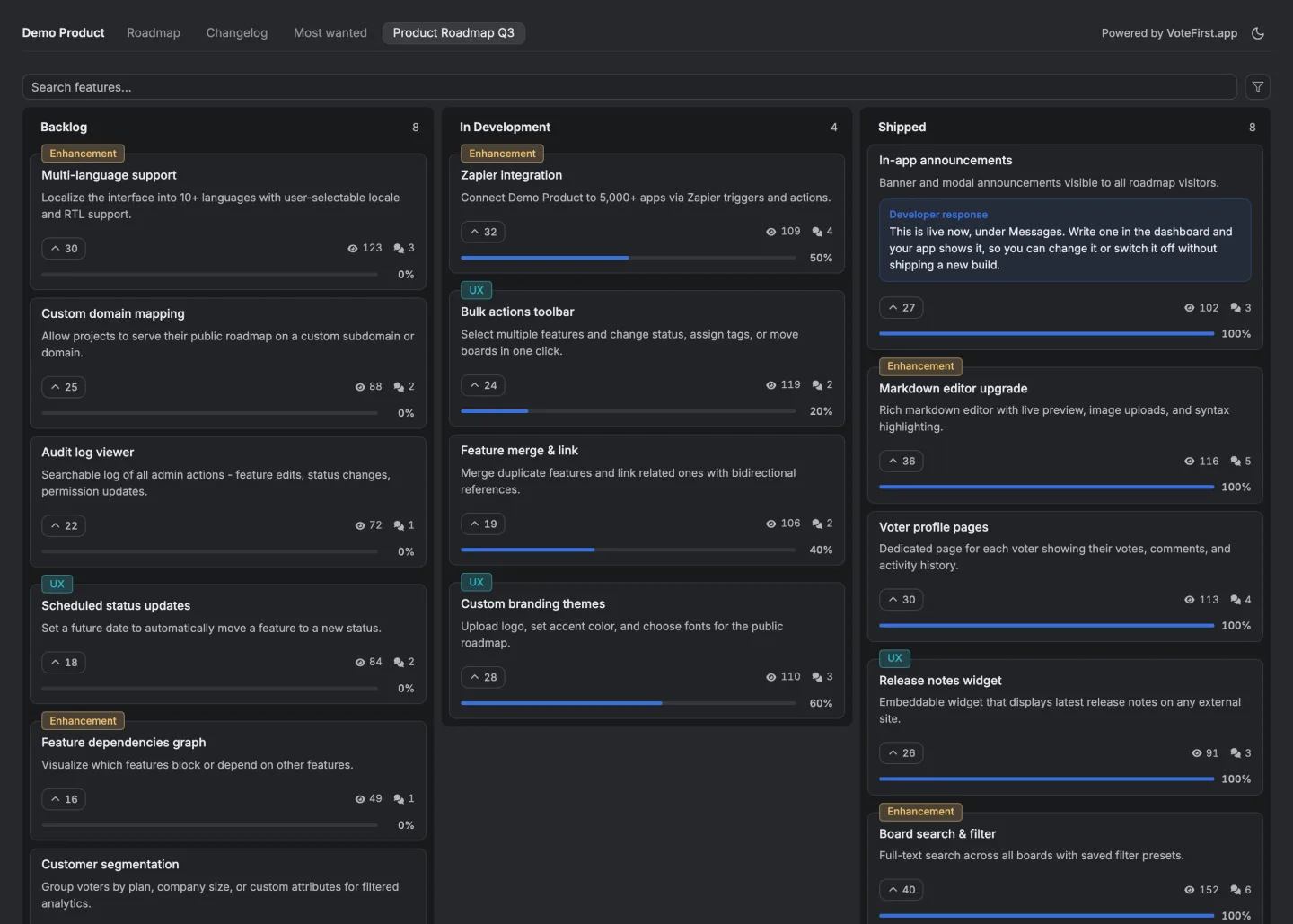
Where a board genuinely helps is recruiting, which is the part of discovery teams find hardest. Everybody who voted for a request is a person who has demonstrably met the problem and given you a way to reach them.
Turning a vote list into an interview list is a far smaller job than starting from nothing, and the voter list is where those people already are.
Which customers should you be talking to?
A deliberate mix, and the default drifts toward the friendly ones on its own.
Left alone, a weekly rhythm fills with whoever answers, and whoever answers is the enthusiastic minority. The correction is to decide in advance what the mix should be, usually some new accounts, some long standing ones, at least one that recently complained and at least one that is quietly not using the product much.
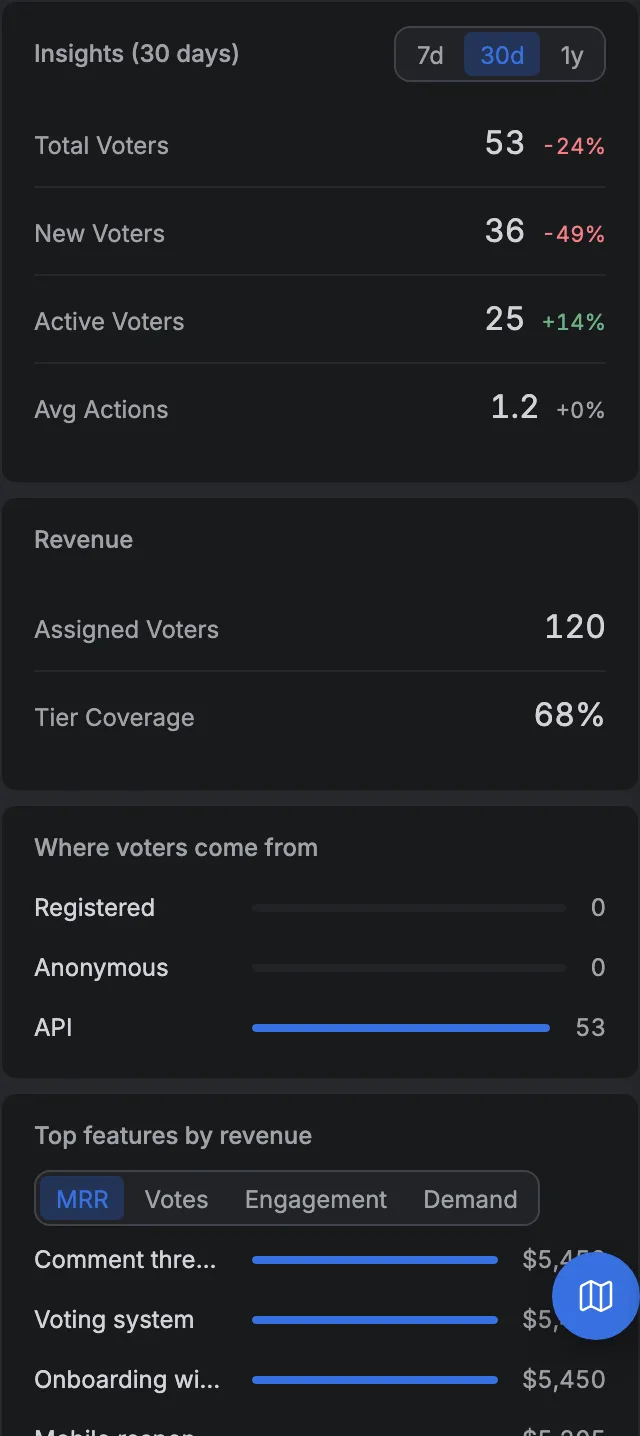
Knowing which is which is where the revenue on the voter helps. When accounts carry the plan they are on and what they pay, choosing who to talk to stops being a memory exercise. How the revenue reaches the voter is written out with the import behind it.
What happens to what you hear?
It changes an ordering, or it did not happen.
The most common failure is a well run discovery habit feeding a roadmap that was decided elsewhere. If the interviews never move a request up or down the list, the loop is open and everybody can feel it, including the customers being interviewed.
Closing it has a visible half and a private half. The visible half is telling the people who asked what happened, which is the customer feedback loop.
The private half is the ordering itself, and here that is driven by what people ask for weighted by what they pay rather than by the last conversation anybody had. The formula and the code behind it are published.
14 days, a card at signup, then $9 or $39 a month.