Weighted scoring is deciding, in advance and in writing, that some signals count for more than others, and then adding them up the same way every time.
That is all it is. The value comes from doing it before you are attached to an answer, because a rule written on Monday is much harder to bend on Friday than a feeling is.
What is weighted scoring?
Pick the things you care about, give each one a number, multiply, add.
If you care about how many people asked and how many people talked about it, and you think an ask is worth more than a comment, you have already designed a weighted score. Writing it down turns an instinct into a rule that treats every item the same, which is the entire benefit.
The thing being scored can be anything. Feature requests, support themes, sales objections. The pattern does not care.
What matters is that the weights are a policy, not a discovery. Nobody measured that an ask is worth one and a half comments. Somebody decided it.
A weighted score is an opinion that has been made consistent, and that is worth a great deal more than an inconsistent opinion, but it is not a measurement and the difference matters.
If the definition is easier to see than to read, the demo board is open with no account and no email.
What weights does this product actually use?
Ours are published rather than described, so here they are in full.
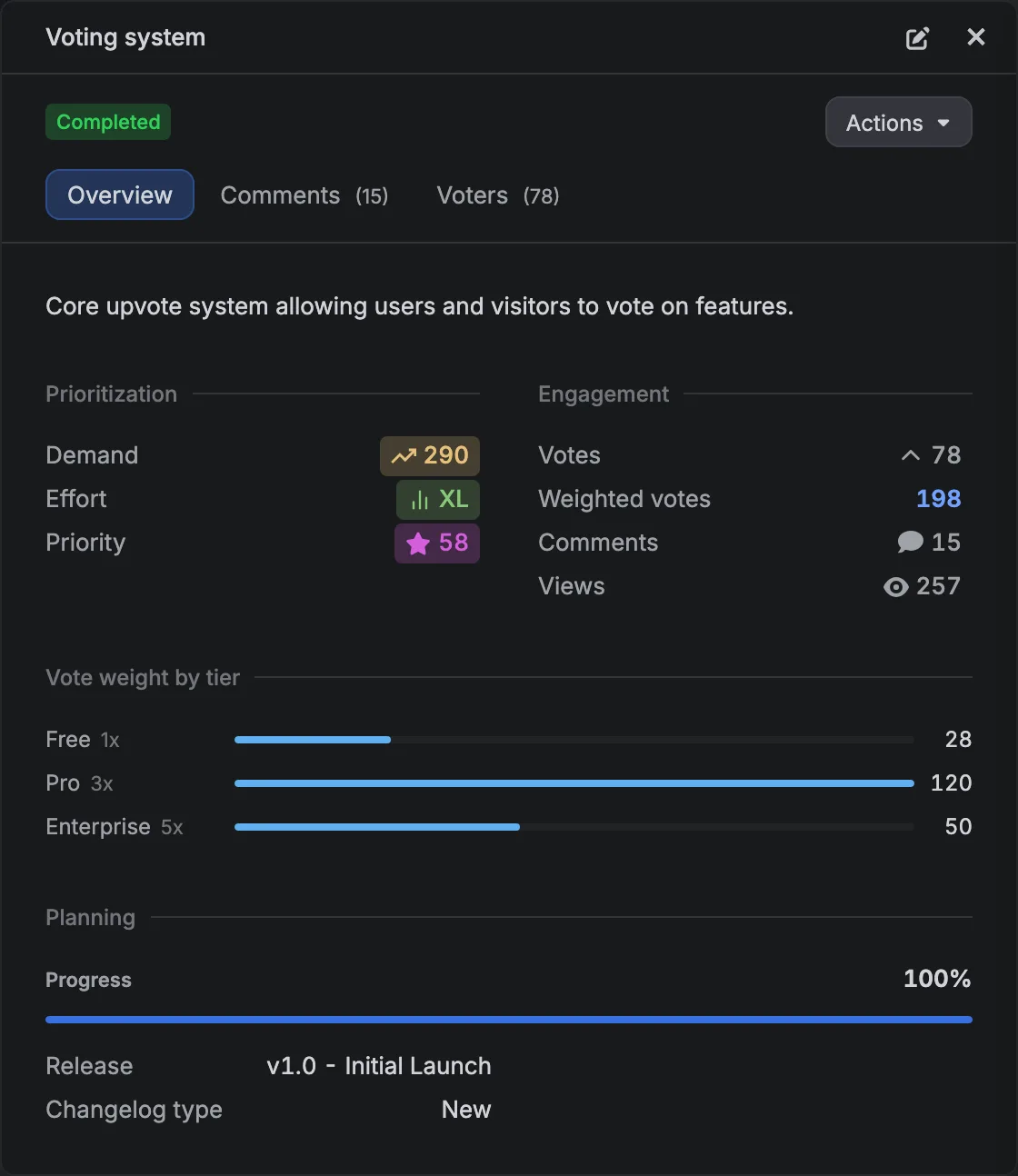
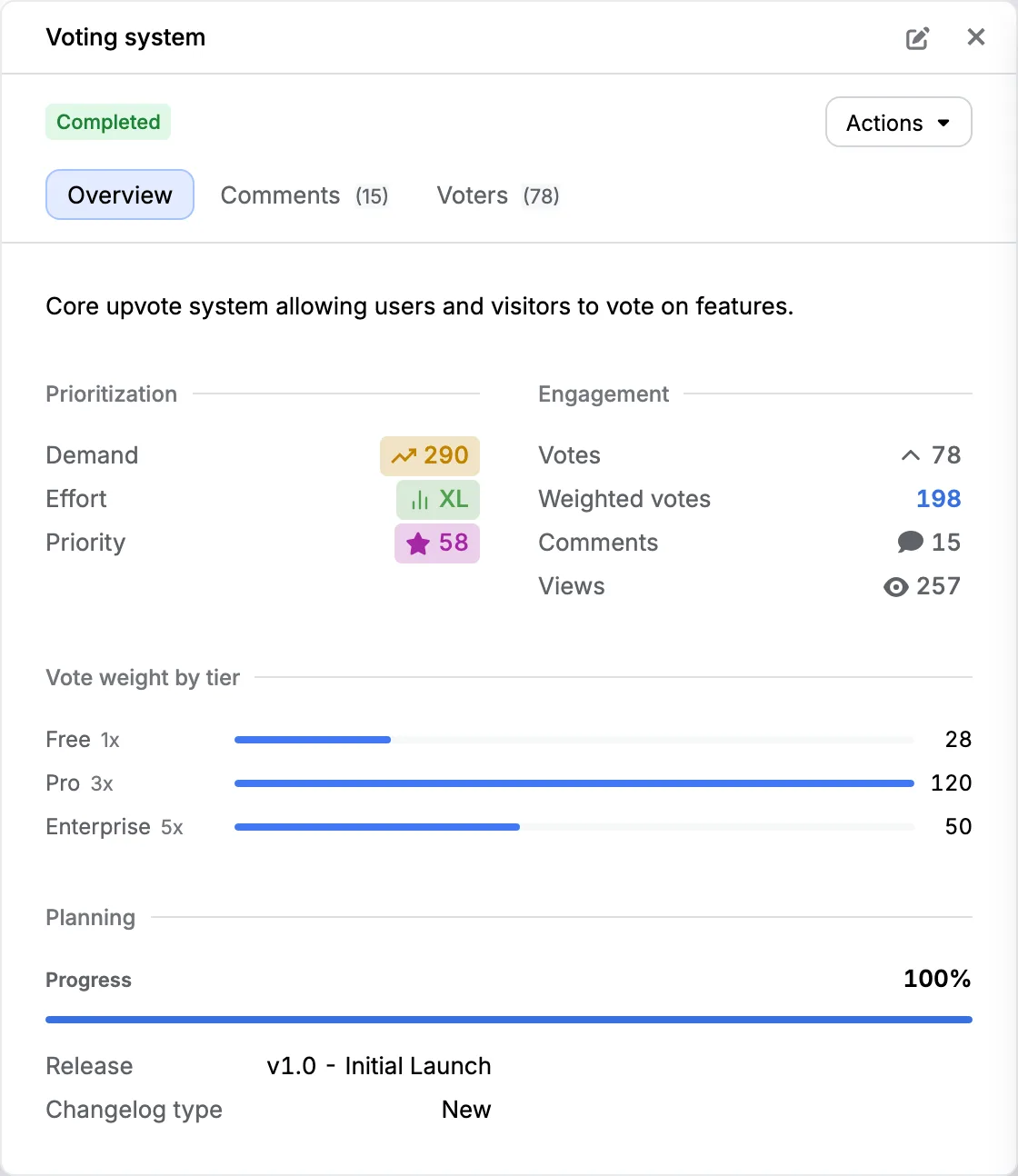
Demand is the votes multiplied by three, plus the comments multiplied by two, plus the views multiplied by a tenth and rounded to a whole number.
| Signal | Weight | Why it is where it is |
|---|---|---|
| A vote | 3 | Somebody took a deliberate action to say they want this |
| A comment | 2 | More effort than a vote and more information, but often from a person who also voted |
| A view | 0.1 | Weak on its own, useful in bulk, and ten views is worth one third of a vote |
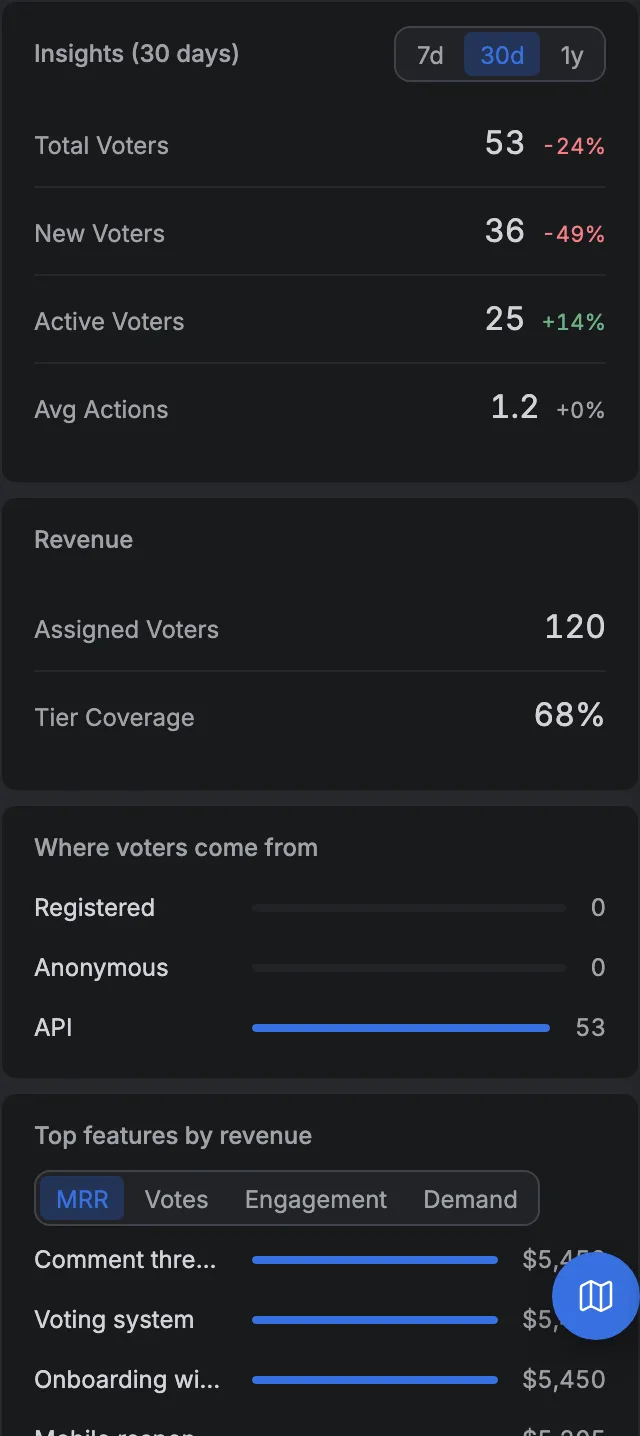
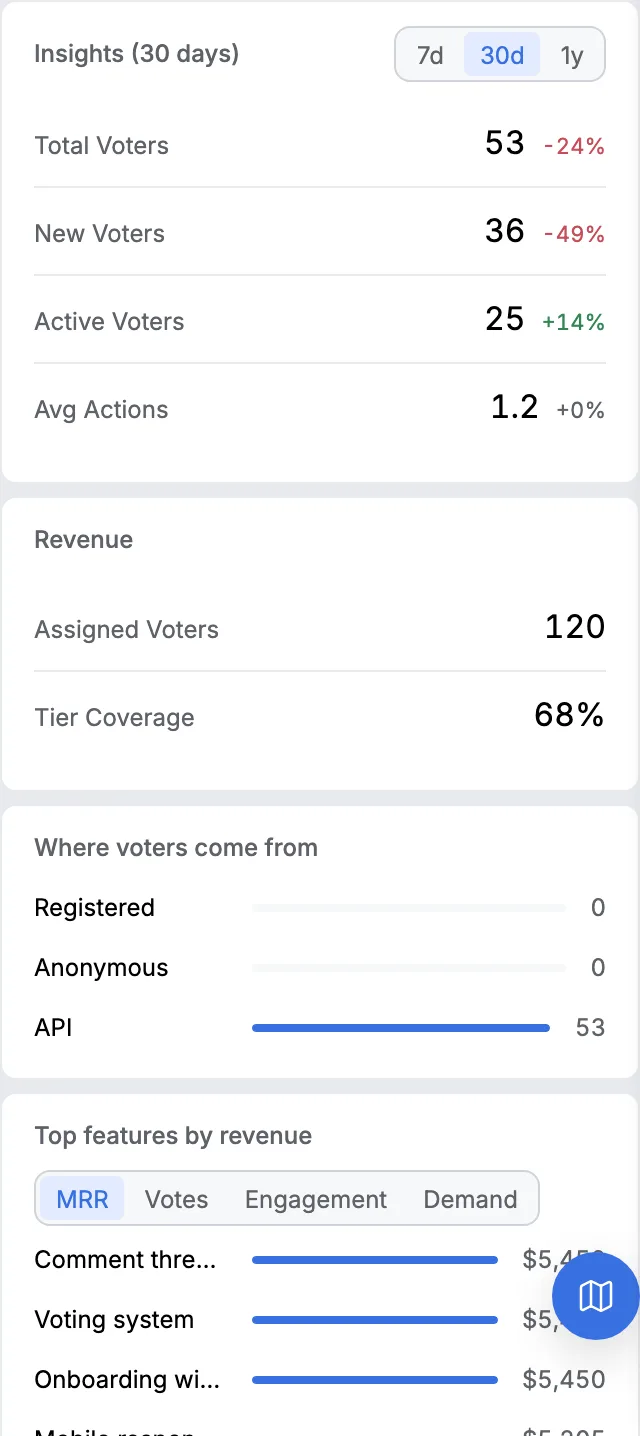
When weighted voting is switched on, the votes term is the weighted total rather than the plain headcount. So revenue enters this model at exactly one place. A vote from a customer paying you more is worth more inside that first term, and nothing else in the formula changes.
Then, when an effort estimate exists, priority is the demand divided by the effort, rounded. Effort is a five point scale with published meanings, being extra small at a few hours, small at a few days, medium at about a week, large at a few weeks and extra large at a month or more.
Is a score like this an output metric?
Yes, and it is worth naming rather than leaving implied.
All three terms above count something a person did before you built anything, and none of them can move after you ship. So the number ranks how much a thing was asked for and says nothing at all about whether building it helped.
The name for an organisation that measures itself that way is the useful thing to read next, because the failure is structural rather than a matter of picking better weights.
Why divide by effort?
Because a score with no cost in it is a wish list, and a wish list sorted by popularity is the most expensive way to run a roadmap.
Two requests can carry identical demand and one takes an afternoon while the other takes a month. Ranked by demand alone they are the same row twice. Divided by effort, the afternoon one lands near the top where it belongs, and the month long one has to earn its place with much more demand.
That division is also the honest limit of the model. It rewards small things, and if you follow it blindly for a year you will ship a great deal of polish and no new capability.
The number is a sort order, not a decision. Anything genuinely strategic is going to lose to a cheap win on this scale, every single time, and knowing that is the price of using it.
What is wrong with weighted scoring?
Three things, and the first one catches nearly everybody.
Precision is not accuracy. A score of 47 looks like a measurement. It is three guesses multiplied by three opinions. Showing one decimal place would not make it more true. The moment a team starts saying the score says rather than naming who decided, the model has stopped helping.
The weights encode a policy that then becomes invisible. Somebody chose three and two, and six months later nobody remembers that a choice was made at all. It reads as arithmetic, and arithmetic does not get argued with in meetings the way an opinion does. That is exactly why we publish ours on this page instead of describing them.
It measures what is countable. Votes, comments and views are all easy to count, which is why they are in the formula, and none of them is the same thing as importance. A model built the other way round, out of estimates rather than counts, has the opposite problem, and the best known one is worth comparing against. The customer who churns silently casts no vote at all. That gap between who is loud and who matters has its own name and no scoring model closes it on its own.
When should you use it and when should you not?
Use it when the list is too long to hold in your head, and stop using it when it starts answering questions you should be arguing about.
Below thirty or so open requests a scoring model is overhead. You can read the whole board, and you will make a better call from reading it than from sorting it.
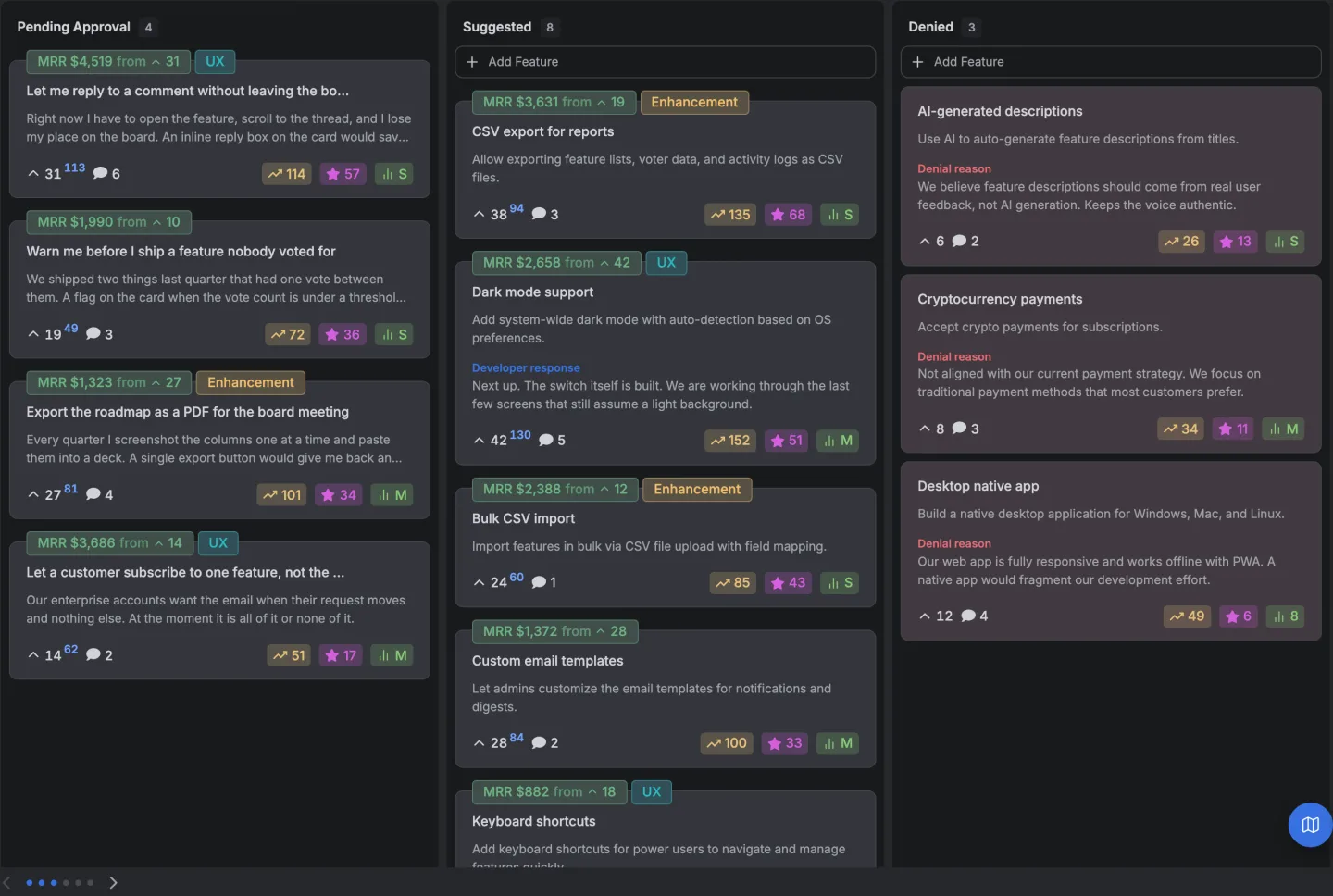
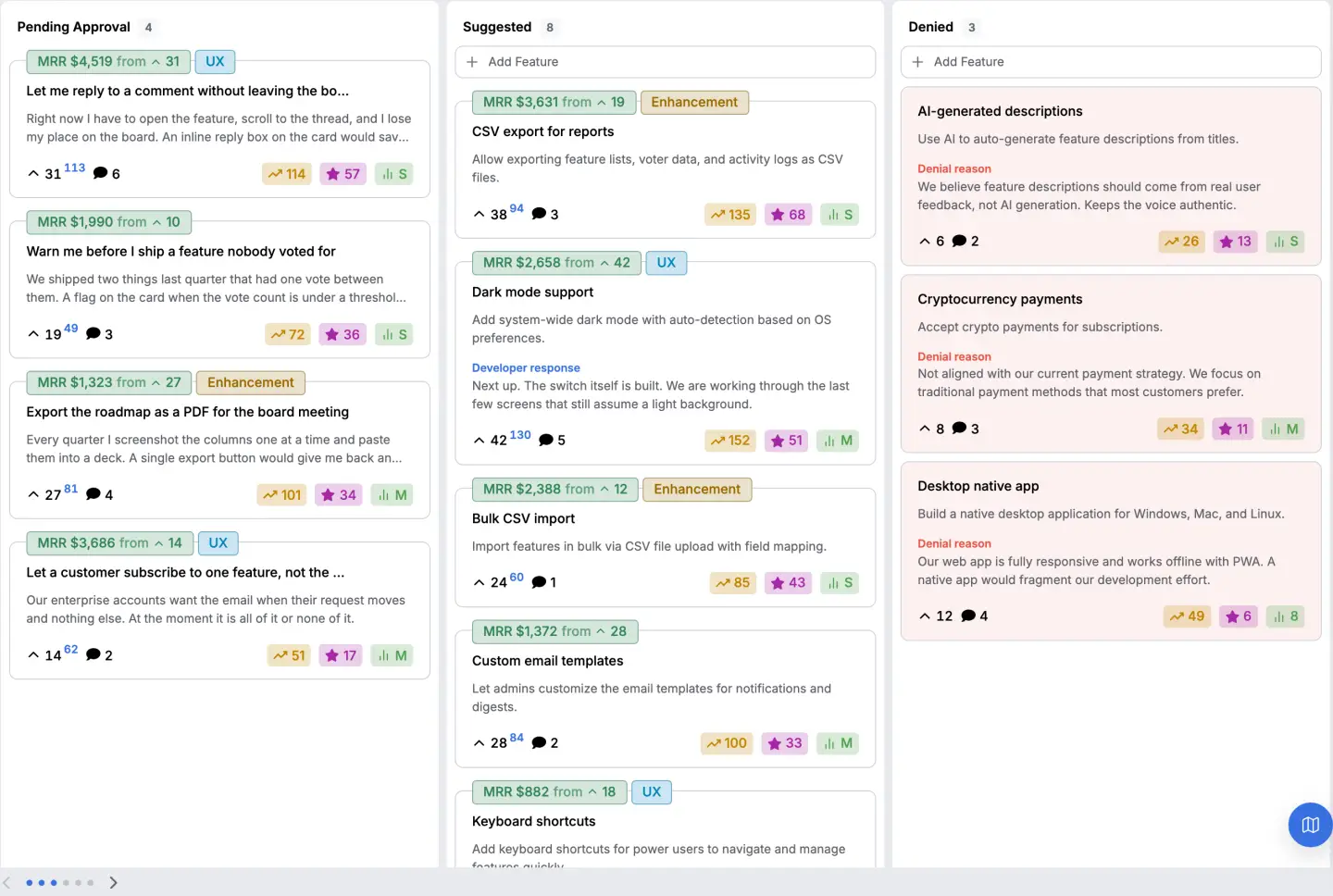
The model earns its keep at the point where nobody can hold the list any more, which is also the point where the loudest few start setting the agenda without anybody deciding that they should.
One thing to know before you rely on ours. The three coefficients are fixed. There is no settings screen for them and no API for them, so if you want a vote to be worth five rather than three, that is not something you can change today.
What you can control is whether the votes term uses the weighted total or the plain count, and the tier multipliers that feed it, which is where nearly all the useful movement is anyway. Put your own tiers in and watch the totals separate before deciding whether that is enough for you.
Whichever way you go, the argument underneath it is about feature prioritization rather than about coefficients, and that page sets out which of the inputs are counted and which are still yours to invent.
If it is, all of it is on the nine dollar plan with nothing gated above it, and a card is required for the fourteen day trial.
14 days, a card at signup, then $9 or $39 a month.