The short version
- Six survey shapes, from one number to twenty questions.
- A survey is the wrong instrument when the question is how many people want this.
- The follow up question is worth more than the score it follows.
- A board answers the counting question. A survey answers the feeling question.
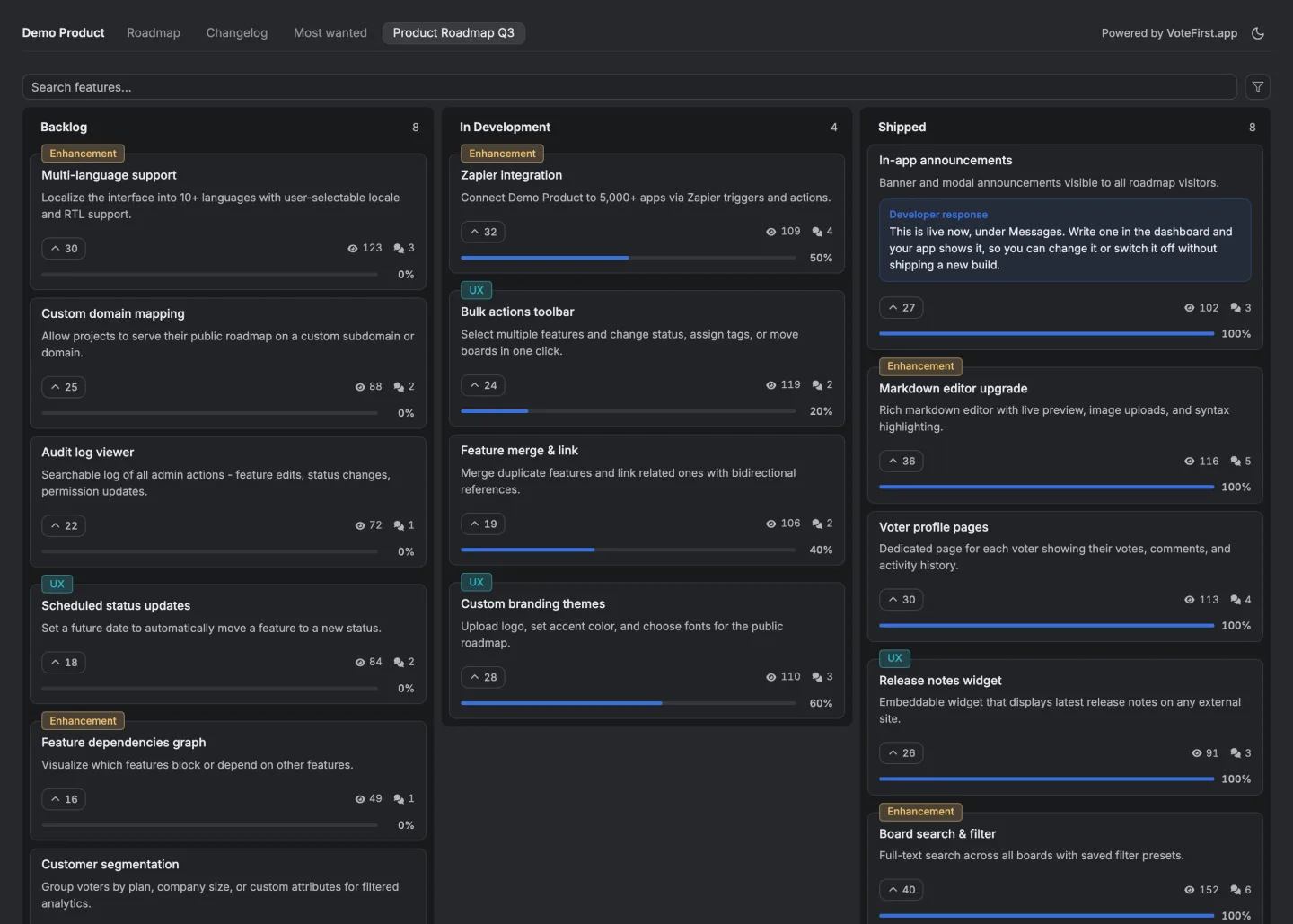
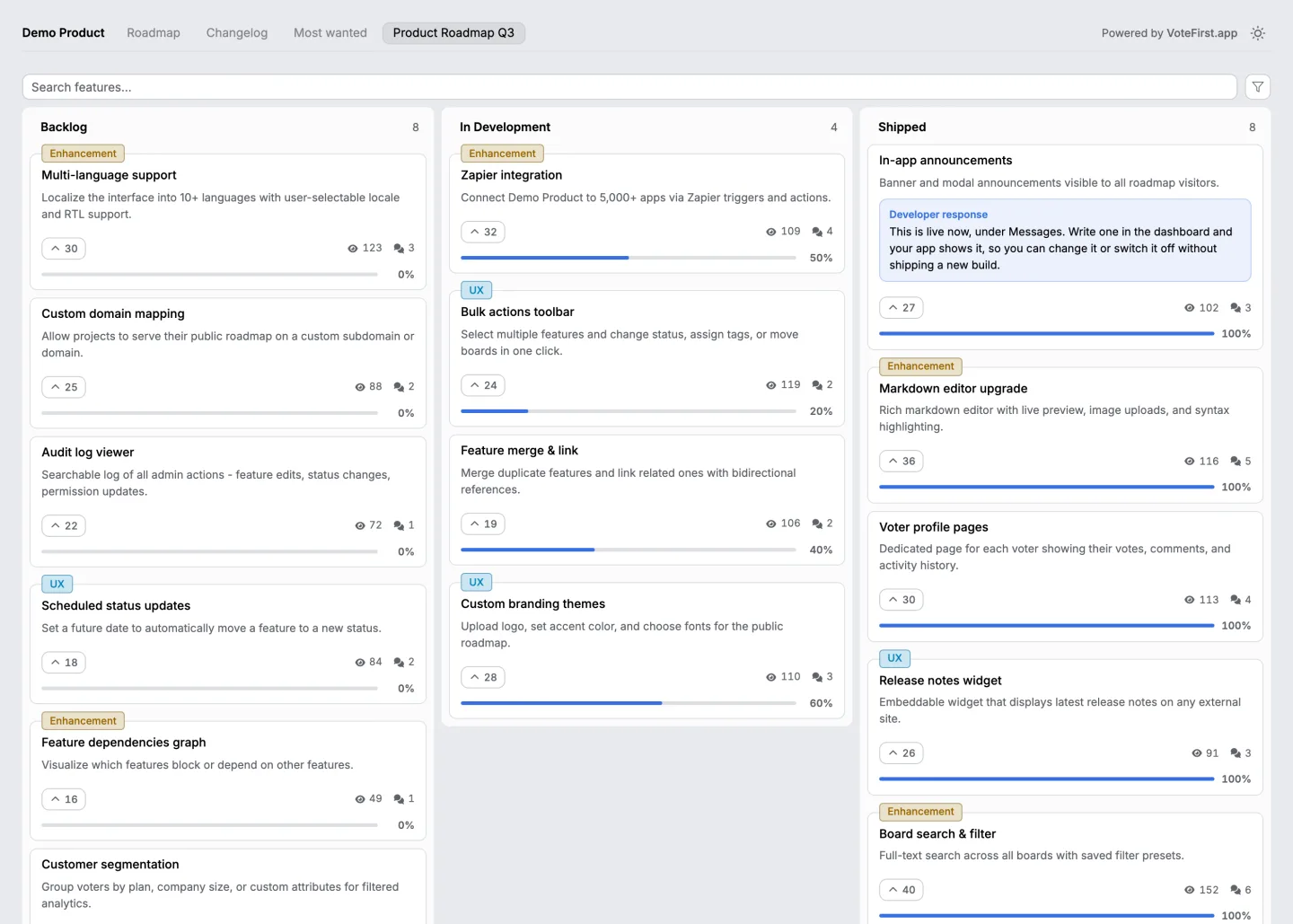
The feedback survey examples below all start from one difference. A survey is a question you ask on your schedule, and a board is a place people write on theirs. Both collect feedback and they're good at almost opposite things, which is why most teams running one should be running the other.
Six survey shapes are below with their actual question sets. Each is followed by what it can support and what it can't, and the last section is the case for not sending one at all.
What is a feedback survey?
A set of questions sent to a group of users at a moment you chose, usually with a rating in it.
The defining property isn't the rating. It's that you chose the moment, which means the answers are about whatever was on the person's mind when it arrived, not about the thing that actually annoyed them three weeks ago.
That's the strength and the weakness in one sentence. It's why a survey is excellent for measuring a trend and poor for finding out what to build.
There's a standing board doing the other job if you want to compare them, and the demo is open without an account.
Want the form to feed a board people can vote on? Twenty eight feedback tools, the price and the unit each one bills on, read on one day.
The six shapes
| Shape | Length | What it can support | What it cannot |
|---|---|---|---|
| The one number | 1 question | A trend over quarters | Any claim about cause |
| The one number with a follow up | 2 questions | A trend, plus the sentences that explain it | A count of how many want a thing |
| The post interaction survey | 2 questions | Whether one moment in the product works | Anything about the product as a whole |
| The onboarding check | 3 to 4 questions | Where new users get stuck | What experienced users need |
| The churn survey | 2 to 3 questions | Where value failed to land | Which feature would have kept them |
| The annual state of everything | 10 to 20 questions | A document | Almost nothing. It is the one to cut |
The one number
On a scale of 0 to 10, how likely are you to recommend us?
This is the whole survey, and its honesty is that it doesn't pretend to be more.
It supports one thing, watching a number across quarters with the same question and the same audience. That's genuinely useful and it's the only thing it supports. A team that sends it and then discusses what the score means is discussing a number with no sentence attached to it.
The one number with a follow up
On a scale of 0 to 10, how likely are you to recommend us?
What is the main reason for your score?
The second question is where the entire value is, and the first question exists to get people to answer the second one.
Make the follow up open. A multiple choice follow up returns your own hypotheses back to you, sorted. What you want is the sentence somebody writes in the ten seconds after choosing a number, because that's the closest thing to an unprompted opinion a survey can produce.
The post interaction survey
Did that do what you expected?
What were you trying to do?
Sent immediately after one specific thing, an import, a first board created, a support conversation closed.
This is the best shaped survey on the list, because the moment is chosen by the user's action rather than by your calendar. The memory is fresh and the subject is narrow, so the answers are specific enough to act on.
The failure mode is asking it after everything. A survey that appears after every action is an interruption, and people learn to dismiss it before reading.
The onboarding check
What were you hoping to get set up today?
What is still missing?
Is there anything you expected to find and did not?
Sent a few days after signup, to people who haven't finished setting up.
The third question is the one worth keeping. It returns the gap between what your marketing implied and what the product does, which is a thing nobody inside the company can see.
The churn survey
What made you decide to cancel?
Was there anything that would have changed that?
Two questions, both open, sent at the moment of cancellation, not a week later.
Read the answers as statements about value, not about features. "Too expensive" almost never means the price is wrong. It means what landed was worth less than the price. The second question is worth asking and worth distrusting, because people name the last thing they noticed rather than the thing that decided it.
The annual state of everything
Twenty questions about satisfaction, features, support, pricing, and future plans.
This is the one to cut.
It produces a document, not a decision. The response rate is the lowest of anything on this list, the people who answer are the ones who like you most, and by the time it's analysed the product has moved.
Every question in it that's worth asking is worth asking at the moment it applies, which is what the four shapes above do.
When is a survey the wrong instrument?
When the question you actually have is how many people want this.
A survey can't answer that, because it can only ask about things you already thought of. The options you list are your own hypotheses, and the result is a ranking of your hypotheses, not a discovery of anything.
A standing board can answer it, because the requests come from the users and anybody who arrives later can agree with one that already exists. The count builds itself between surveys rather than being manufactured twice a year.
The honest division of labour is that the survey watches a number and the board answers what to build.
How do you do this without a tool?
Any survey tool sends these six shapes. Use the shortest one that answers your question, ask the open follow up, and read the sentences, not the averages.
The part no survey tool gives you is the standing collection between sends. For that you need somewhere permanent that users can reach on their own initiative, and the cheapest version is a public page where requests accumulate.
How does this product do it?
Requests arrive whenever somebody has one, on a public board. Nothing a visitor writes appears publicly until somebody approves it.
Other people vote on what's already there, so the count grows without anybody being asked, and each voter carries whatever you know about them, so a count can be read by revenue as well as by headcount.
There's no survey in it. That's deliberate. This product does the standing collection and leaves the periodic number to the tools built for it.
The feedback board is the standing collection this compares against, the types of user feedback sorts every source by what it proves, and voice of the customer covers the phrase most of these surveys are sold under.
14 days, a card at signup, then $9 or $39 a month.