The short version
- A feedback form is a short structured message, collected at a moment you chose.
- Four fields decide whether it works, and who sees the answer is the biggest decision.
- Two fields is the right number for a request, and that's defensible rather than taste.
- Anonymous is more honest and less useful.
A feedback form is the place a user writes something about your product and presses a button. That's the whole definition, and it's worth saying plainly because most pages under this title are selling a template.
The interesting part isn't what a form is. It's that a form is four decisions wearing the costume of a layout, and every one of them changes how many people finish it.
What is a feedback form, in one sentence?
A short structured message from a user to you, collected at a moment you chose, that lands somewhere you can read it later.
Three of those clauses do work. Structured means you decided the fields, which means you decided what you'll and won't hear. At a moment you chose means the form has a trigger, and the trigger matters more than the fields. Somewhere you can read it later is where most forms fail, because the message arrives in an inbox nobody owns.
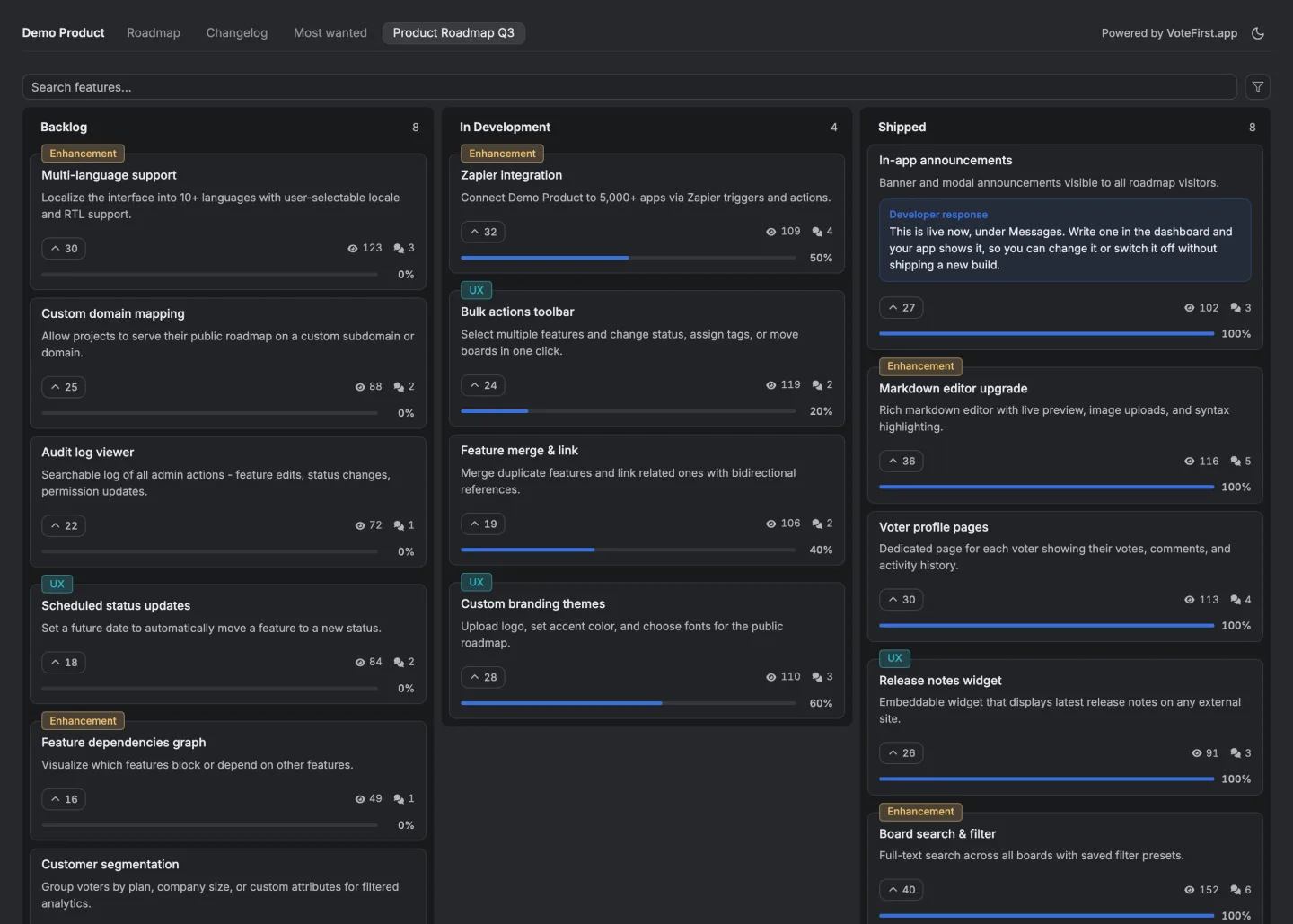
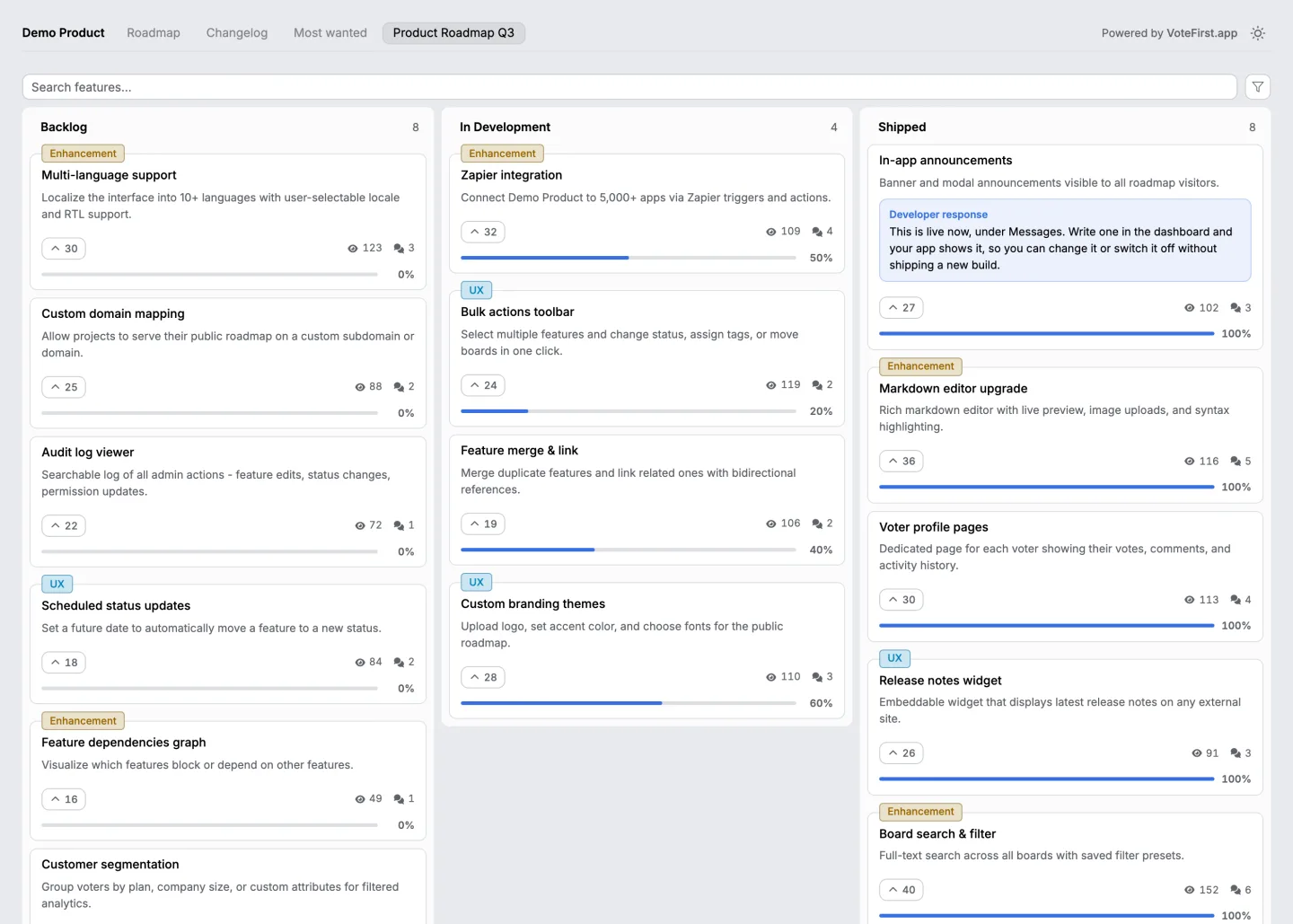
There's a form on a live board if you want to see one, not read about one, and the demo is open without an account.
Want the form to feed a board people can vote on? Twenty eight feedback tools, the price and the unit each one bills on, read on one day.
The four decisions
| The decision | The two options | What it costs |
|---|---|---|
| Who sees the answer | Only you, or everybody | Private gets more replies. Public gets counts, because others can agree with a message that already exists |
| How many fields | Two, or more than two | Every field past the second costs replies. Every field you drop costs you context |
| Whether the sender is identified | Anonymous, or attached to a person | Anonymous gets more honesty and less follow up. Identified lets you ask the second question |
| What happens after submit | Nothing, a thank you, or a visible item | Nothing is the default and it is why people stop writing. A visible item is the only one that pays the sender back |
Those four are the form. The colours and the rounded corners aren't.
Who should see the answer?
This is the decision people skip, and it's the largest.
A private form is an inbox. It gets more replies, because writing to one person feels safer than writing to a room, and it gets you nothing you can count. Ten people writing the same request privately looks like ten separate messages, and you'll read them across three weeks and never notice.
A public form is a board. Fewer people write, because writing in public is a decision, but the ones who do are joined by everybody who recognises the problem and clicks. The count is the thing the private version can never produce.
The version that works is usually both, a public board for requests and a private channel for the things people won't say in front of other customers, which is mostly pricing and frustration.
How many fields?
Two is the answer for a request, and this is defensible, not a taste.
Every field is a small decision the sender has to make, and every decision is a place to close the tab. A field you added because it would be nice to have is a field you'll find empty or filled with a shrug.
Our own suggestion form has exactly two, a title of at most 200 characters and a description of at most 2,000. There's no category picker, no priority selector, no email field and no attachment. The whole form is those two boxes, a line saying what happens next, and two buttons.
The thing to notice is what's missing. A category picker moves the work of classification from the person who knows the product to the person who doesn't, and you get things filed under Other. Priority asked of the sender returns High, from everybody, every time.
Should the sender be identified?
Anonymous is more honest and less useful. Identified is less honest and much more useful, because it lets you go back and ask the one question the message didn't answer.
The middle position that actually works is to let people write without making an account, and attach whatever you already know about them from the session. Somebody who arrives through your product is already a customer, and a form that makes them sign in again to tell you something is a form that measures patience.
What happens after submit?
The default is nothing, and nothing is why second messages stop.
A thank you screen is polite and costs you nothing to build. A visible item is the one that changes behaviour. The sender's message becomes a thing on a page, with a state, that other people can agree with. That's the difference between reporting into a void and putting something on a list.
The complication is that a public form with instant publication becomes a wall of noise inside a week, including things you can't leave up. So the working version publishes after somebody looks.
On our side, nothing a visitor writes appears publicly until somebody approves it, and the form says so where the sender can read it before writing.
The mistakes
A form nobody can find. The best form on a page nobody visits collects nothing. Put it where the frustration is, not on a contact page.
A form that asks for the category. You know your product's categories. The sender doesn't.
A form with a rating on it and nothing else. A number with no sentence is evidence the number moved and nothing more.
A form that closes the loop nowhere. If the sender never learns what happened, they won't write twice, and the people who write twice are the ones worth having.
A form with a required email on a public board. You have just traded away most of your replies for a field you'll use on one message in twenty.
How do you do this without a tool?
A two field form from any form builder into a shared inbox does the collecting. What it doesn't do is the counting, because nobody but you can see what has already been asked.
That's fine while the number of requests is small enough to hold in your head. It stops being fine at the point where you can't remember whether the thing in front of you is new.
How does this product do it?
The form is the two fields above, on a public board. Nothing a visitor writes appears publicly until somebody approves it.
Once it's up, other people vote on it and comment on it, and each voter carries whatever you know about them, so the count can be read by revenue as well as by headcount.
There's a longer version of what to put in each of those two fields on what to put in a feedback form, and the feedback board page has the rest of what the board does.
How to write one covers the wording of each field.
14 days, a card at signup, then $9 or $39 a month.