The short version
- Six strings decide whether a form gets finished: heading, labels, placeholders, button, and the line under it.
- People finish a form when they know what will happen to what they write.
- The placeholders carry the real writing, and they're where forms are laziest.
- Don't be cheerful. Somebody filling in a feedback form is usually mildly annoyed.
How to write a feedback form is mostly how to write six short strings, being a heading, two labels, two placeholders and a button. Most of a form's completion rate is decided in those six, and they're the part that gets the least attention.
This post is about the wording. What to put in a feedback form is about which fields exist at all, which is the decision above this one.
What makes somebody finish a form?
Knowing what will happen to what they write, before they write it.
Everything else in this post is a version of that sentence. A person with a tab open and a complaint is deciding whether the next ninety seconds are worth it, and the thing that decides it's whether the form reads like it goes somewhere rather than how it looks.
There's a form on a live board doing this if you want to read the actual strings, and the demo is open without an account.
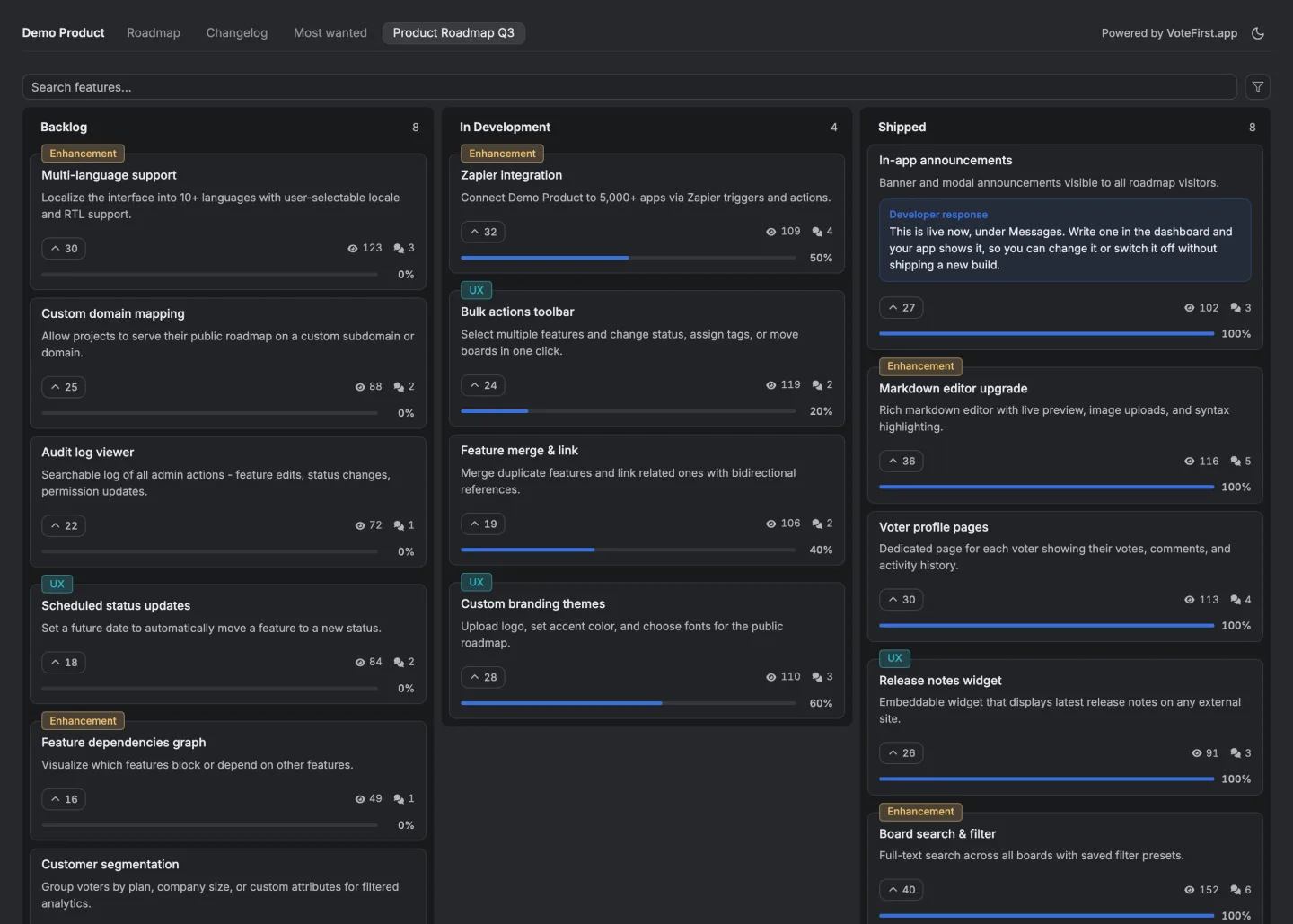
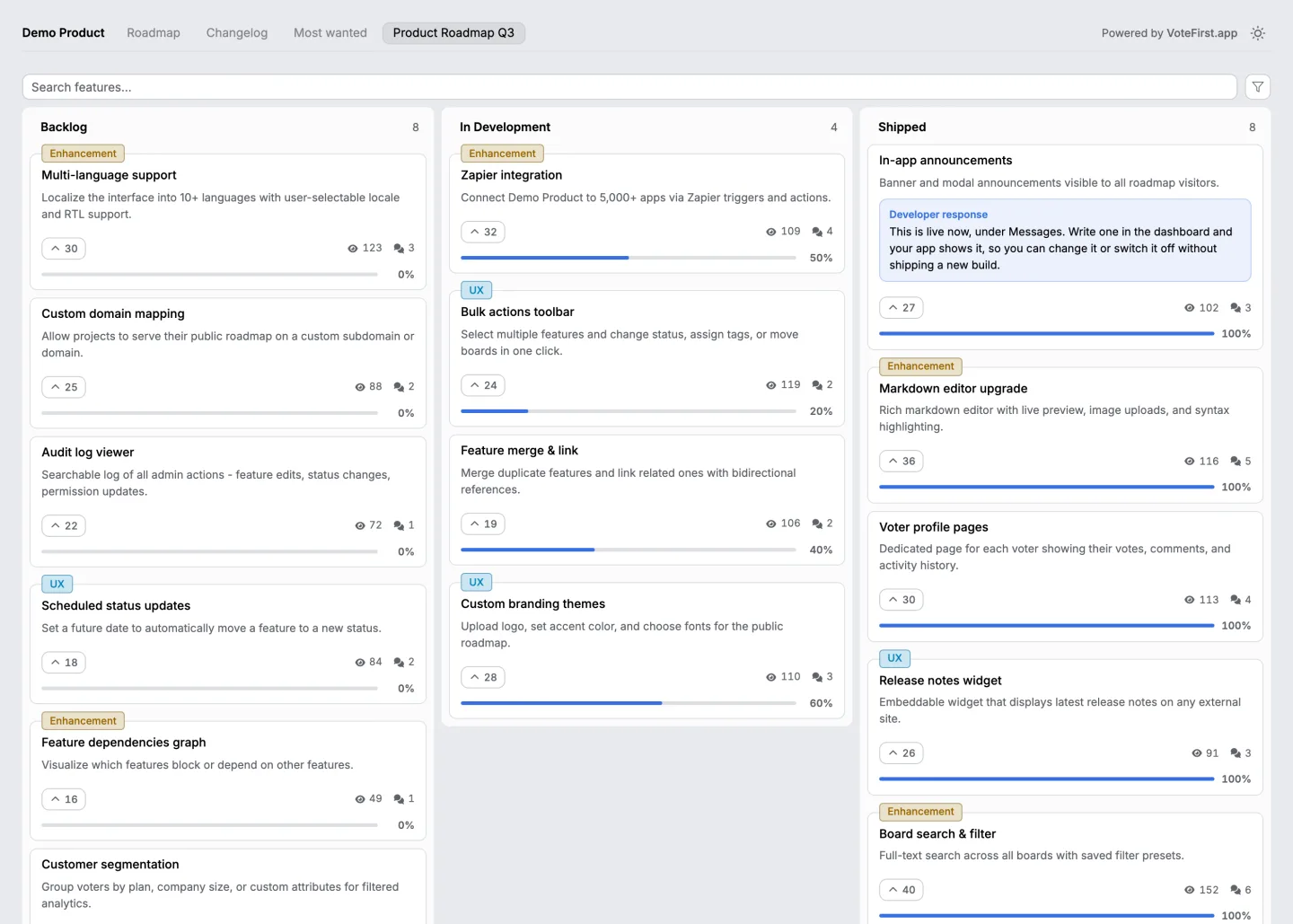
Want the form to feed a board people can vote on? Twenty eight feedback tools, the price and the unit each one bills on, read on one day.
The six strings
| The string | Ours | What it is doing |
|---|---|---|
| Heading | Suggest a Feature | Names the act, not the form. Nobody wants to fill in a form |
| First label | Title | One word. A label is not a place for instructions |
| First placeholder | A short, descriptive title | The only instruction most people read |
| Second label | Description | One word again |
| Second placeholder | Describe the feature you'd like to see... | Tells the sender what kind of thing goes in the box |
| Button | Submit | The plainest word available |
Six strings and a seventh line under them saying what happens next. That's the whole text of the form.
The heading
Name the act. Suggest a feature, report a problem, tell us what's missing. Every one of those is a thing a person might want to do.
Feedback form isn't a thing a person wants to do. Neither is We value your input, which is about you, not about them and reads as a preamble to being ignored.
The labels
One word each, wherever one word will do.
A label that carries instructions is a label doing the placeholder's job, and it stays on screen forever taking up space. Title and Description are labels. What would you like to tell us about your experience today isn't a label.
The placeholders
This is where the real writing is, and it's where forms are usually laziest.
A placeholder that repeats the label is wasted. Enter title under a label reading Title has told the sender nothing. The placeholder's job is to answer the question the sender actually has, which is what kind of thing goes in here and how much of it.
Ours says a short, descriptive title for the first, and describe the feature you'd like to see for the second. Both say what shape of thing to write.
The version worth trying if you want situations, not solutions is a placeholder that asks about the moment. What were you doing when this came up. It costs no extra field and it changes what arrives.
The question that gets skipped
Any question whose honest answer embarrasses the sender, and any question they can't answer.
How important is this to you is both. The honest answer is that they don't know how it compares to the other things you could build, because they can't see the other things. So they pick the top option, and the field returns nothing.
The same is true of which area of the product does this relate to. They will guess. Their guess costs you more than the sorting it saved.
The button
Submit is fine. Send is fine. So is anything that names the act, like Post my suggestion or Send the report.
What doesn't work is a button that promises something the form can't keep. A button reading Get help on a form that goes into an unread inbox is a broken promise with a click on it.
The other thing a button does is tell the sender how final this is. If the message becomes visible to other people, the button is the last honest place to say so, and it's better said in the line under the button than inside it.
The line under the button
The most useful sentence on any feedback form is the one that says what happens next.
Ours reads that your suggestion will be reviewed by the project owner before it appears on the board. This may take some time.
That sentence does three things. It says the message goes somewhere. It says a person will read it. And it says there will be a delay, which is the thing that otherwise makes a sender conclude the form is broken.
The mistakes
Being cheerful about it. A person filling in a feedback form is usually mildly annoyed. Matching that with enthusiasm reads as not listening.
Asking for a rating first. The number gets chosen, the box below it gets skipped, and you've traded a sentence for a digit.
Required fields that aren't required. Every asterisk is a place to stop.
A thank you page that says nothing. If you can say what happens next, say it. If the message becomes an item somebody can look at, link to it.
How do you do this without a tool?
The six strings are six strings in any form builder. Write them, then fill in your own form as a stranger and count the decisions you had to make. Every decision is a place somebody else leaves.
What no form builder gives you is the line under the button being true. That sentence is only worth writing if a person really does read what arrives.
How does this product do it?
The strings in the table above are the ones our board renders. The suggestion goes to the project owner, nothing a visitor writes appears publicly until somebody approves it, and once it's approved it becomes a card with its own thread that other people can agree with.
The feedback board page covers the board the form sits on.
Six feedback forms with their fields written out shows the wording in place.
14 days, a card at signup, then $9 or $39 a month.