The Kano model sorts features by how customer satisfaction responds to them, rather than by how much people say they want them.
That distinction is the whole idea. Asking people to rank a list gives you a list of wants. The model asks a different question, which is what happens to satisfaction when a feature is present and what happens when it is absent, and those two answers together put a feature in a category.
What are the Kano categories?
Five, and the useful part is that three of them behave in ways a ranked list cannot show.
Must be. Nobody praises it when it works and everybody leaves when it does not. Login, billing that charges the right amount, data that is still there tomorrow. Satisfaction from these things is capped at zero and the downside is unlimited.
Performance. More is better, in a straight line. Speed, storage, limits. These are the features a ranked list handles well, which is why teams that only rank end up with a product made almost entirely of them.
Attractive. Nobody asked and the presence of it delights. The category is unstable by nature, because today's delight is next year's expectation.
Indifferent. Presence and absence both change nothing. Every backlog has more of these than anybody wants to admit.
Reverse. Some people actively dislike it. Rare, and worth finding before you build it rather than after.
How does the Kano survey work?
Two questions per feature, asked as a matched pair, and the pair is the trick.
The first question asks how you would feel if the feature were there. The second asks how you would feel if it were not.
Both use the same five answers, running from liking it, through expecting it, being neutral about it and being able to live with it, to disliking it. The combination of the two answers puts the feature in one of the categories above, read off a fixed table.
It works because neither question alone is informative. Almost everybody says they would like almost anything. The second question is what separates the feature people would miss from the feature they would merely accept.
What does the Kano model cost to run?
Real time from real customers, which is the reason most teams read about it and never do it.
Every feature you want classified needs two questions, so a survey covering fifteen candidates is thirty questions long. You need enough respondents for the categories to be stable, and you need them to be your customers rather than whoever answers surveys. Then the result ages, because attractive features decay into expected ones on their own.
None of that makes it wrong. It makes it a periodic exercise for a small set of important decisions, not a way of ordering a backlog every week.
Does a feedback board do anything like this?
No, and pretending otherwise would be the easiest lie on this page.
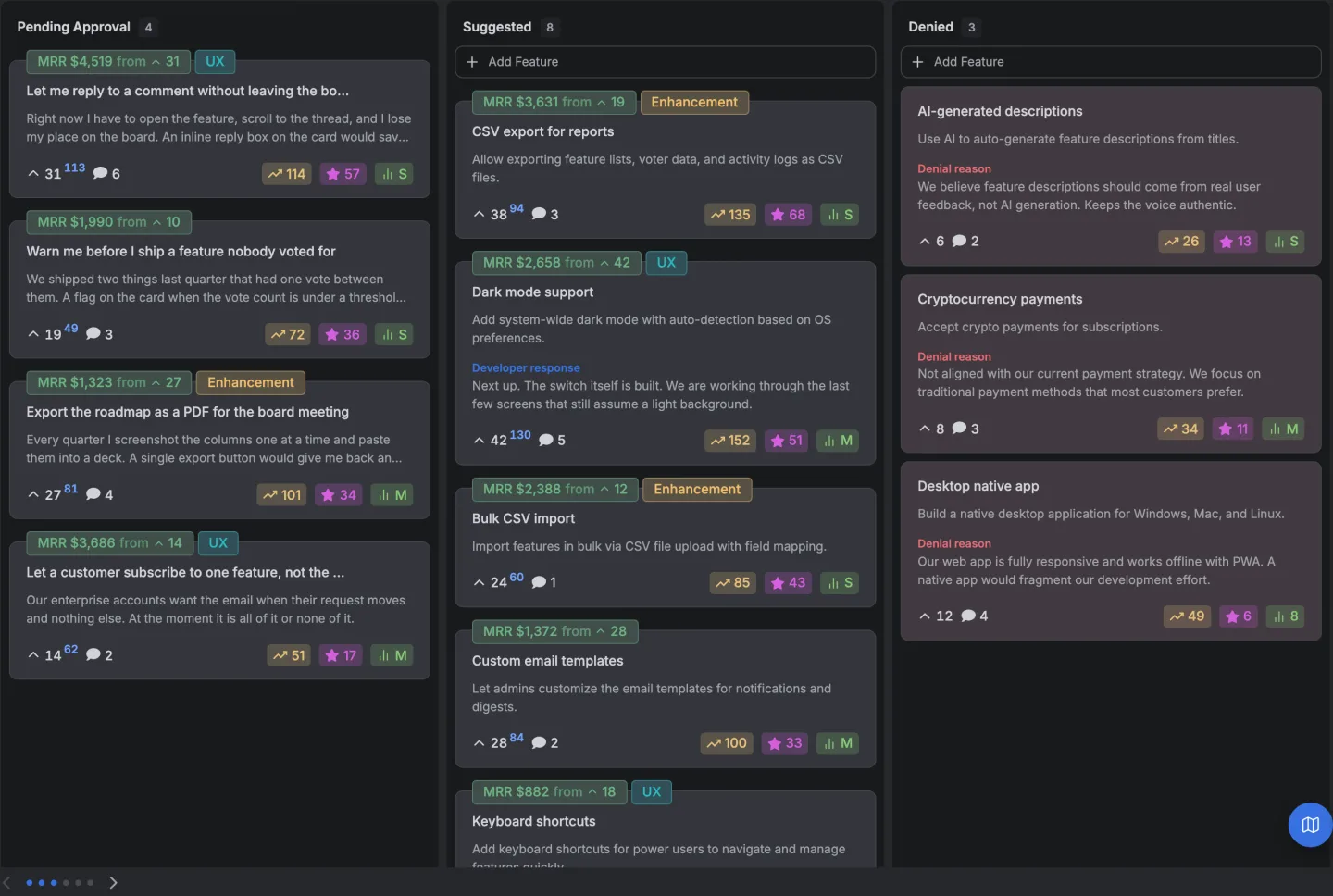
A board counts asking. Every vote on it is one person saying they would like a thing, which is the first Kano question and only the first. The second question, the one that does the work, is not asked anywhere in this product and there is no survey mechanism in it to ask with.
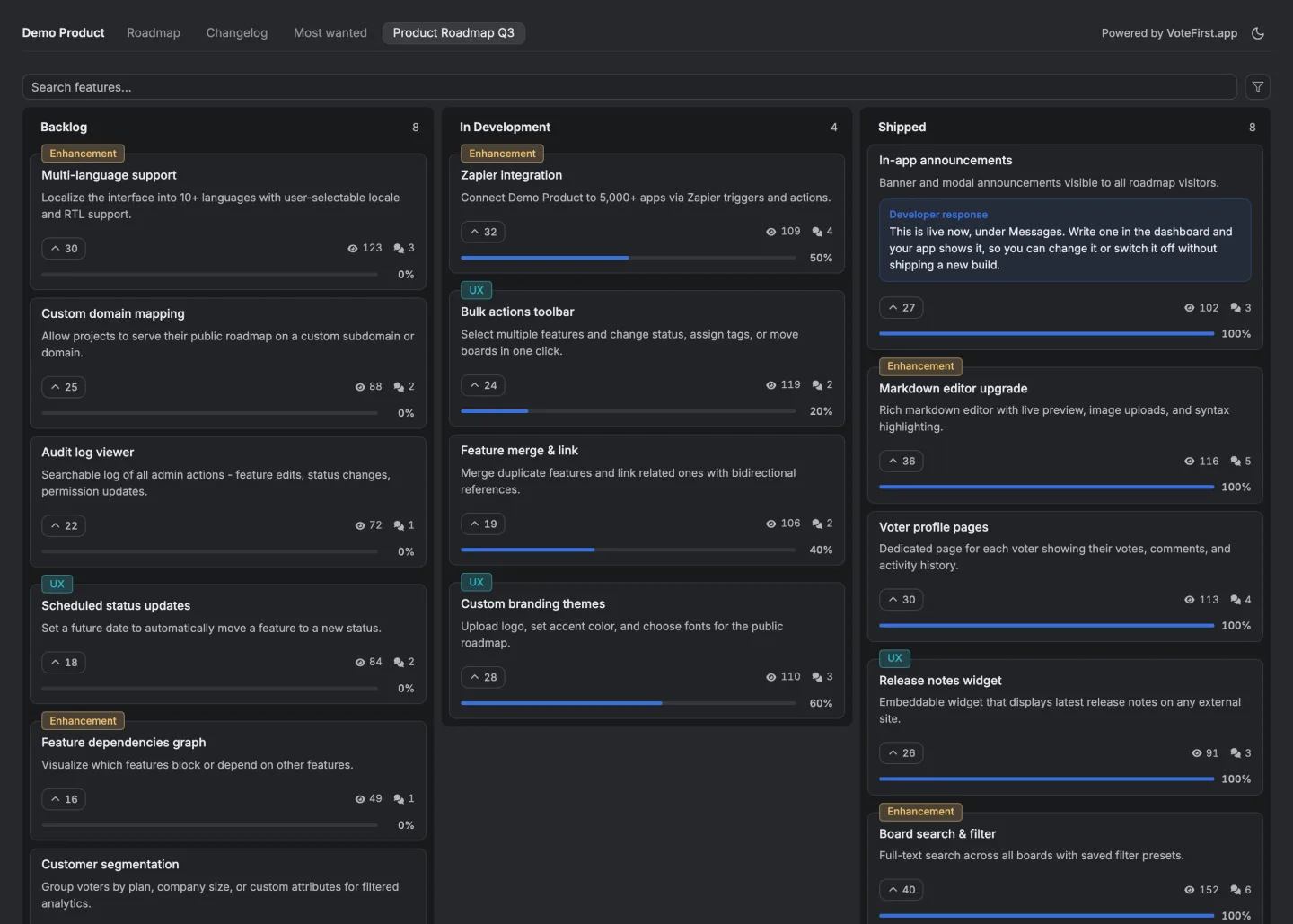
What a board does give you is the raw material for the exercise.
The requests that keep arriving, the ones with the most voters behind them, and the ones your paying customers voted for are a better candidate list than a brainstorm, and a candidate list is what a Kano survey needs before it can start. How the ordering works here is written out in full.
Which method should you use for ordering a backlog?
Whichever one you will actually keep doing, and for most teams that is not this one.
Scored methods like RICE are cheap to run weekly and expensive in judgement, because somebody has to type the numbers. Vote counts are cheap and biased toward whoever is loudest.
Weighted votes replace the popularity part with something connected to the business, which is why the weighting exists here at all, and the code and formula behind it are published rather than described.
The Kano model is the one to reach for when the argument is not about order but about kind. When a team is arguing over whether a feature is table stakes or a differentiator, that is a Kano question and no vote count will settle it.
14 days, a card at signup, then $9 or $39 a month.