Harvestr draws a line most of this category does not draw at all. There is an editor, who changes things, and a contributor, who adds feedback and comments, and contributors are unlimited on every plan.
The editor is seventy nine dollars a month, or sixty five on the yearly rate. Everything below was read on Harvestr's own pricing page on 16 September 2026.
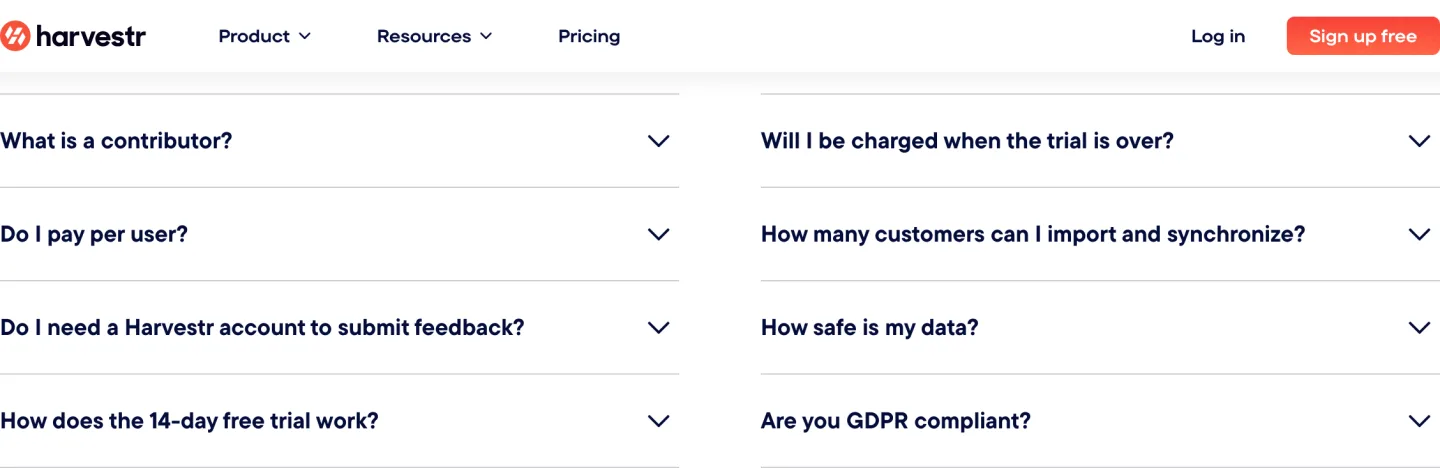
What does Harvestr cost?
Two published plans and a quoted one.
| Plan | Monthly per editor | Yearly per editor | AI categorisations | AI questions |
|---|---|---|---|---|
| Core | $79 | $65 | 250 a month | 100 a month |
| Scale | $99 | $85 | 500 a month | 250 a month |
| Elite | Contact sales | Contact sales | Custom | Custom |
- Core carries unlimited contributors, the essential connectors, feedback intelligence, customer insights and product decisions.
- Scale doubles the AI categorisations, more than doubles the AI questions, and adds advanced connectors, smart inboxes, catchup and AI actions.
- Elite adds Salesforce, automations, custom dashboards, contributor roles, SAML single sign on and a custom contract.
The trial is fourteen days.
If that arithmetic came out badly, a trial here is 14 days with a card at signup and the bill after it is $9 or $39 a month.
How has Harvestr's price changed?
Harvestr's pricing page carries a Monthly/Annually switch. The entry plan cost $39 a month, $49 billed monthly, in July 2019 (the page loaded on the Annually tab that capture; later captures load on Monthly). Read live on 3 October 2026, the cheapest plan is Core at $79 a month per editor, $65 on the yearly rate.
| Date | What the pricing page showed | Source |
|---|---|---|
| July 2019 | Starter $39, Team $79, Company $119 a month billed yearly ($49, $99, $149 billed monthly), all per editor; the page loaded on the Annually tab | archived page |
| April 2020 | Starter $49, Team $99 billed monthly ($39, $79 billed yearly), Company quoted, all per editor | archived page |
| April 2021 | Launch free for 1 editor, Rise $39, Scale $79 billed monthly ($32, $65 billed yearly), Elite quoted, all per editor | archived page |
| May 2022 | Unchanged from April 2021 | archived page |
| January 2023 | Rise gone; Launch free, Scale $79 billed monthly ($65 billed yearly), Elite now published at $139 flat (no annual discount on Elite), Enterprise added as a quoted tier above it | archived page |
| February 2025 | Launch free for 1 editor, Scale $79 ($65 yearly), Elite back to quoted | archived page |
| May 2026 | Launch still free for 1 editor, Scale $79 ($65 yearly) | archived page |
| June 2026 | Launch gone; Core $79 ($65 yearly) replaces it as the entry plan, Scale risen to $99 ($85 yearly) | archived page |
| 3 October 2026 | Core $79 ($65 yearly), Scale $99 ($85 yearly), Elite quoted | live page |
Between the May and June 2026 captures, the free Launch plan gave way to Core at $79 an editor, the price Scale had carried from the April 2021 capture to the May 2026 one, and Scale rose to $99. Elite's $139, published in the January 2023 capture, was back to a quote by the February 2025 capture.
What does the team size do to the bill?
It multiplies it, which is the whole point of a per editor price and the whole risk of one.
| Editors | Core monthly | Core yearly rate | Scale monthly |
|---|---|---|---|
| 1 | $79 | $65 | $99 |
| 3 | $237 | $195 | $297 |
| 5 | $395 | $325 | $495 |
| 10 | $790 | $650 | $990 |
The yearly rate takes about eighteen percent off, which is a normal discount for this category.
Nobody is being overcharged here. Per editor is the right shape for software a product team lives inside, and it is the wrong shape for a board a founder checks twice a week.
Does Harvestr have a free plan?
No. There is a fourteen day trial and then the smallest possible subscription is one editor at seventy nine dollars a month.
That is the highest floor of any tool in this comparison that publishes a price at all, and it is a deliberate signal about who the product is for.
What this costs
Lite
$9 /mo
Pro
$39 /mo
Lifetime
$999 once
Fourteen day trial of Pro, card asked for at signup. Nothing here counts the people who vote, so the bill does not move when the board starts working. The long version, with what happens if you stop paying.
Fourteen days on Lite or Pro, a card at signup, then nine or thirty nine a month.
What is an AI categorisation, and what happens when you run out?
An AI categorisation is the product reading a piece of incoming feedback and filing it against an existing theme, which is the slow manual job this kind of tool exists to remove.
Two hundred and fifty a month on Core is roughly eight a day. A team collecting feedback from a support desk, a widget and a sales call log will pass that in a busy week, and the published route past it is the Scale plan at twenty dollars more per editor.
So the AI allowance is a second meter running beside the editor count, and on a six person team moving up a tier to get it costs a hundred and twenty dollars a month.
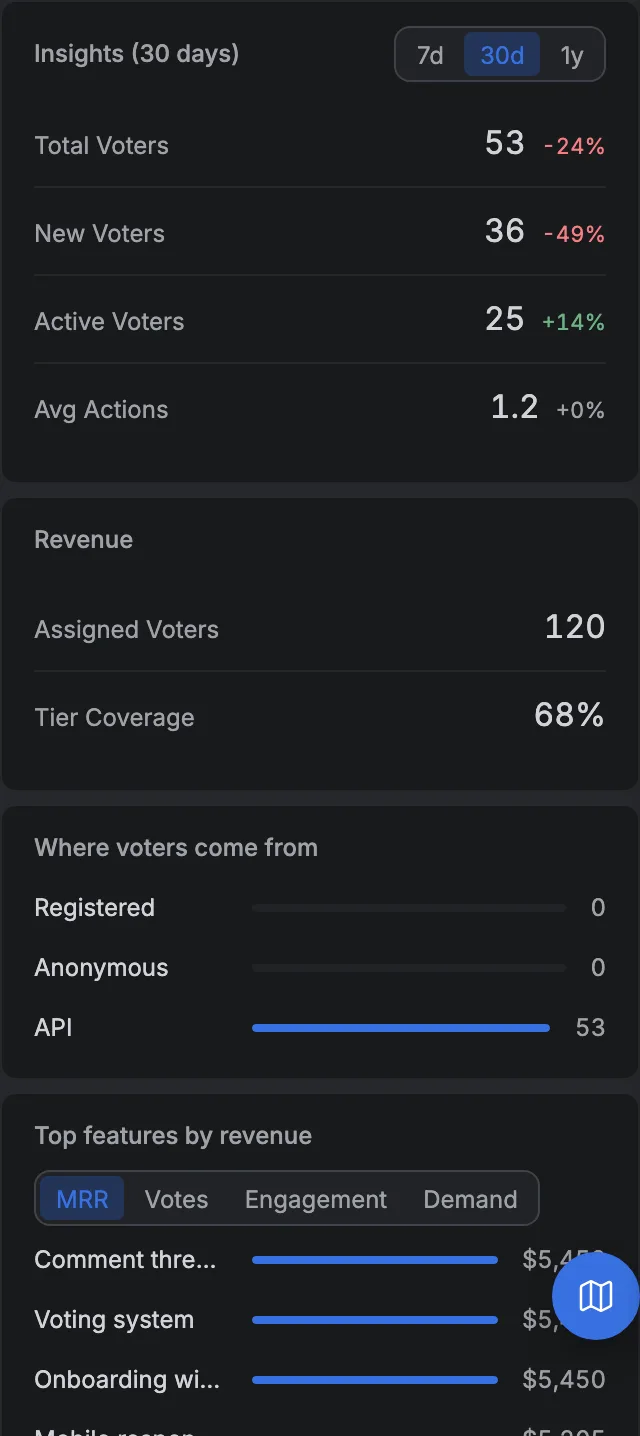
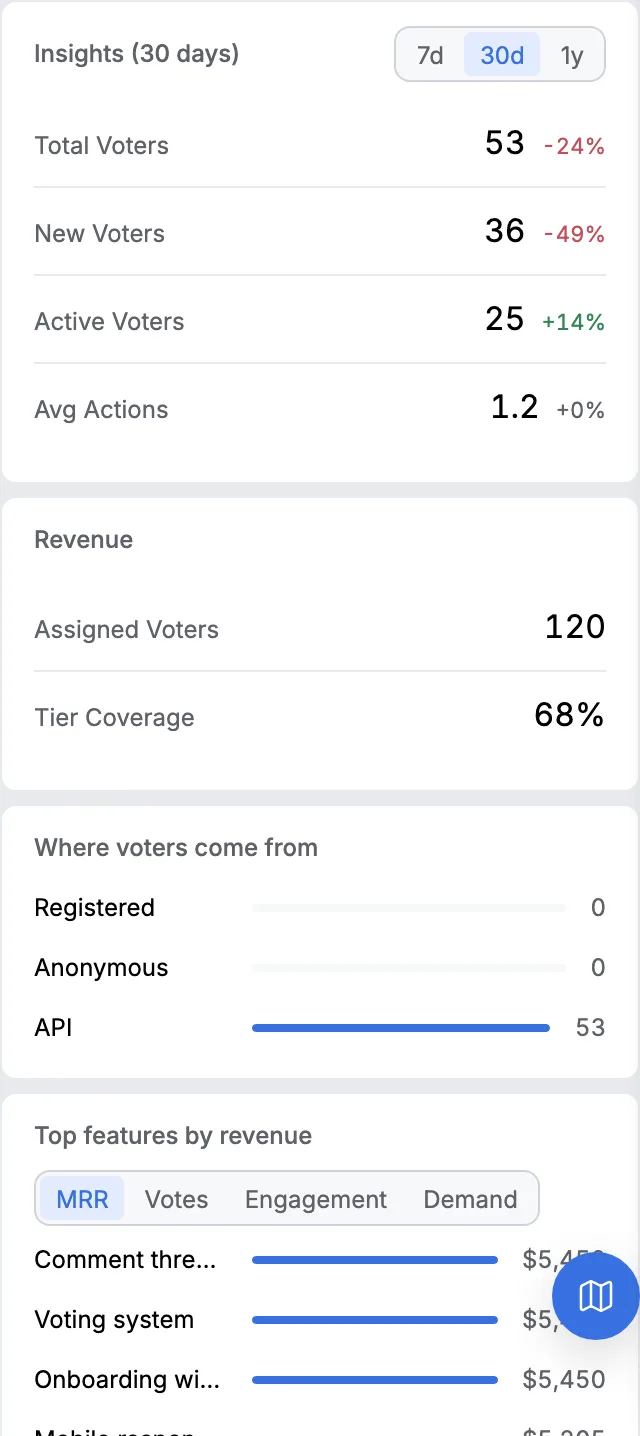
Where does revenue sit in each product?
Harvestr publishes revenue data as one of its pillars, for building around acquisition, retention and expansion. It is context a product manager reads while deciding.
Here the revenue is applied rather than displayed. Each customer tier carries a multiplier, the multiplier is applied at the moment the vote is cast, and the board can be sorted by the money behind each request without anybody opening a spreadsheet. The plain vote count sits beside the weighted one so the ranking can be argued with.
One of those is better if a person is going to do the thinking. The other is better if nobody has time to.
What does this cost on VoteFirst?
Nine dollars a month for one project, thirty nine for unlimited projects, the API, a custom domain and a team.
Nobody is metered on either plan, not your colleagues and not your customers, so the bill does not move when the team grows or when the board gets busy.
What Harvestr has that this does not is the AI categorisation, the connector depth and an analysis layer built for a full product organization. The weighted vote is explained here and the alternative page compares the rest.
14 days, a card at signup, then $9 or $39 a month.