Backlog grooming is the recurring session where a team goes through everything it might build and puts the list back into a state somebody can work from. Refinement is the same activity under a newer name, and the argument about which word is correct has never once changed what happens in the room.
Almost everything written about it assumes a sprint backlog, where the items are tickets your own team wrote. A backlog of customer requests behaves differently in three ways. You did not write the items.
You cannot rewrite them freely without putting words in somebody's mouth. And a good share of them are the same request typed twice by two people who happened to use different words.
What actually happens in a grooming session?
Four things, and only one of them is the argument everybody expects to have.
Deduplication. Somebody asked for a dark theme in March and somebody else asked for night mode in July. Until those are one item the vote count on each of them is wrong, and every decision made from those counts is wrong with them.
Closing. Every backlog carries requests nobody is ever going to build. Leaving them open is not kindness. It is a slower no, delivered by silence instead of by a person.
Clarification. On a team backlog this means rewriting the ticket. On a customer backlog it mostly means reading the comments underneath, because the person who asked has usually explained themselves better in a reply than they did in the title.
Ordering. This is the part that gets all the airtime and it deserves less of it. When the items are customer requests an order is already being expressed by the people asking, and the session's job is to read it rather than to invent it. Five methods run over the same twenty requests disagree completely, which is worth knowing before you spend an hour arguing about one of them.
The product this site is about does this part on a board, and the demo is open without an account.
Why is deduplication most of the work?
Because a public board has no vocabulary control, and it should not have one.
The moment you make people choose from a list of approved phrasings you stop collecting what they think and start collecting what you already thought of. The price of leaving the box open is that the same idea arrives under several names, and somebody has to notice.
There is no honest way to automate that noticing. Two requests that share no words can be the same thing, and two requests that share most of their words can be different things.
Telling a bug from a feature request runs into the same wall and has the same answer, which is that a person reads it.
What a tool can do is make the merge cheap and make it truthful. That is a narrower promise and it is a keepable one.
What does merging two requests do to the numbers?
More than moving a number across, and the order it happens in is the interesting part.
Anybody who voted for both requests has their duplicate vote deleted before anything moves. That is the whole reason a merged vote count is not simply the two counts added.
Two requests with eight votes each do not become a request with sixteen votes when six people voted for both. They become a request with ten.
The remaining votes move across, and then the count is recounted from the votes rather than totted up. The weighted count is recomputed by the same function the board card and the detail panel already read, so a merged request cannot end up carrying a weight that nothing else in the product agrees with.
Comments move and are recounted the same way. Views are the one figure that is genuinely added together, because two people looking at two pages is two views however those pages are later joined.
The surviving request records what it absorbed, and the request that disappeared is kept rather than destroyed. Its heading and its description are read back and shown on the survivor under a heading of their own, so the words the second person used are still there for anybody who opens it.
All of that is one transaction, which matters more than it sounds. Half a merge leaves the comments on one card and the counts on the other, and that is a worse state than never having merged at all.
What does a merge not do?
Three things, and each of them is a reason to go slowly.
It does not find the duplicates for you. The merge picker is a search across headings, ordered by vote count, fifty at a time. Somebody still has to know that night mode and dark theme are the same request.
It does not tell anybody. Nobody who voted for the request that disappeared hears that it moved. The only message our board sends a voter is when a release ships carrying something they asked for.
It cannot be undone from the interface. There is no unmerge button. The absorbed request is kept and shown on the survivor, so the words are not lost, but putting the two back apart is not a click.
Merging also stays inside one board. A request on a custom board can only be merged into another request on that same board, which is a limit rather than a feature and is worth knowing before you plan a tidy up.
What happens to the ones you are never going to build?
Say so, and use a status that says it.
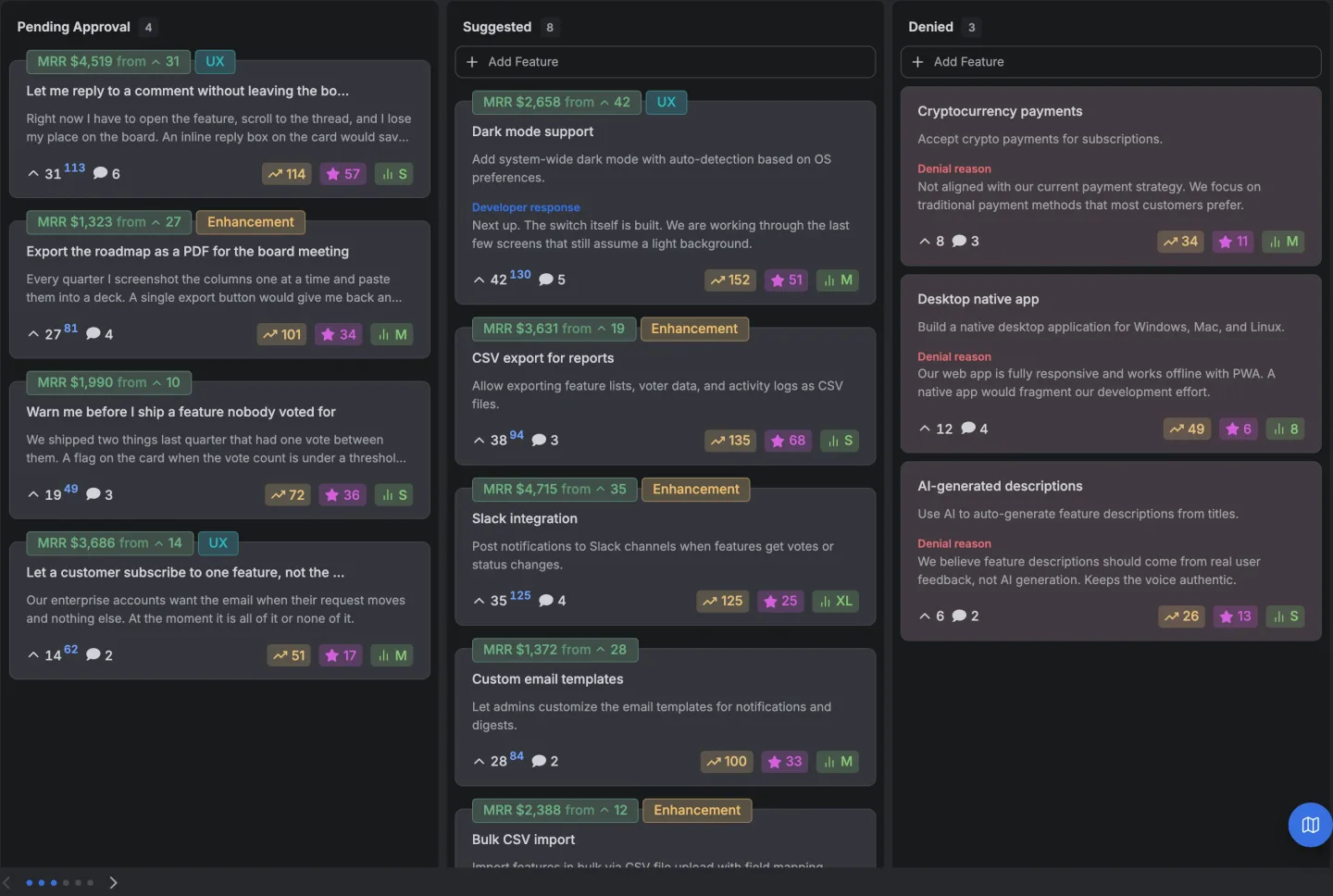
The board ships with a Denied status alongside Suggested, In Review, In Progress and Completed. Moving a request there is a public answer, which is exactly the point of it. A request sitting in Suggested for two years has been refused already. It has just been refused in a way that leaves everybody guessing.
Two warnings before you lean on it. Nothing is emailed when you move a request to Denied, so a status change is something people find rather than something they receive.
And a public no is a real conversation you are choosing to have, which is uncomfortable, and is still better than a backlog that grows forever.
That is what the alternative actually costs. The session gets longer every month, and the same handful of requests get discussed every single time, because nobody is willing to kill them and nobody can quite justify building them either.
There is a third door for exactly those, which is neither a yes nor a public no. What archiving does to a request, and what it deliberately refuses to republish, is worth reading before you use it as a bin.
Does a board let you skip the session?
No, and anything promising otherwise is describing a smaller problem than the one you have.
What changes is what the session is for. The hour that used to go on arguing about order goes instead on the two things a person genuinely has to do, which is deciding which requests are the same thing and deciding which ones are never happening. The order arrives already made, by the people paying you.
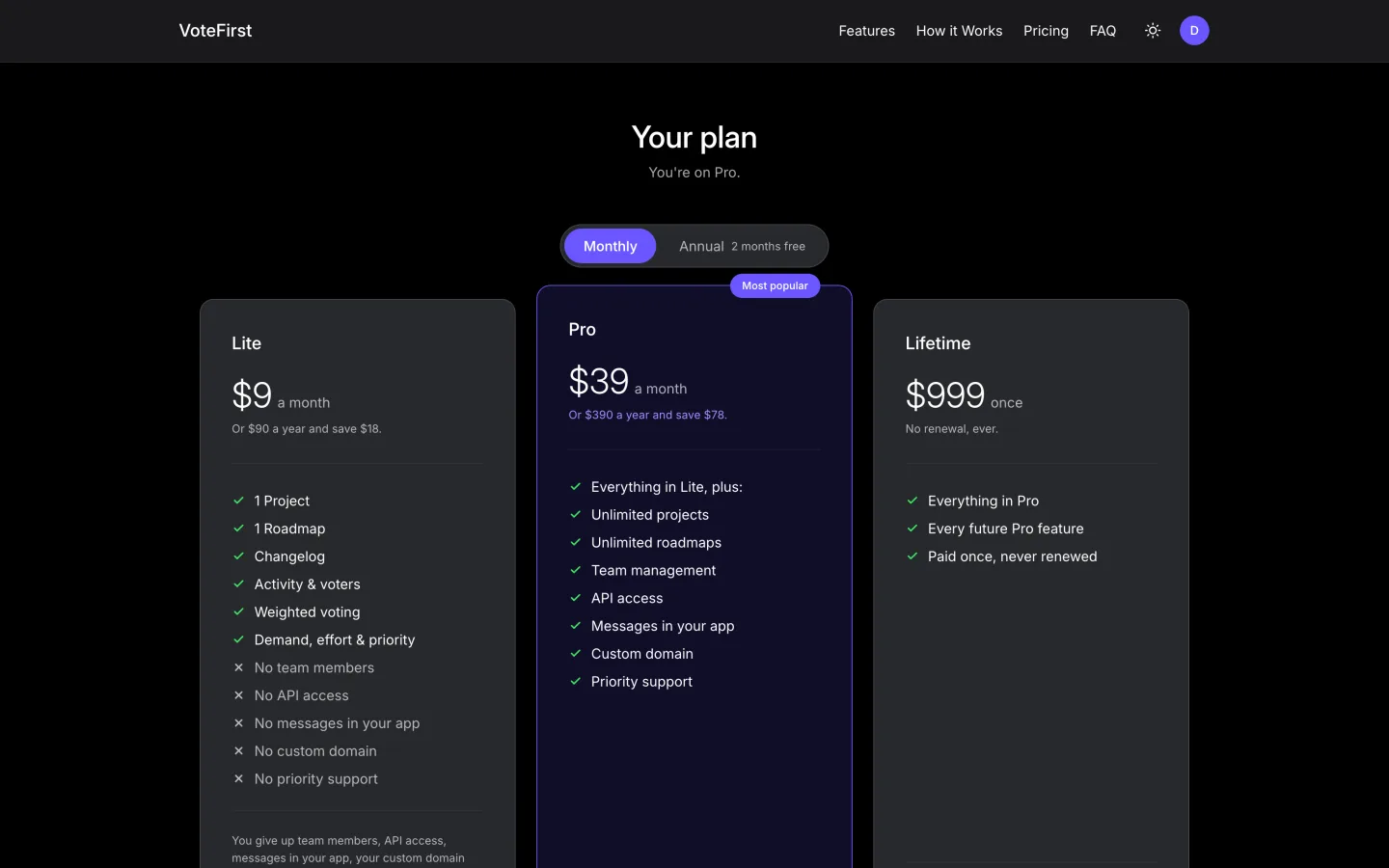
The board is the part that collects them, and it is nine dollars a month on the smaller plan, with a card required for the fourteen day trial.
14 days, a card at signup, then $9 or $39 a month.