The short version
- Seven techniques, all worked on the same problem, so the outputs can be compared.
- Pick by the shape of answer you need, not by what the session will feel like.
- Three things go wrong, and none of them is the technique.
- You can run any of them across a week without booking a workshop.
Ideation techniques differ in what shape of idea they produce, not in how many, and the seven examples below are each worked through on the same problem.
Picking one is picking what kind of answer you're likely to end up with, which is why running all seven on the same problem is more instructive than any list of definitions.
The problem below is the same in every example. New accounts stop before they invite a second person. It's written as a situation, not a request, because a technique applied to a vague goal produces vague output no matter which technique it is.
Which technique should you use?
Pick by the shape of answer you need, not by what the session will feel like.
| Technique | How it runs | What it tends to produce | When it is the wrong choice | |
|---|---|---|---|---|
| 1 | Silent writing | Everyone writes alone for ten minutes before anybody speaks | Independent starting points, and the widest spread of the seven | Never. This belongs at the front of five of the others |
| 2 | Crazy eights | Eight sketches in eight minutes, one per fold of a sheet | Interface answers. Fast, shallow, visual | When the problem is not about a screen |
| 3 | How might we | Rewrite the problem as several openings, then answer each | Different framings of the same problem, which is the rarest output | When the problem statement is already sharp |
| 4 | Inversion | Ask how you would guarantee the bad outcome, then undo each way | Answers nobody proposes directly, because they are embarrassing | When the team is new and the honesty would cost too much |
| 5 | Constraint forcing | Solve it with no new screens, or in one day, or with no code | Cheap answers that ship. The best value per hour on this list | When the real answer genuinely is large |
| 6 | Analogy | Ask who else has this problem and what they do about it | Borrowed structures, which are often the right ones | When it drifts into copying a competitor's screen |
| 7 | Mining what you already have | Read the last hundred support and cancellation conversations | Ideas attached to real situations, with a count behind them | Never, and it is the one that gets skipped |
The seventh is different from the other six in a way worth being explicit about. Six of them produce ideas from a room. The seventh produces ideas from people who aren't in the room, which means it's the only one whose output arrives with evidence already attached to it.
There's a standing board of that kind of idea open without an account, which is the same source running continuously rather than for one afternoon.
Want a board rather than a list? Seven idea management tools, what each bills on and what it costs.
The seven, worked on one problem
Silent writing. Ten minutes, alone, on paper. One such round produced these. Send the invite prompt on day three instead of at signup, let someone paste a list of addresses, make a shareable link rather than an invite, and show what the product looks like with two people on it. Four different directions, which a conversation wouldn't have produced because the first confident sentence would have anchored the rest.
Crazy eights. Eight sketches of the invite step in eight minutes. The output is nearly always eight versions of the same screen, and that's the technique working as designed. It explores one surface thoroughly rather than exploring the problem.
How might we. Rewrite the problem three ways. How might we make inviting somebody feel useful rather than administrative. How might we make the product valuable for one person so the invite stops being load bearing. How might we let a second person arrive without being invited at all. The third framing is the interesting one and no other technique here produces it.
Inversion. How would you guarantee nobody ever invites anybody? Ask for it during signup when they haven't seen the product yet, make them type email addresses one at a time, give the invited person nothing to look at when they arrive. Then undo each. Inversion finds the things a team is quietly aware of and doesn't say.
Constraint forcing. Solve it with no new screens. One answer is that the empty state of the main list already exists, so put the invite link in it. Solve it in one day, and the answer is one email on day three. Both are small, both are testable this week, and both would have been dismissed in a session that wasn't constrained.
Analogy. Who else needs a second person to arrive? Shared documents do it with a link rather than an invitation, and the link works before anybody has an account. That structure transfers cleanly, which is what a good analogy does.
Mining what you already have. Read the last hundred conversations. A team doing this usually finds that the invite step isn't the problem at all, and that people were waiting to find out whether the product worked before they were willing to put a colleague's name to it. That's not an idea anybody in a workshop proposes, because it says the problem statement was wrong.
What goes wrong with all of them?
Three failures, and none of them is about the technique.
Deciding inside the session. An objection kills an idea, the room agrees, and forty minutes later the survivors are the ideas nobody could object to. That's a consensus, not a spread. Ideation ends with an ordered list, and the decision belongs to the step where something can be tried cheaply.
Starting from a goal instead of a situation. Improve activation is a goal. New accounts stop before they invite a second person is a situation. Techniques applied to goals produce restatements of the goal.
Only ever asking the room. Six of the seven above are bounded by who is present. A team that never runs the seventh will produce incremental variations indefinitely and will believe it has explored the space.
How do you run any of them without a workshop?
Write the problem in a shared document on Monday, ask people to add ideas alone by Wednesday, group them yourself, and vote on Friday.
Nothing about these techniques requires a room. Silent writing is easier when it's genuinely silent. Inversion works as a single written prompt. Only crazy eights really wants people together, and then only for thirty minutes.
The reason sessions are scheduled anyway is that a meeting looks like progress and a document doesn't. If the choice is between a workshop this quarter and a shared document this week, the document wins, because the input is the same and the delay isn't.
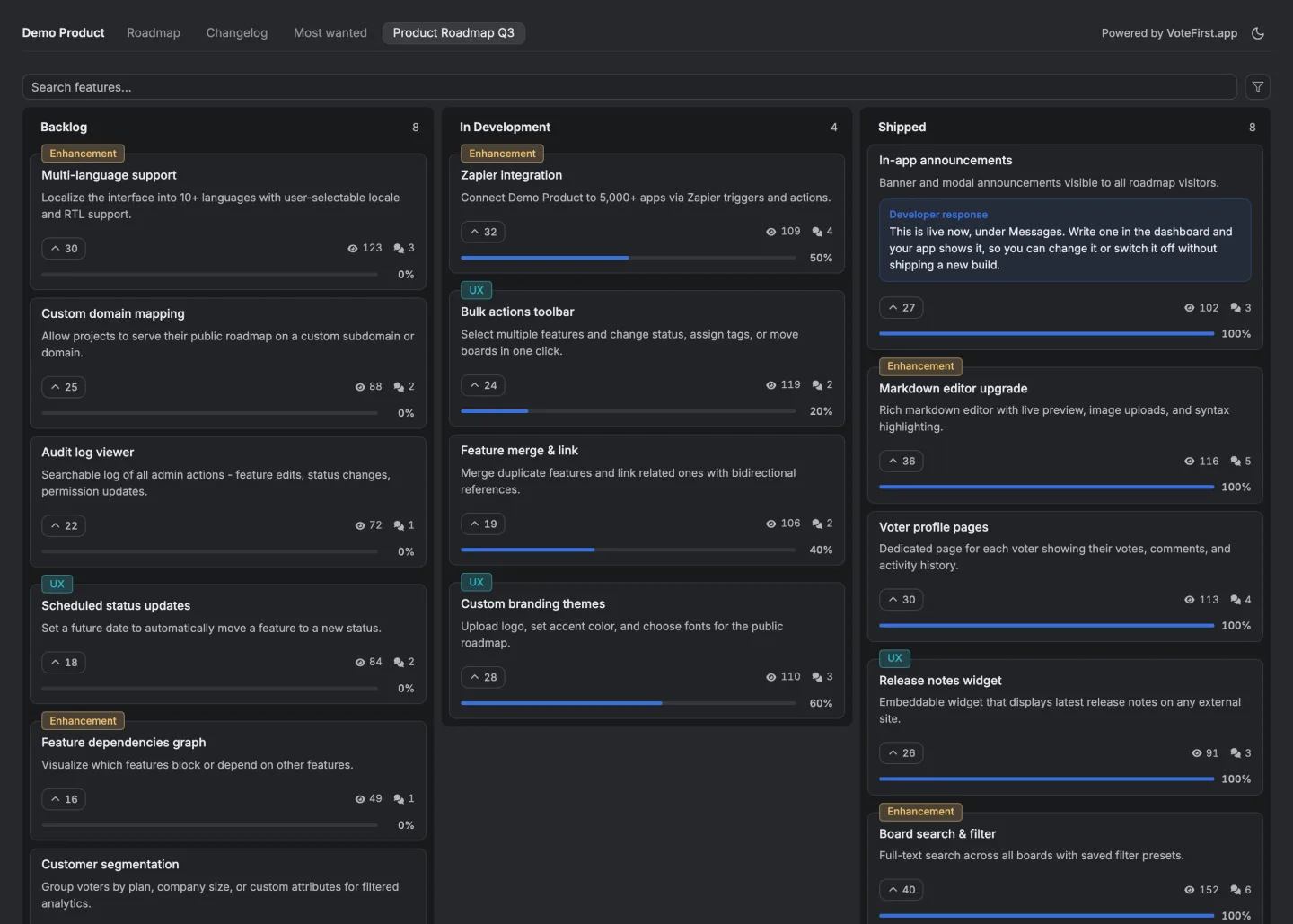
What a standing board does for the seventh technique
It makes mining what you already have something that runs every day instead of something a person volunteers to do.
Requests arrive from people who aren't in the building, with a count of who else agreed, and they stay there. The count is the part that deserves a caveat, not a claim.
Thirty six public feedback boards belonging to real companies were read on 27 August 2026, and on the median one the median request on page one had nine votes. That's a good source of candidate answers and a weak measure of how badly each one is wanted. The full measurement is here.
Which is why both counts sit on every card, the plain one and one weighted by what the person voting pays. The multiplier per tier is set on one screen.
Weighting doesn't manufacture a signal out of nine votes, and if everybody voting pays you roughly the same it has nothing to weigh. How the board is wired is written up here, and what the ideation step is for has its own page.
14 days, a card at signup, then $9 or $39 a month.