Featurebase charges by the colleague, and Frill charges by the workspace, capped by how many ideas sit open on the board. Everything below was read on each vendor's own pricing page on 15 September 2026.
What does each one charge?
Twenty nine dollars a seat a month, and twenty two dollars a month for the whole workspace, and the two numbers meter different things entirely.
| Vendor | From | Billed per | Free plan | Trial |
|---|---|---|---|---|
| VoteFirst | $7.50/mo | plan | – | 14 days, card |
| Frill | $22/mo | workspace | – | 14 days |
| Featurebase | $29/seat/mo | seat | 1 seat | – |
Read on each vendor's own pricing page on 2026-09-15.
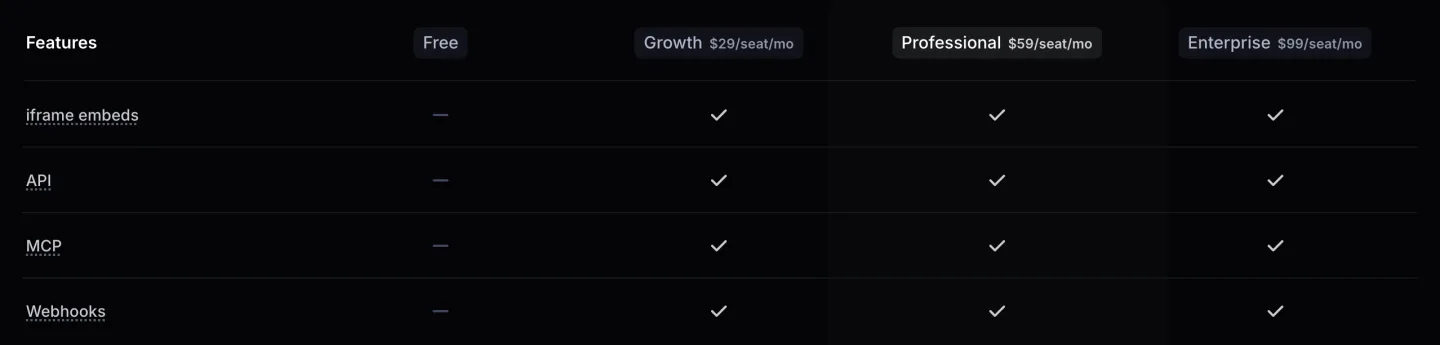
Featurebase's price arrives switched to the yearly rate inside each plan card, and the switch reads as a label if you do not look closely. Off, the same three plans read thirty seven, seventy five and a hundred and twenty nine dollars a seat.
Frill's toggle sits above the cards instead, and it starts on the monthly rate, the more expensive of the two.
Frill has no proof figure to add here beyond the table above, since its own pricing page was already read in full for the numbers used on this page.
How much does Featurebase cost compared to Frill?
It depends on whether your team is growing or your backlog is, and here is the arithmetic at three shapes.
| Your situation | Featurebase | Frill |
|---|---|---|
| 1 person, backlog under 50 open ideas | Free, 1 seat | $22/mo billed yearly |
| 4 people, backlog under 50 open ideas | $116/mo at $29 a seat | $22/mo, unchanged |
| 4 people, backlog over 50 open ideas | $116/mo, unchanged | $44/mo billed yearly, Business |
Featurebase's bill moves when you add a colleague and stays flat no matter how many ideas pile up on the board. Frill's bill does the opposite. It stays flat as your team grows and moves the moment your backlog crosses fifty open ideas.
A lean team with a busy board pays less on Frill. A larger team with a tidy backlog pays less on Featurebase, up to the point where Featurebase's free seat runs out at the second colleague.
If you would rather look at a board than read about billing, the demo is open without an account.
Which one should you choose?
They solve different problems and the honest answer names both.
Featurebase's free plan is a genuinely good offer and cheaper than anything we sell. One seat, one board, one roadmap, a public portal and uncapped end users, forever, at no cost. If your budget today is zero, that beats our nine dollars.
Frill's decision to meter ideas instead of seats is the fairer design for a team that is growing. Unlimited admins and unlimited widgets on every paid tier means your tenth colleague costs nothing, which is rare in this category.
Choose Featurebase if you also want a helpdesk, live chat and an AI agent in the same subscription. Choose Frill if several people need to be inside the tool and you want the price to ignore that fact.
Why choose Featurebase over Frill, or Frill over Featurebase?
Because one of them is a support desk with a feedback board attached, and the other is a feedback board with surveys attached.
Choose Featurebase when the board is one piece of a wider support operation, because the helpdesk, the AI agent and the feedback board share one login and one bill.
Choose Frill when the board and the roadmap are the whole job and your team is more than a couple of people, because the workspace price does not grow when a fifth or a tenth colleague joins.
The price follows from the job, not the other way round. Buying either one for the wrong job is expensive at any figure.
Nothing here counts the people who vote, so a busy board costs the same.
Is there a cheaper alternative to both?
Several, and which one is cheaper depends on what you are counting.
Against Featurebase's per seat rate, a flat plan is cheaper the moment a second colleague needs in. Against Frill's fifty idea cap on its cheapest plan, a plan with no cap on requests is cheaper the moment your board actually works.
The calculator runs both comparisons on a size you choose, and ours is nine dollars flat with no seat count and no idea limit.
The whole field, with the unit each vendor bills on, is one page.
What does each do with a vote from a big customer?
Featurebase sorts by the revenue a feature affects. Frill scores benefit against cost instead, and neither of those is the same as multiplying a vote.
| Vendor | Weighting by revenue | API | Single sign on |
|---|---|---|---|
| Featurebase | Sorts by revenue impact, Growth | Growth | Enterprise |
| Frill | – | Startup | Every paid tier |
| VoteFirst | All plans | Pro | No SAML |
Read on each vendor's own pricing page on 2026-09-15. A dash means nobody could read it on the pages opened that day, never that the capability is absent.
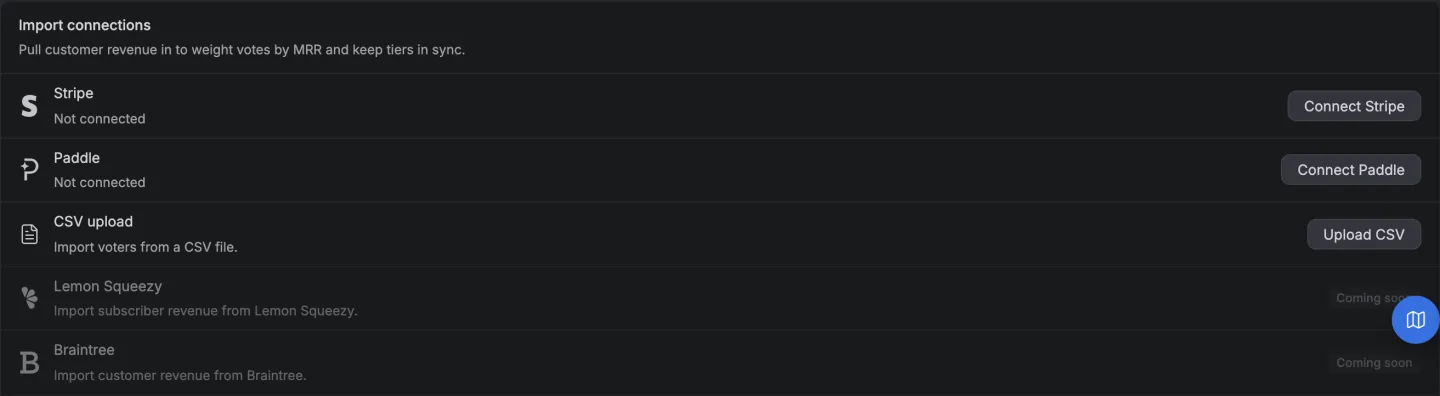
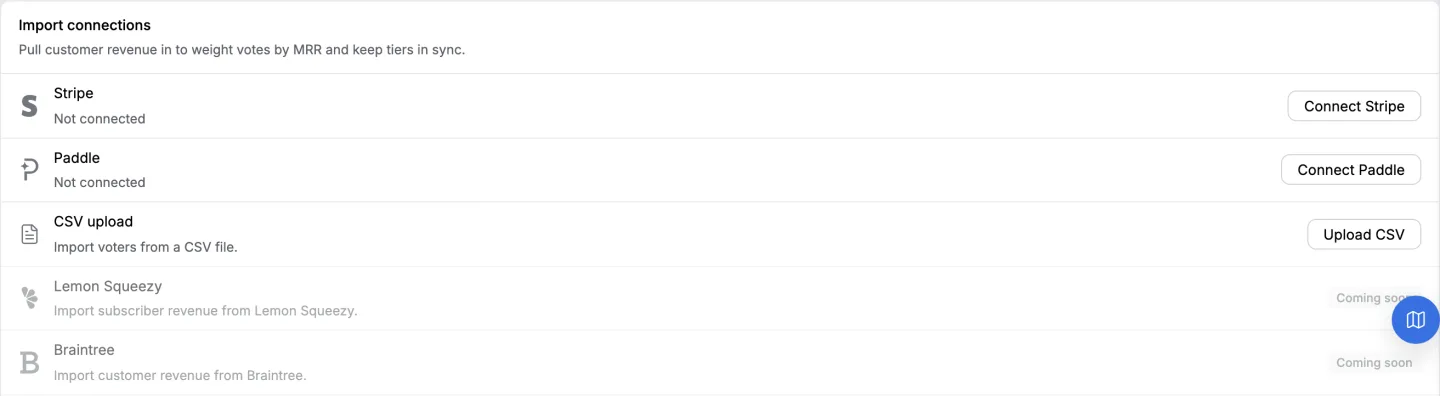
Featurebase's own words are that it syncs a user's monthly spending and sorts feedback by revenue impact. That orders a list. Frill's Priority Matrix asks what a feature is worth to build, which is a legitimate question and a different one from who asked for it and what they pay.
Can I move from one to the other?
Both publish an export path, and what an export loses is usually the part nobody writes down.
Frill's own comparison table ticks bulk CSV import as well as export on its cheapest plan, so a request list can travel in either direction. Featurebase's pricing and alternative pages we read do not print an export feature anywhere on the page, so call that unread rather than confirmed absent.
Four things tend not to survive a move between any two tools in this category regardless of what the export button promises. Who cast each vote rather than the total, the threading on comments, the original timestamps, and every board URL anybody has ever shared.
Where we fit, and where we do not
We are not a support desk and we are not a survey tool. There is no helpdesk, no AI agent and no survey module of any kind, and none is planned.
Both Featurebase and Frill ship surveys. Featurebase bundles a survey module into the same login as its helpdesk, and Frill sells five separate survey types, from net promoter score to quick polls, with the count per type growing by plan.
Both also carry single sign on somewhere in their plans, Frill on every paid tier and Featurebase on Enterprise. We have no SAML option for a team login at any price.
What this product does instead is put a multiplier on a tier, write that weight onto the vote when it is cast, and show the plain count beside the weighted total on the same card. Neither Featurebase's sort by revenue nor Frill's priority matrix does that.
What is Featurebase, and what is Frill?
Featurebase is a support desk and a feedback board sold as one subscription, with a public board, a changelog, a help centre, a survey module and an AI agent behind the same login, billed per seat.
Frill is a feedback board, a roadmap and a changelog sold together, with unlimited admins on every paid tier, billed per workspace and capped by how many ideas are open on the cheapest one.
Does either one have a free plan?
Featurebase does and Frill does not.
Featurebase's pricing page read on 15 September 2026 gives one seat, one board and one roadmap for free, with uncapped end users and feedback under it. The wall is the second colleague, not the number of customers on the board.
Frill's page carries a fourteen day trial that its own banner says needs no card, and no free tier under it.
What this costs
Lite
$9 /mo
Pro
$39 /mo
Lifetime
$999 once
Fourteen day trial of Pro, card asked for at signup. Nothing here counts the people who vote, so the bill does not move when the board starts working. The long version, with what happens if you stop paying.
The honest summary
Featurebase gives one person a real free board and then charges for every colleague after that. Frill lets the whole team in for one flat price and charges instead when the backlog itself gets long.
Ours charges nine dollars flat from the first day, with no seat count and no idea cap, and multiplies the vote by what the voter pays rather than sorting or scoring it.
The Featurebase alternative page and the Frill one carry each side on its own.
14 days, a card at signup, then $9 or $39 a month.