Teams comparing these two are usually asking one of two different questions without noticing. The first is where ideas should live before they become work. The second is where customers should put requests in the first place.
Jira Product Discovery answers the first well. Trello answers it cheaply. Neither answers the second, and that is worth knowing before either invoice starts. Everything below was read on each vendor's own pricing page on 14 September 2026.
What does each one charge?
| Vendor | From | Billed per | Free plan | Trial |
|---|---|---|---|---|
| Trello | $5/user/mo | user | Yes | – |
| VoteFirst | $7.50/mo | plan | – | 14 days, card |
| Jira Product Discovery | $10/creator/mo | creator | 3 creators | – |
Read on each vendor's own pricing page, with the yearly switch left where the vendor leaves it.
Jira Product Discovery counts creators.
| Plan | Price | Billed per |
|---|---|---|
| Free | $0 | up to 3 creators |
| Standard | $10 | per creator |
| Premium | $25 | per creator |
| Enterprise | Custom, billed annually | per creator |
Annual billing saves up to seventeen percent on their own page, and annual subscriptions are billed at the tier nearest your creator count rather than at an exact headcount.
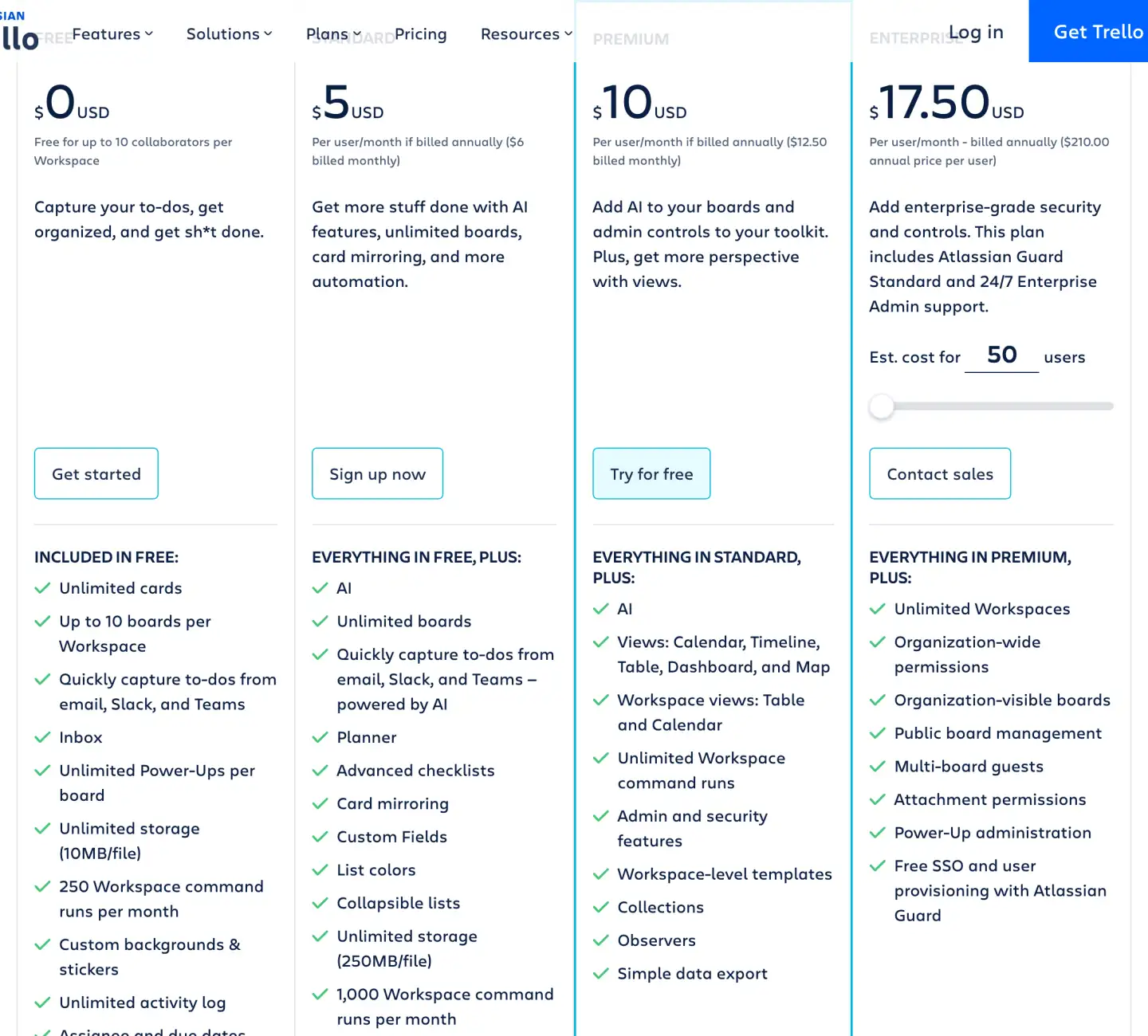
Trello counts users.
| Plan | Paid yearly | Paid monthly |
|---|---|---|
| Free | $0 | $0 |
| Standard | $5/user/mo | $6/user/mo |
| Premium | $10/user/mo | $12.50/user/mo |
| Enterprise | $17.50/user/mo | Yearly only, at $210 a user each year |
Trello's free plan carries up to ten collaborators per workspace, up to ten boards, and unlimited power ups per board. For a roadmap board that is usually plenty, and the voting power up runs on it.
How much does Jira Product Discovery cost compared to Trello?
A creator is somebody who shapes ideas. A Trello user is anybody in the workspace. The two words count different populations, so the multiplication diverges quickly.
| Your team | Jira Product Discovery | Trello Standard |
|---|---|---|
| 3 people shaping ideas | Free, at the three creator line | $15/mo |
| 5 people shaping ideas | $50/mo | $25/mo |
| 5 shaping, 20 who only comment | $50/mo, if contributors stay contributors | $125/mo, because everybody is a user |
| 12 people shaping ideas | $120/mo | $60/mo |
The third row is the one worth sitting with. Jira Product Discovery separates creators from everybody else, so a large audience does not move the bill. Trello does not have that distinction below Enterprise, so a large audience is the bill.
The free tier on each is genuinely usable, and for a small team that is often where this comparison ends.
Nothing here counts the people who vote, so a busy board costs the same.
Can either of them collect feedback from customers?
Only by making a board public, and that is where both of them stop being suitable.
Trello boards can be made public, and a voting power up will let people upvote cards. What you get is a Trello board with your internal columns, your internal card titles and your internal comments on it. There is no separation between what the team writes and what a customer reads.
There is one line on Trello's own comparison table worth reading before you rely on this. Public board management, meaning the administrative control over which boards may be made public, is an Enterprise feature. On every plan below it, any board admin can make a board public from the board menu and there is no central setting that stops them. That is a governance question rather than a pricing one, and it tends to arrive later than people expect.
Jira Product Discovery has views you can share, and it is built for the product team rather than for the customer. Its ideas arrive from the team and from connected Jira work, not from a stranger who found your changelog.
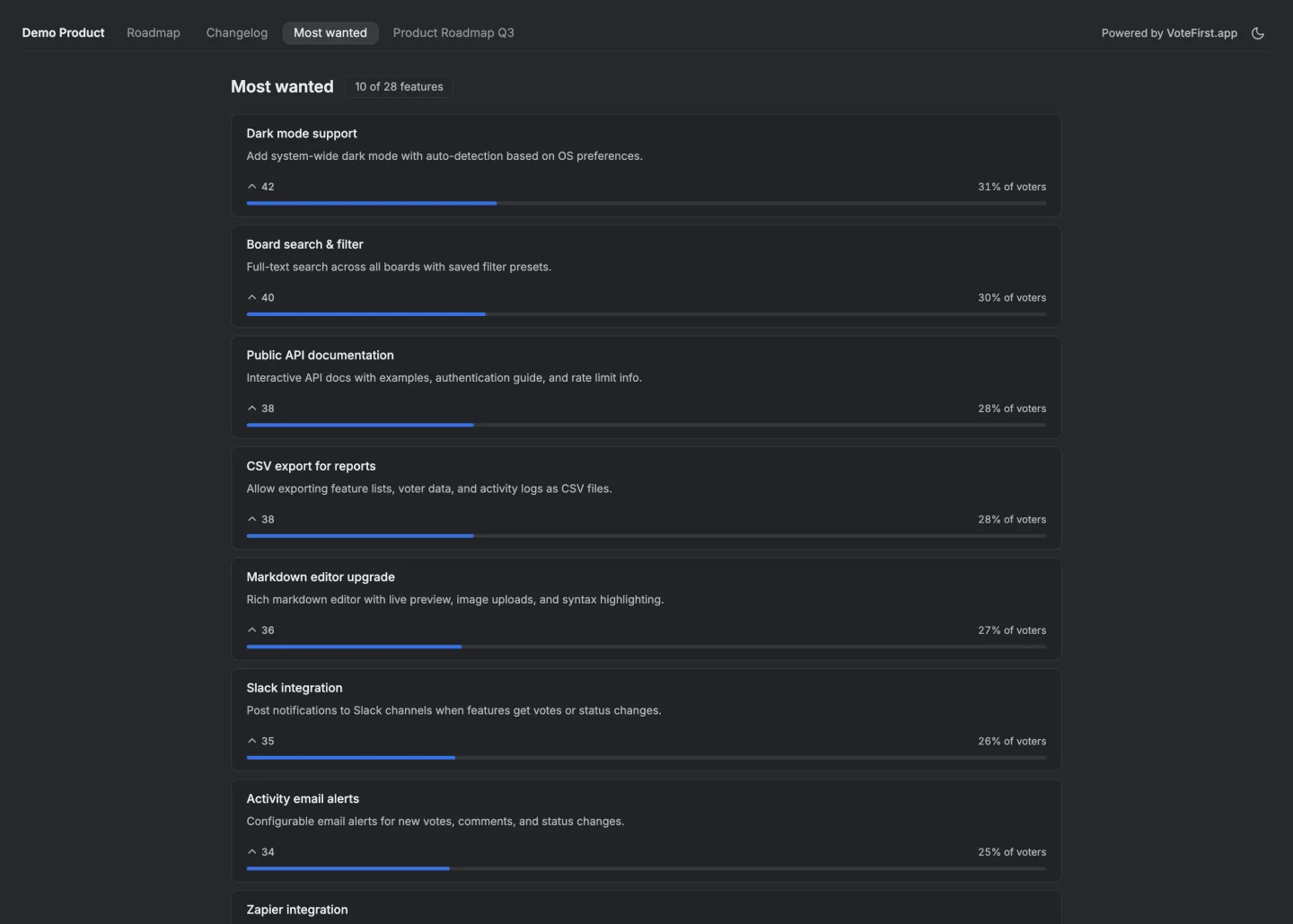
What is missing from both of them?
A place a customer can post without an account, vote, and see the answer.
That is not a criticism of either product, because neither is trying to be that. It is the reason teams end up running one of these alongside a feedback board rather than instead of one.
What a feedback board adds is a public front door, a roadmap the customer can read, a changelog that closes the loop when the thing ships, and a way of ordering the queue that is not simply who shouted loudest. Here each vote carries the revenue behind the customer who cast it, so the top of the list is what your paying customers want. The plain count stays visible beside the weighted total.
Which one should you choose?
Jira Product Discovery, if you already run Jira and the job is getting ideas into delivery. The creator unit is the right unit for that job, three creators are free, and the handoff into Jira is the whole point.
Trello, if the job is a lightweight roadmap board for a small team and the budget is nearly nothing. Ten boards and ten collaborators free is a lot of product for no money, and the voting power up covers a simple internal vote.
A feedback board alongside either, if customers need somewhere to ask. Nine dollars a month for one project, thirty nine for unlimited ones, with nobody on your side or theirs counted.
Why choose Jira Product Discovery over Trello, or Trello over Jira Product Discovery?
Choose Jira Product Discovery when the ideas have to become tickets, and when the people who only read should not be on the invoice.
Choose Trello when the team is small enough that everybody is a user anyway, and when a simple board is honestly all that is needed.
Choose a customer facing board for the part neither of them does, which is letting the people who pay you tell you what to build next.
What this costs
Lite
$9 /mo
Pro
$39 /mo
Lifetime
$999 once
Fourteen day trial of Pro, card asked for at signup. Nothing here counts the people who vote, so the bill does not move when the board starts working. The long version, with what happens if you stop paying.