Collecting customer feedback in a subscription business is the same activity as anywhere else with one difference, and the difference changes what you do with the result rather than how you gather it.
Your customers pay you different amounts, every month, and any of them can stop.
That single fact makes a plain count of who wants what the wrong number to act on, and almost every tool in this category hands you exactly that number.
What is actually different about SaaS feedback?
Four things, and only the fourth is usually designed for.
The people giving feedback are already inside the product. They are not a survey panel and not a prospect. They are logged in, at a screen, at the moment something is missing. That is the cheapest feedback in existence and most of it is never collected, because the place to say so is somewhere else entirely.
They pay different amounts. A request from your two thousand dollar account and a request from a free trial look identical on a board that counts heads.
They can leave. Feedback in a one off purchase business is information about the next sale. Feedback in a subscription business is information about this month's revenue, which is why an unanswered request is more expensive here than almost anywhere.
The loop has to close back inside the product. Somebody who asked for a thing in March and reads about it in a release note in June is the whole mechanism. Telling everybody else about it is noise.
Where should a SaaS product collect feedback?
Inside itself first, and on a public board second.
A public board mostly reaches people who went looking for it, which is a smaller and more motivated group than your paying customers. Seven widgets put the board, the roadmap, the changelog or a vote control for one feature on a screen you already own, with one script tag, and none of them is held back for the higher plan.
The vote control is the one worth planning for. A single button beside the thing that is missing, on a screen somebody is already paying to use, collects from a population you cannot reach any other way.
The public board still earns its place. It is the address you put in a help centre, the page a prospect reads to see whether you ship, and the thing that lets two customers discover they want the same feature.
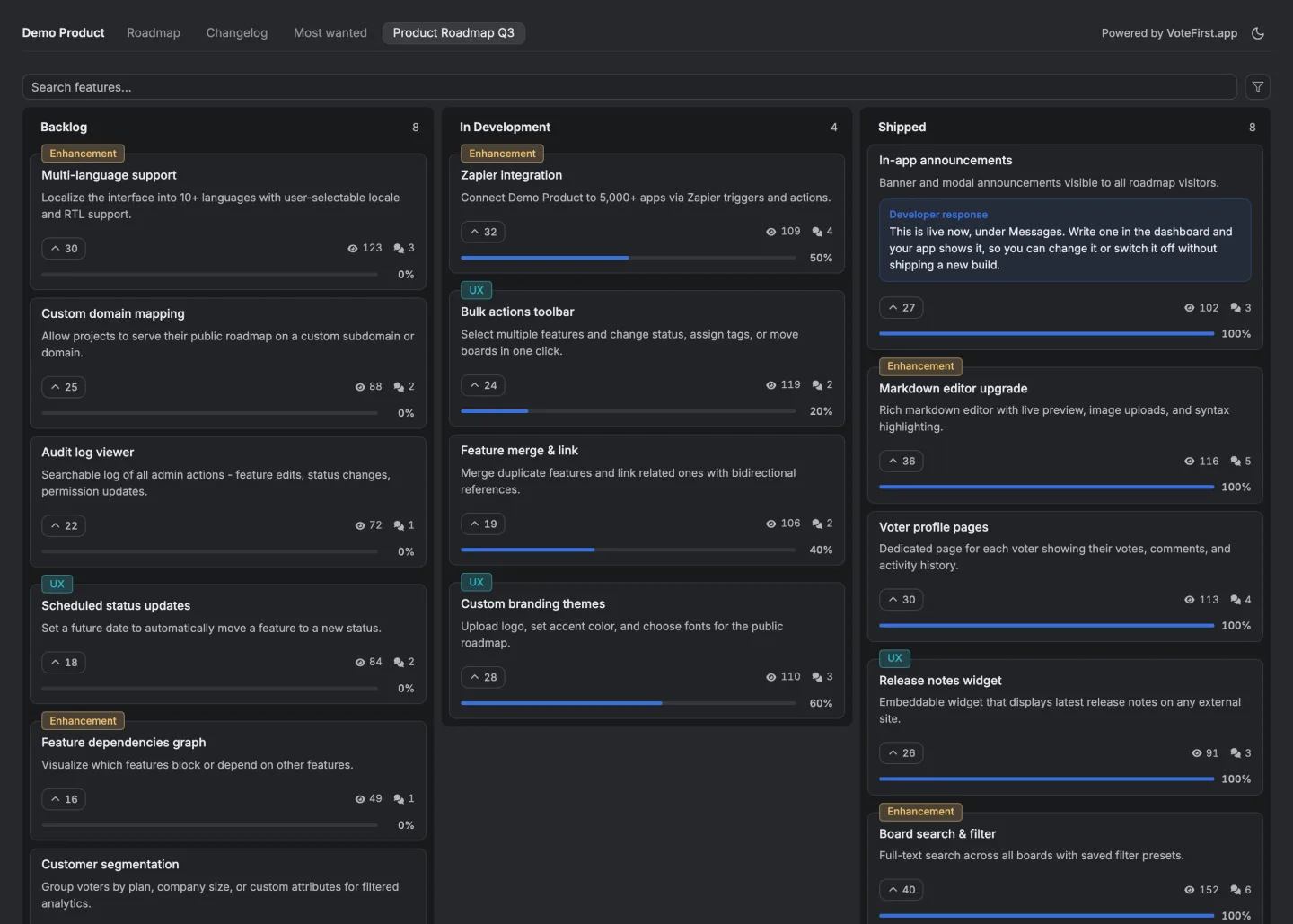
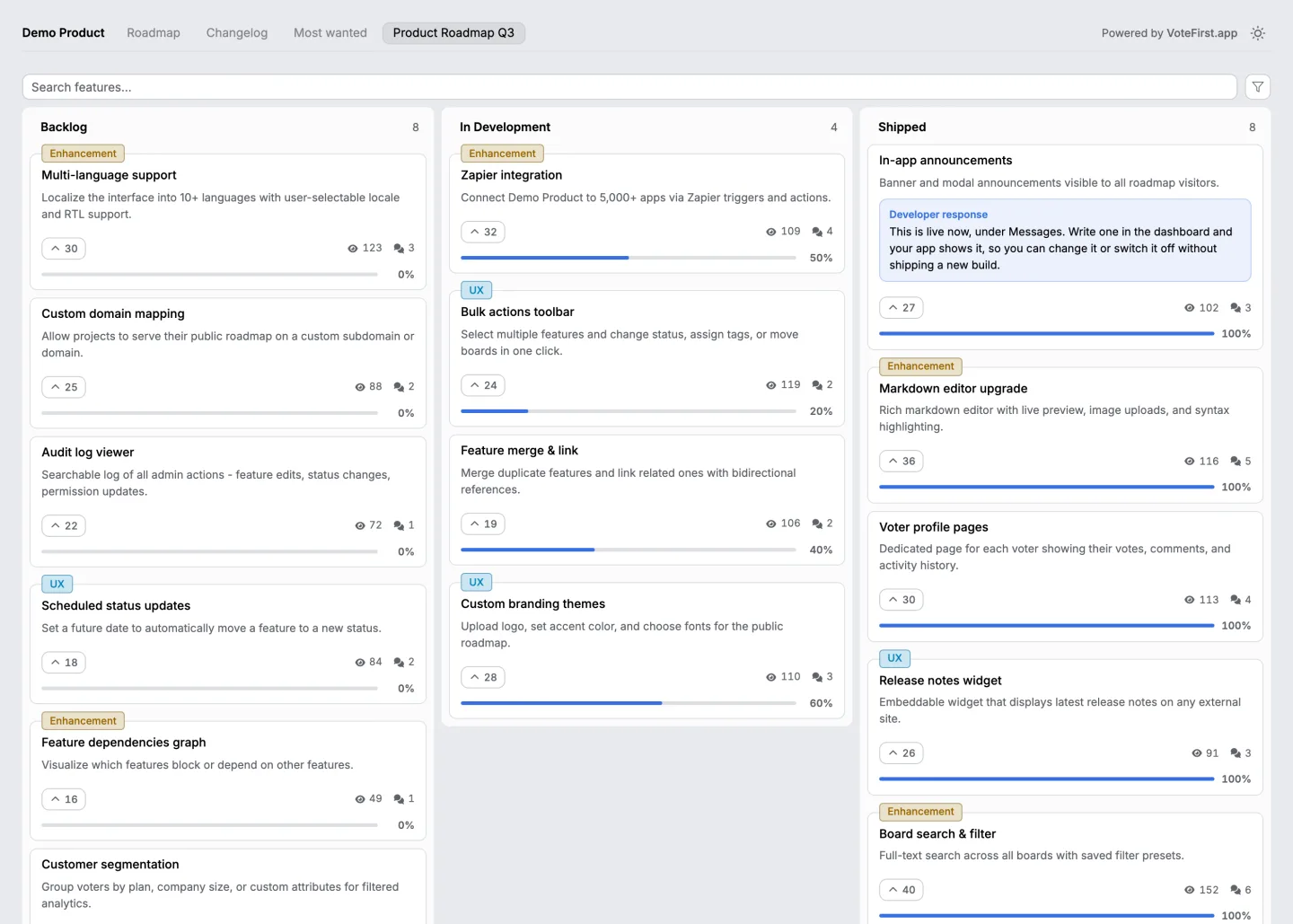
Should a SaaS board require an account?
It depends which of your two populations you are trying to hear from, and the honest answer is that you want both and they need different doors.
A signed out visitor here gets an anonymous identity minted in their own browser, and can vote, comment and suggest from the first page load. That door collects from prospects, from trial users who have not committed, and from the customers who would never have bothered to sign in again. What an anonymous vote is worth, and where it fights with weighting, is a page of its own.
The other door is the one that matters for a subscription business. Your application issues a signed token for the person already logged in, we check it against a secret held on the project, and the vote is recorded against that real person. It is a JSON web token with an HMAC signature, and a token signed any other way is refused rather than trusted.
That is the mechanism that makes everything below possible, because a weight is only worth as much as knowing who is voting. It is on the higher plan.
Worth being precise, because the phrase single sign on covers two products. This one identifies your customers so they vote as themselves. It is not SAML, it does not read your company directory, and it will not sign your staff in through an identity provider. The exact shape is on the integrations page, and if you need the directory kind, we do not have it.
How do you make a vote carry what the customer pays?
Three steps, and the first one is the only one anybody skips.
Get the revenue in. Import what each customer pays from Stripe, from Paddle or from a CSV. Importing revenue changes nothing on your board by itself, and the page says so rather than implying otherwise.
Create tiers and set a whole number multiplier on each. A voter in no tier counts as one. A multiplier below one is read as one. Every multiplier is a whole number, so nothing is ever rounded and the weighted total is a whole number too.
Assign voters to tiers. A vote then carries that tier's multiplier, written onto the vote at the moment it is cast rather than looked up later.
That last detail has a consequence worth understanding. If a customer moves from a small plan to a large one tomorrow, the votes they cast yesterday keep yesterday's weight. The board records what was true when people spoke, so a total cannot be quietly rewritten by a change in somebody's subscription.
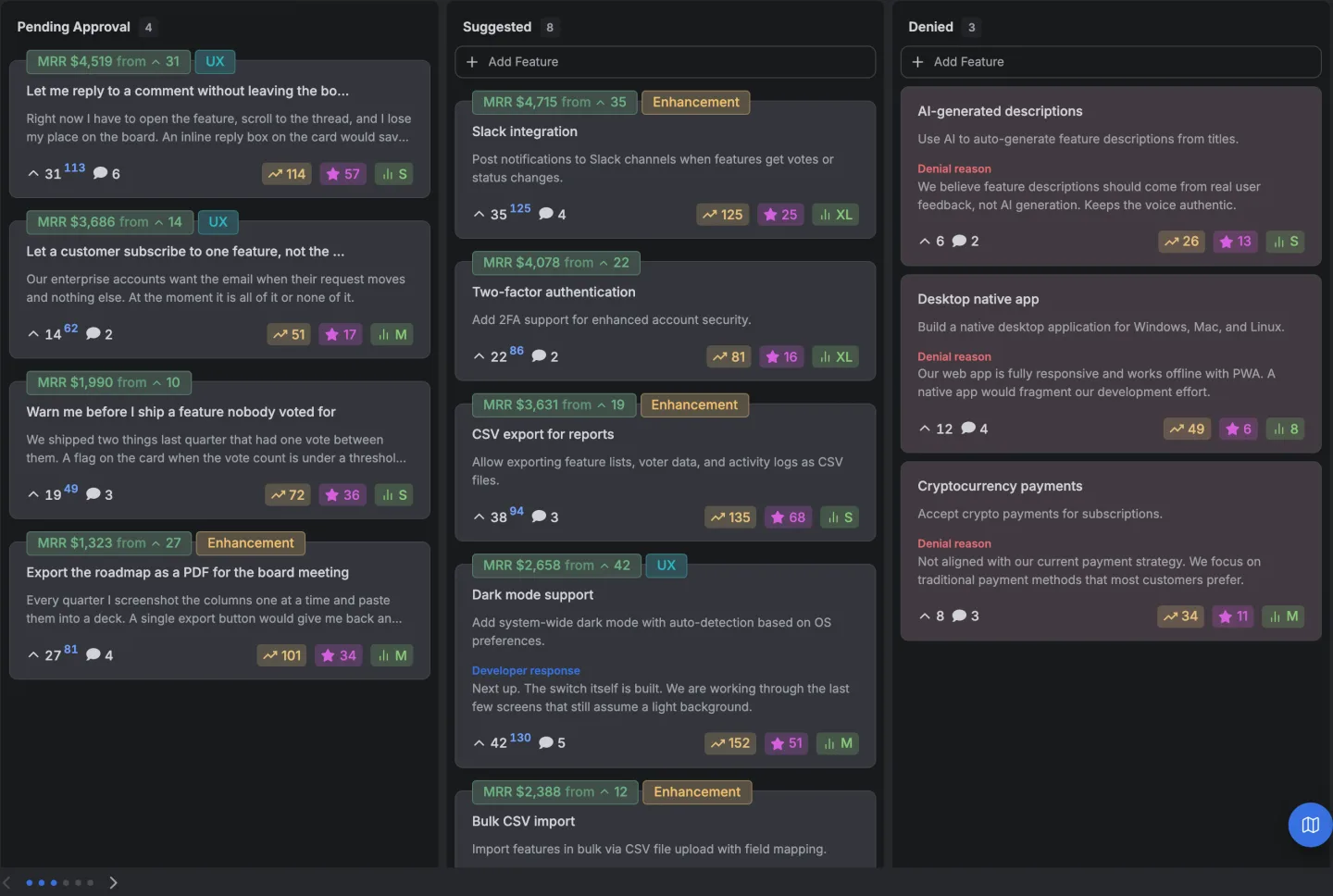
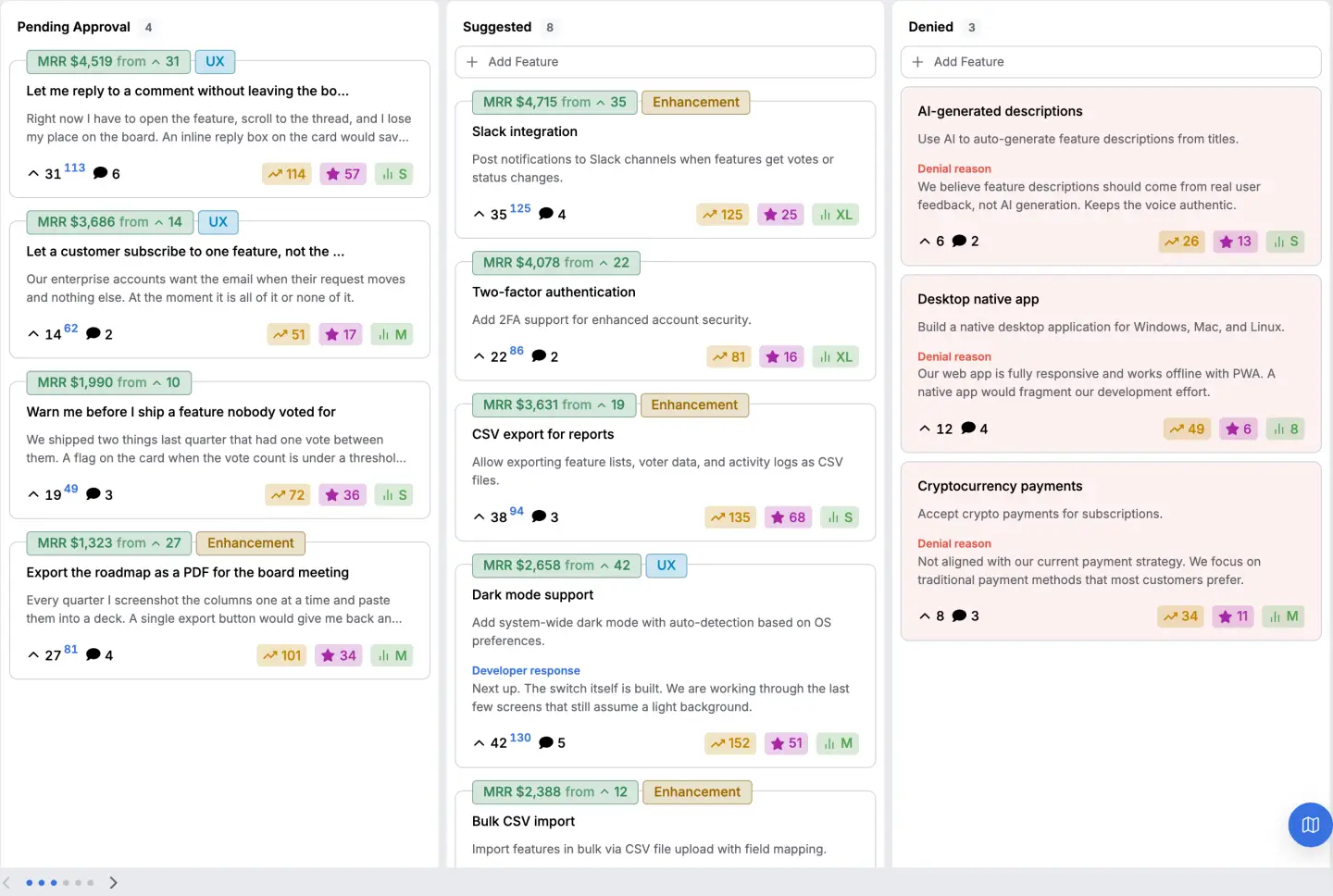
Both totals sit on the same card. Sixty one weighted votes from forty three voters tells you instantly that the paying accounts are behind it. The full mechanism, including what it deliberately does not do, is here.
14 days, a card at signup, then $9 or $39 a month.
What do you do with it once you have it?
Two numbers and one habit.
Every request carries a demand score computed from what people did, an effort estimate you type, and a priority that is demand divided by effort. The page prints the formula rather than describing it, because a ranking you cannot recompute by hand is a ranking you cannot argue with.
The habit is closing the loop. The changelog emails the people whose own vote is in the release, and there is no subscriber list anywhere in it. That is a limit and it is deliberate: nobody is told about something they did not ask for, and the person who asked in March finds out the week it ships.
If you want the arithmetic on what an unanswered request costs a subscription business, the churn cost calculator runs it from four numbers you already have, on the page, with no email address asked for.
What does this cost, and what is the catch?
Nine dollars a month for one project with weighted voting included, and thirty nine for more projects, a custom domain, a team and the secret key.
There is no meter on the number of people who participate, which matters more in this category than it sounds. A board with fifty voters and one with fifty thousand cost the same here. The price and billing unit for every tool in the field is in one table and it names the ones that beat us.
The catches, said plainly. There is no free tier, and a card is required to start the fourteen day trial. There are no outgoing webhooks, no Slack app and nothing that writes an issue into your tracker. There is no artificial intelligence anywhere in this product, and that is a decision rather than a gap.
And weighting is only worth having if your customers actually pay you different amounts. If every one of them pays the same, there is nothing to weigh, and you should pick on price and on whether voting needs an account.
What this costs
Lite
$9 /mo
Pro
$39 /mo
Lifetime
$999 once
Fourteen day trial of Pro, card asked for at signup. Nothing here counts the people who vote, so the bill does not move when the board starts working. The long version, with what happens if you stop paying.