The phrase product feedback tool is sold by three different kinds of product, and they do not overlap much.
One watches what people do. One asks people questions. One collects what people say they want and puts it in an order.
This is the third kind, and the first job of this page is to make sure you did not want one of the other two.
What are the three kinds?
Three, and the word tool is doing all the hiding.
Something that watches. Session recordings, heatmaps, funnels, how far people scrolled. It answers what happened on a screen and never answers why. We are not this and do not compete with it.
Something that asks. Surveys, scores, a box that appears after a task. It answers a question you already thought to ask, which makes it good at confirming a suspicion and poor at discovery. We are not this either.
Something that collects and ranks. A board where people file what they want, other people agree with it in public, and the result comes out in an order. That is this product.
The three are complements rather than alternatives, and most teams end up with two of them. What causes the wasted month is buying one and expecting the job of another.
Which part of building a product does each stage need?
Six stages get searched for by name, and only three of them are this kind of tool.
Product development. Yes. This is the main case: a queue of requests with a count on each, so the next thing you build is decided by evidence rather than by whoever spoke last.
Product improvement. Yes, and it is the same mechanism pointed at what already exists. A board collects complaints about shipped work as readily as requests for new work, and the ranking treats them the same way.
Product launch. Partly. A board is a good place to catch what a launch surfaces, and it is a poor substitute for talking to people in the first week. Use it to hold what arrives, not to find out whether the launch worked.
Product design. No, not on its own. Design questions are about how a thing should work, and a vote count answers how many people want it to exist. Those are different questions and a board will confidently answer the wrong one.
User research. No. Research is about discovering what people need before anybody has asked for it, and a board can only ever show you the things people already knew to ask for. That gap is real and no voting tool closes it.
Usability testing. No. Watching somebody fail to complete a task is a different instrument entirely.
Being clear about the last three costs us nothing, and it is the part of this page most likely to save you a purchase.
What features does a product feedback tool of this kind need?
Six, and the last two are where products in this category quietly differ.
A place to file without an account. Every step between having an opinion and recording it loses people, and the ones who push through are the unusually motivated rather than a representative sample. Filing, voting and commenting here all work from the first page load.
A review queue. Every visitor suggestion is held until somebody approves it, which cannot be switched off, so the board your customers read has always been looked at.
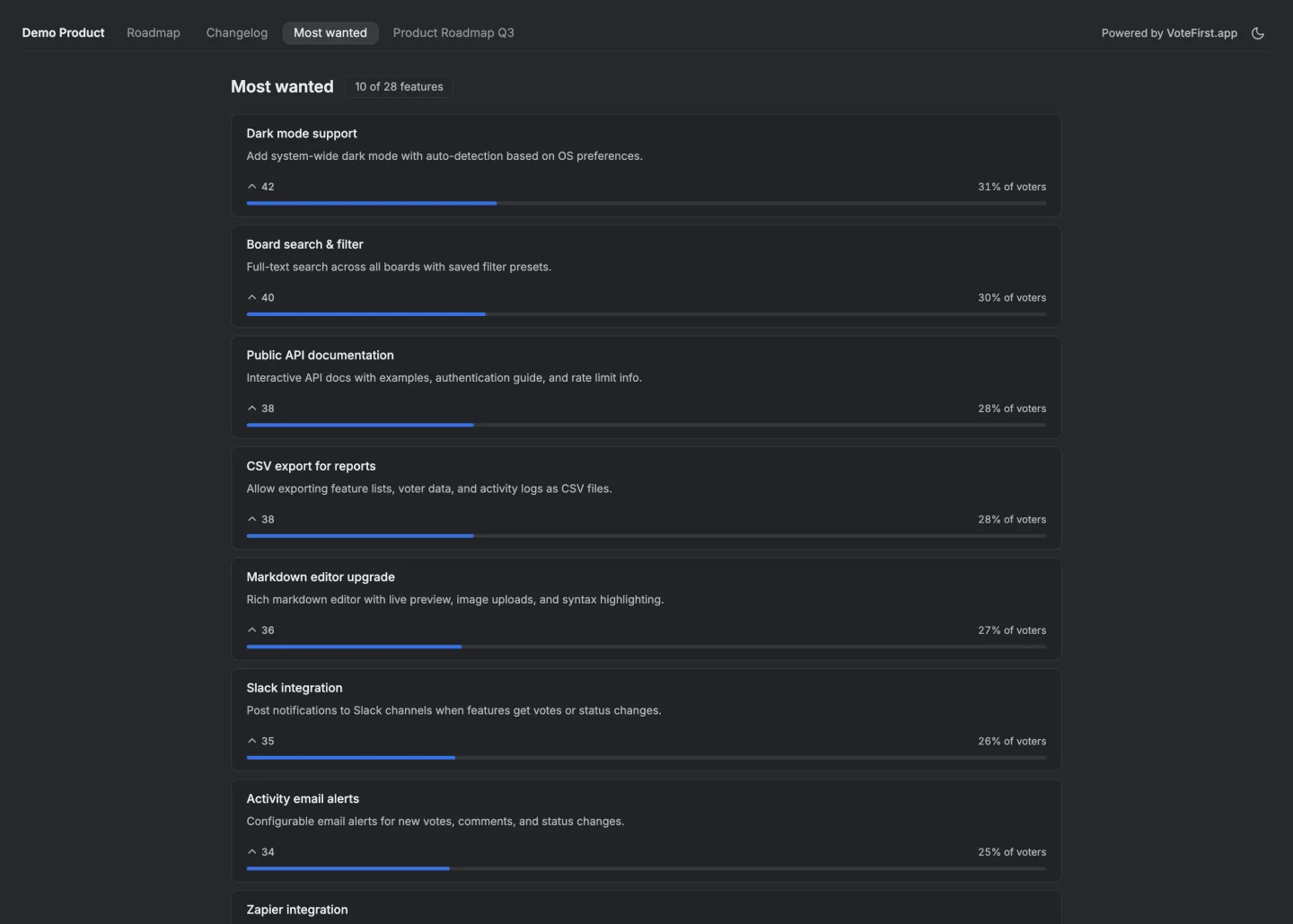
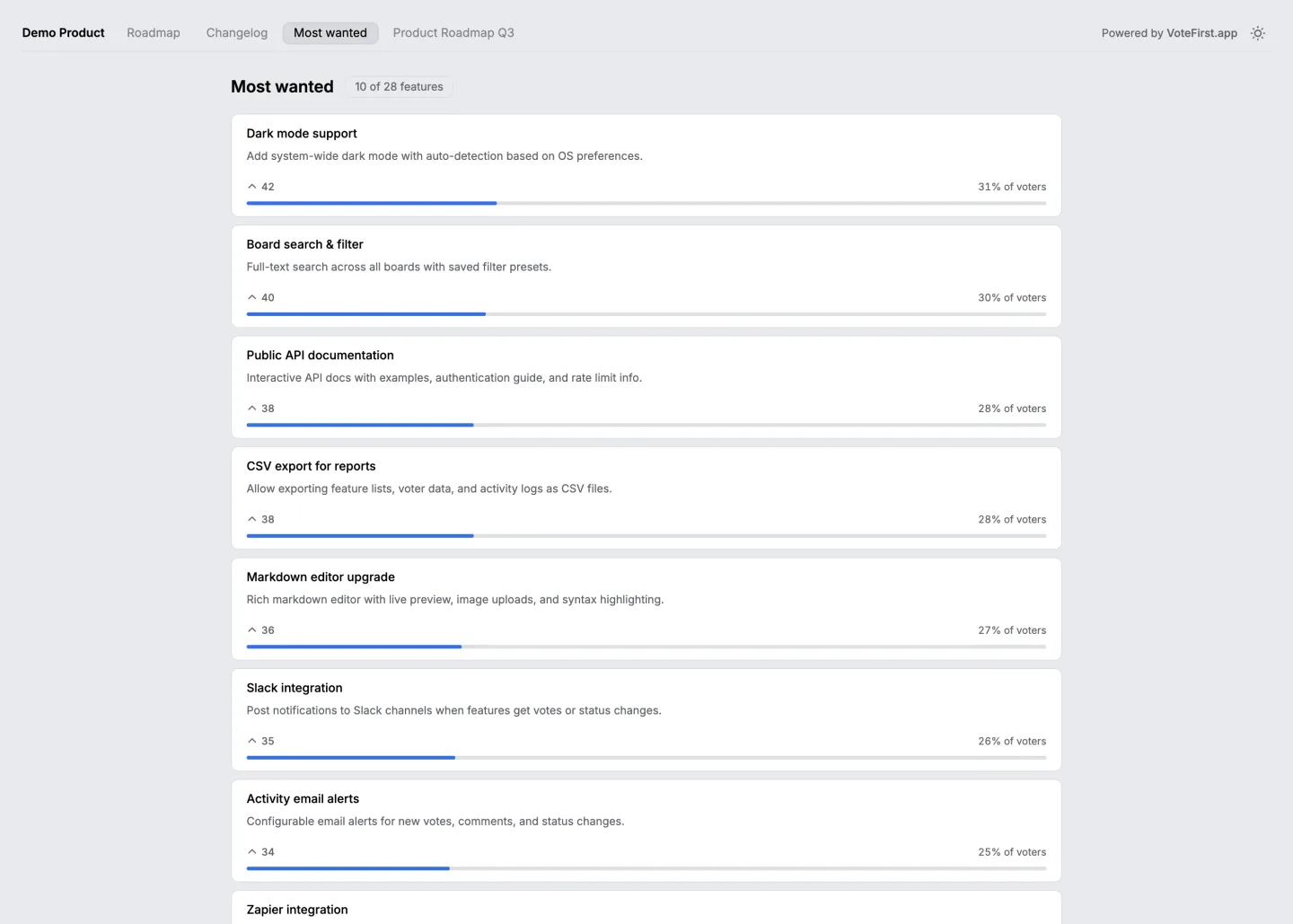
A count, and a comment thread under it. The count says how many. The comments say why, and the why is the half that changes what you build rather than only what order.
A public status on every item. Five columns here: Suggested, Denied, In Review, In Progress and Completed. Denied is on by default, which is unusual, and it is the column that keeps people filing.
A way to close the loop. The changelog emails the people whose own vote is in the release and nobody else. There is no subscriber list, which is a limit and a deliberate one.
A way to weight a vote. A plain count answers how many people want this, which is the right question only if your customers are interchangeable. If they pay you different amounts, it is the wrong question, and the information that separates two cards with twelve votes each was never recorded unless you set it up first.
Where does the tool sit, on your site or ours?
Both, and the version inside your own product is the one worth planning for.
Seven widgets place the board, the roadmap, the changelog or a vote control for a single feature on a screen you already own, with one script tag, and none of them is behind the higher plan. Twenty one API endpoints let you build your own interface on top, on the PRO plan. The widgets are not the API and need no API key, which is why they work on the nine dollar plan.
A public board mostly reaches people who went looking for it. A vote control beside the thing that is missing reaches somebody you already know is paying, at the moment they notice.
14 days, a card at signup, then $9 or $39 a month.
How do you compare tools in this category without wasting a week?
Four questions, and everything else is furniture.
What is the bill metered on? Seats, projects, boards, workspaces, or the number of people who participate. That last one is the trap, because a successful board becomes an expensive board. Every tool in the field with the unit it bills on is in one table, and the calculator runs your own numbers against it.
Does a voter need an account? This decides how much you collect and how well you can attribute it, and there is no answer that is right for everybody.
Can the board be embedded? Some products give you a page on their domain and stop there.
Does every vote count the same? Almost everywhere, yes, and it is invisible as a limitation until it costs you something.
Those four separate this category faster than any feature list. The full comparison, priced and dated, is here, and it names the products that beat us on each.
What this one does not do
No outgoing webhooks, no Slack app, no Zapier listing, and nothing that writes an issue into your tracker. The integrations page leads with the absences rather than burying them.
No artificial intelligence anywhere in the product, which is a decision rather than a gap.
No free tier, and a card is required to start the fourteen day trial. If your board will stay very small, a free plan elsewhere is cheaper than us and the free plan page says which ones.
What this costs
Lite
$9 /mo
Pro
$39 /mo
Lifetime
$999 once
Fourteen day trial of Pro, card asked for at signup. Nothing here counts the people who vote, so the bill does not move when the board starts working. The long version, with what happens if you stop paying.