In app feedback is what a user tells you without leaving the product: a star rating, an answer to a one question survey, a bug report with a screenshot attached, or a request on a board where other users can vote. Of the 22 tools below, each read on 3 October 2026 from its own pricing page and developer docs, 14 print a price and 17 ship a native iOS SDK, one of them in beta.
One of the four kinds is fenced off by the platforms. Apple shows its rating prompt to a person at most three times a year and disallows any review prompt an app builds itself, and Google tells an app not to ask a question before its rating card appears.
What are the four kinds of in app feedback?
| Kind | What the user does | What the team gets | Who else sees it |
|---|---|---|---|
| Rating prompt | Taps one to five stars in a sheet the platform draws | A store rating, sometimes a written review | Everyone on the store page, nobody in the app |
| Survey | Answers one question, or a few, at a moment the team picks | A score or a sentence tied to that moment | Nobody |
| Bug report | Shakes the phone or taps a button, then marks up a screenshot | The screen, the device, the OS and the app version | Nobody |
| Request board | Suggests a feature, or votes on one already there | A ranked list, with a count behind each request | Every user, when the board is public |
The first belongs to the platform. A tool can choose the moment to ask for a rating, and Apple's or Google's own sheet does the asking. The other three are channels the team owns, which is what most of the tools below sell.
What do Apple and Google let an app ask?
On iPhone and iPad. Apple's StoreKit documentation says the system shows the review prompt to a person a maximum of three times within 365 days, and not again for a version they were already asked about. The app decides when to call it; the system decides whether anything appears. App Store Review Guideline 5.6.1 requires the provided API and disallows custom review prompts.
On Android. Google's In App Review guide enforces a time bound quota whose number it does not publish and may change without notice, so a second call within a month may show nothing. It also says an app shouldn't ask any question before or while showing the rating card, naming "Do you like the app?" as one, and shouldn't put the flow behind a button, because a user over the quota would tap it and see nothing.
That rules out a pattern many apps still ship: a screen asking whether you enjoy the app, sending a yes to the store and a no to a feedback form. On Android it is the question Google's guide says not to ask, and on iPhone a star prompt drawn by the app in place of Apple's sheet is what 5.6.1 disallows. Ask for a rating rarely and after something went well, and give every other kind of feedback a channel of its own.
What does each in app feedback tool cost?
Grouped by the kind of feedback each one is built around, cheapest printed price first within each group.
| Tool | Collects | Native SDK | Free plan | Cheapest paid plan, as printed | Billed per |
|---|---|---|---|---|---|
| VoteFirst | Requests and votes on a public board | iOS, in SwiftUI; no Android | None; 14 day trial, card at signup | Lite, $9/mo | plan |
| Featurebase | Requests and votes on a public board | None named in its help centre; its iOS and Android apps are for the team | 1 seat | Growth, $29/seat/mo billed yearly | seat |
| Canny | Requests and votes on a public board | Neither; the mobile widget is a web view that needs SSO | 25 tracked users | Pro, $79/mo billed yearly | tracked user |
| Aha! Ideas | Ideas and votes on a portal | Neither; Aha! advises the widget for desktop only | None; 30 day trial | Ideas Advanced, $59/user/mo billed yearly, 3 users minimum | seat |
| Userback | Bug reports with a screenshot; a request portal as an add-on | iOS and Android | 2 seats, 2 projects, feedback kept 7 days | Team, $29/mo billed yearly, $39 monthly; the portal adds $31/mo billed yearly | plan |
| Gleap | Bug reports, chat and surveys | iOS and Android | None | Starter, $49/mo billed yearly, AI usage extra | seat |
| Usersnap | Bug reports with a screenshot; public boards from Professional | iOS and Android, both in beta | None; a trial | Starter, €49/mo | plan |
| Shake | Bug reports with a screenshot | iOS and Android | 1 app, 3 seats, 20 bug reports a month, data kept 1 month | Premium, $200/mo billed yearly, $250 monthly, 25 seats | plan |
| Luciq, formerly Instabug | Bug and crash reports | iOS and Android | None | Quote only | daily active users and seats |
| Qualaroo | Surveys | iOS and Android | 50 responses | Essentials, $19.99/mo beside a struck $39.99, $239.88 billed yearly | responses |
| Formbricks | Surveys | iOS and Android | 250 responses a month, 1 workspace | Pro, $74/mo | responses |
| Survicate | Surveys | iOS and Android | None; 10 day trial | Growth, $114/mo billed yearly, for 250 responses a month | responses |
| 1Flow | Surveys | iOS and Android | None; 14 day trial | Basic, printed as both $150 and $200 a month billed yearly | tracked users |
| Userpilot | Surveys and in app guides | iOS and Android | None | Starter, $299/mo | monthly active users |
| Refiner | Surveys | iOS and Android | 25 responses a month | Essentials, $124/mo billed yearly, or $149 monthly, for 5,000 monthly active users | monthly active users |
| Pendo | Feedback, surveys and in app guides | iOS and Android | 500 monthly active users | Quote only | monthly active users |
| Amplitude | Guides and surveys | iOS and Android | 2 million events a month | Plus starts at $0 and rises with events; no figure printed | events |
| Appcues | Surveys and in app guides | iOS and Android | None | Quote only | monthly active users |
| Sprig | Surveys | iOS and Android | Not readable | Quote only | Quote only |
| Zonka Feedback | Surveys | iOS and Android | None; 14 day trial | Quote only | responses |
| Userflow | Guides and surveys | Not readable | Not readable | Not readable; the page refused the read | Not readable |
| Hotjar, now Contentsquare | Session replay and surveys | Not stated | 100 survey responses a month, 3 surveys and feedback widgets | Voice of Customer Growth, from 99 a month for 500 responses, in dollars outside Europe and euros inside it | survey responses |
Fifteen print a paid price. Five print none and send every buyer to sales: Pendo above its free plan, Luciq, Appcues, Sprig and Zonka Feedback. Amplitude prints only the $0 its Plus plan starts at. One could not be read: Userflow refused the request. Refiner and Contentsquare draw their prices in script and hold them in the page's data, where they were read on 4 October 2026.
Which in app feedback tool fits which job?
A store rating. No tool. Apple's review API and Google's In App Review API do the asking, and any tool here can only pick the moment.
Bug reports from a phone, with the screen attached. Shake, free for one app, or Userback from $29 a month billed yearly, or Gleap from $49 billed yearly.
A one question survey inside a mobile app. Qualaroo, free to 50 responses, or Formbricks, free to 250 a month and then $74 billed yearly.
Surveys and onboarding guides in a web product. Userpilot at $299 a month, or Pendo, free to 500 monthly active users and then quote only. UserGuiding adds a feature request board on its $349 Growth plan, billed yearly.
Requests users can see and vote on, inside an iPhone app. VoteFirst at $9 a month, the one request board here with a native iOS SDK. Canny's mobile widget loads its board in a web view, Featurebase's help centre names no SDK for a customer's app, and Aha! advises its widget for desktop only.
A public board on top of bug reporting. Userback with its $31 portal add-on (its alternatives, widget and board, are priced here), or Usersnap from its Professional plan.
Why put a request board inside the app?
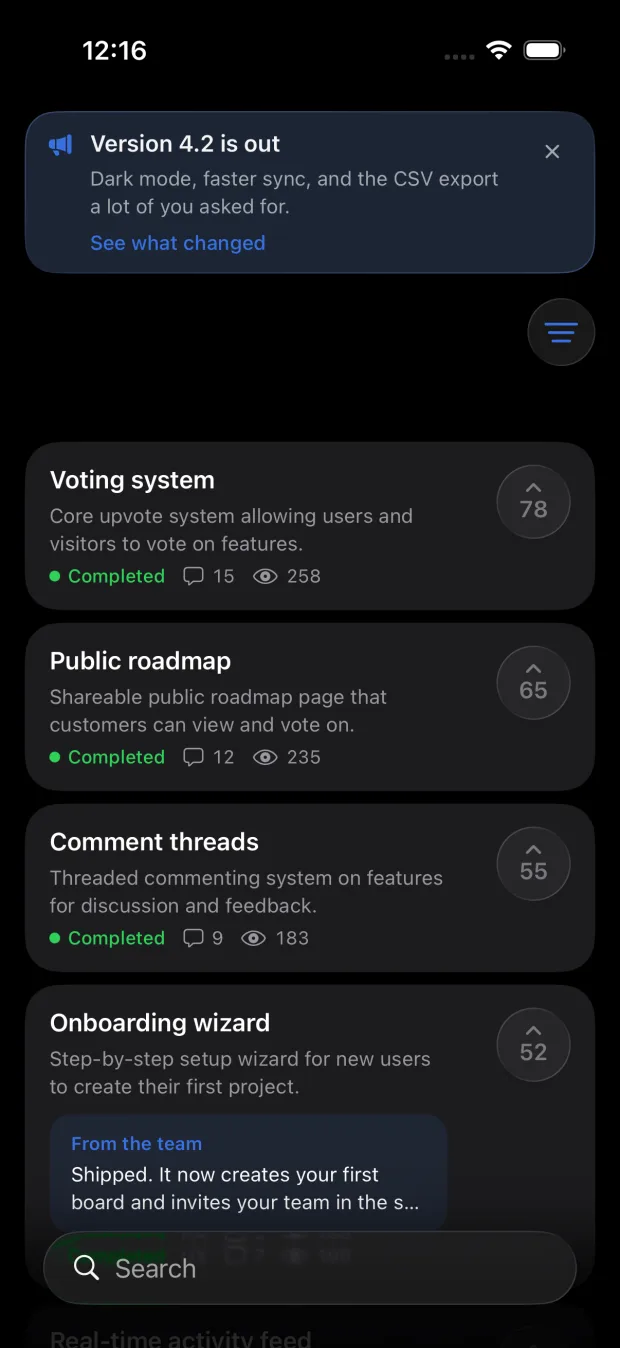
A survey answer and a bug report reach the team and nobody else. A board is the one kind where users see each other's requests, so the second person with the same need adds a vote instead of a duplicate, and the team's answer is public.
It only works when someone answers. Across 634 public Canny and Featurebase boards read on 3 October 2026, the median request held two votes, one of them its poster's, and on the median board half the requests carried a status. The votes on every board are in one open file.
In app feedback examples
A rating prompt, timed. A recipe app calls the review API the third time someone saves a recipe, never on first launch and never after an error. The platform may still show nothing.
A one question survey. The first time someone exports a report, one free text box asks what almost stopped them getting there. No score, shown once.
A bug report. A Report a problem row in Settings, or a shake, opens a screenshot the user can mark up. The tool attaches the device, the OS version and the app version, the three things a store review leaves out.
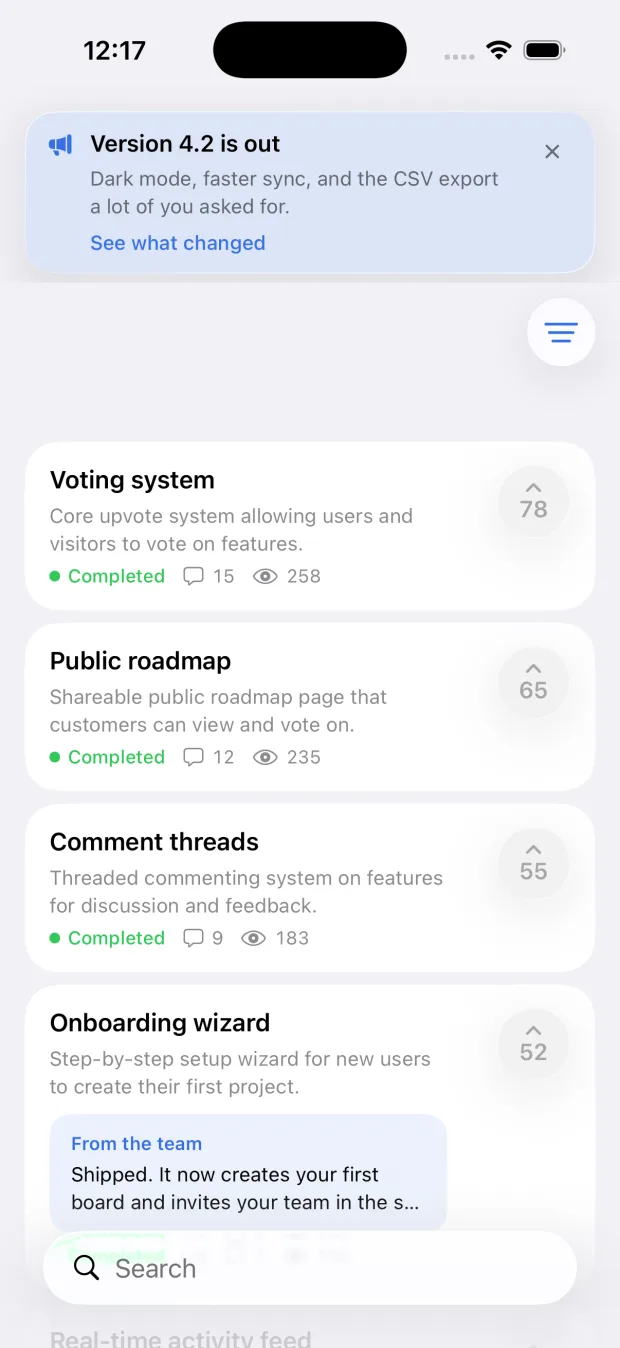
A request board. A Suggest a feature row opens the board inside the app, sorted by votes. The user finds the request already there and votes on it, or adds it, and hears back when it ships.
What users write in each channel, with the messages in full, is on the mobile app feedback examples page. Tours and onboarding checklists are a separate kind of tool, and eight of them are priced by the active user on their own shortlist. Website bug reporting tools, which pin a client's comment to a page, are priced for a team of five on another.
Where does VoteFirst fit, and where does it not?
VoteFirst does one of the four kinds: the request board, with a public roadmap and a changelog beside it. Its Swift package draws the board in SwiftUI inside an iPhone, iPad or Mac app, on iOS 15 or macOS 12 and later, and a visitor can vote without an account through an anonymous voter kept in the device keychain. The same board runs on the web through an embed script. Lite, at $9 a month, covers one project with the package. Pro, at $39, covers unlimited projects and a custom domain.
There is no Android SDK, no React Native or Flutter package, no survey, no bug report with a screenshot, no session replay and no rating prompt. A team that needs those runs a second tool from the table.
How was this list read?
Each tool's pricing page and developer docs were read on 3 October 2026, by plain request first and by a rendering fetch where a page draws its prices in script. A cell says what the vendor's own page says. Not readable means neither read returned the figure, and quote only means the page prints no number.
Two pages disagree with themselves. 1Flow's pricing page carries its Basic plan twice, at $150 and at $200 a month, both billed yearly, and Qualaroo prints each paid plan beside a struck through higher price with no label. Instabug's pricing address now redirects to Luciq, and Hotjar's to Contentsquare. Usersnap prices in euros. The platform rules come from Apple's StoreKit documentation, Apple's App Store Review Guidelines and Google's In App Review guide, read the same day.
14 days, a card at signup, then $9 or $39 a month.